
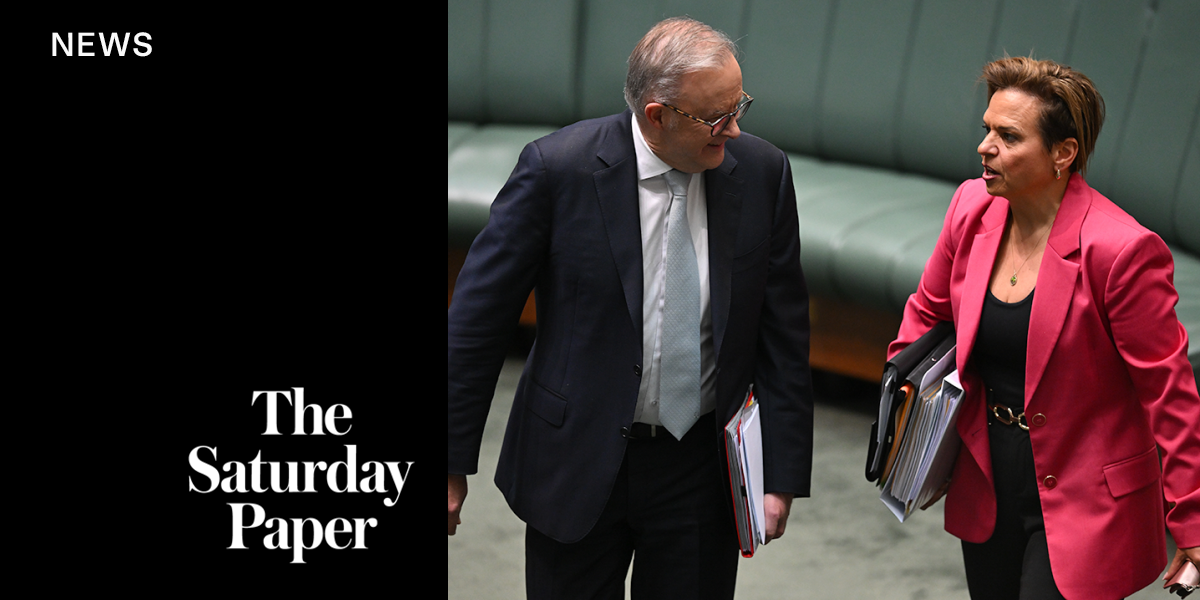
In principle, Anthony Albanese says he backs open government. In practice, as prime minister, he has grown increasingly hostile to it.
“He hates transparency,” one Labor adviser tells The Saturday Paper. “Loathes it.”
Freedom of information requests have always inspired a certain degree of fear and dislike in Canberra.
Warnings about how to avoid a paper trail that might later be accessed by an FOI request are part of the induction kit for new political staffers.
Even the acronym has its own crude nickname among those who walk on the ministerial wing’s mid-blue carpet: “FOI. Fuck Off Idiot.”
That longstanding aversion is now being written into law, with Attorney-General Michelle Rowland introducing the Freedom of Information Amendment Bill 2025 on September 3, a bill that seeks to tilt the system firmly away from disclosure.
If passed without amendment, the proposed law will impose a 40-hour processing cap on all FOI requests, allowing Commonwealth agencies to refuse broad or complex requests. It will empower them to reject applications they deem vexatious or harassing and ban anonymous requests by requiring applicants to identify themselves and, in some cases, provide proof of identity.
The bill would, for the first time at the federal level, allow fees to be charged for lodging requests and seeking reviews – adding a direct financial hurdle for those trying to obtain documents. It also seeks to widen cabinet and deliberative-process exemptions, which are often used to deny FOI requests, and allow for the routine redaction of public servants’ names from released material.
Government insiders present these measures as a way to modernise and streamline an overloaded system, arguing that the FOI system is being used in ways that go
far beyond its original purpose of exposing corruption or maladministration.
Other arguments being advanced in favour of the bill are that some applicants – including advocacy groups, political opponents and even commercial consultants – have turned FOI into a tactical weapon. It is argued that agencies are flooded with broad or repetitive requests, sometimes generated by automated tools, in order to tie up staff time or embarrass ministers rather than to illuminate genuine matters of public interest.
In this view, such “weaponisation” imposes heavy administrative and financial burdens on the public service, diverts staff from policy work and discourages frank written advice because of the risk that private deliberations will be released out of context.
Government insiders argue that FOI requests are now often used for fishing expeditions or to pry open internal political advice. They cite instances where disclosure without proper redaction could have harmed individuals unnecessarily. From this perspective, tightening the rules is presented as a practical response to misuse and as necessary to keep the system functioning.
In a 2015 review of the Rudd–Gillard government’s scandal-plagued Home Insulation Program, former Department of the Prime Minister and Cabinet secretary Peter Shergold warned that the FOI system was discouraging ministers and officials from putting sensitive advice in writing. He noted a shift to oral briefings that weakened accountability by leaving few records of how decisions were made.
Shergold called for better record keeping but also limited protection for genuine deliberative exchanges, so officials could provide frank written counsel without fear of premature disclosure.
The Albanese government has invoked that argument to defend its FOI Amendment Bill. Rowland has cited it to justify expanding cabinet secrecy and adding new public-interest factors against disclosure.
Critics such as Andrew Podger, himself a former Commonwealth department head and Australian Public Service commissioner, say the government has stretched Shergold’s case, using it to justify a much broader roll-back of access rights.
“The government is using its mega majority not to strengthen our FOI laws but to make it even harder for voters to know what their elected representatives are up to.”
In a 2024 speech, current APS Commissioner Gordon de Brouwer made a similar point to Shergold’s – that fear of disclosure deters officials from recording sensitive advice. He proposed temporary protection for deliberative material, with release after several years.
The government has drawn on this reasoning, although critics argue de Brouwer’s narrow fix has been turned into a sweeping reduction of the public’s right to know.
“FOI is a vital feature of democracy but, right now, the system is broken,” Albanese told parliament on Thursday, in response to a question from independent MP Allegra Spender.
“The current framework was established in the 1980s and one of the things that’s occurred is that some of those crossbenchers, I don’t know if the member of Wentworth is one of them, have participated in a business model where a failed former senator has set up a model where they’re actually paid to put in FOI requests, thereby costing taxpayers money twice the way through.”
The former senator to whom Albanese was referring was South Australian Rex Patrick, a former staffer for Liberal senator David Johnston who later went to work for South Australian independent senator Nick Xenophon and filled a casual Senate vacancy created by Xenophon’s resignation in 2017. Patrick served in the Senate as a member of the Nick Xenophon Team from 2017 to 2020, then as head of his own party from 2020 to 2022.
Patrick, whom Xenophon nicknamed “Inspector Rex” for his investigative skills and knowledge of freedom of information laws, tells The Saturday Paper that no crossbencher has ever paid him to do an FOI request, apart from one instance when Senator Jacqui Lambie reimbursed him for costs incurred.
“The prime minister is poorly briefed,” Patrick says. “I have never charged a crossbench member to do an FOI request or submissions. From the prime minister’s tone at question time, I think I’ve gotten under his skin. That’s great, it tells me I’m doing my job well.
“If the prime minister wants to join other officials who feel the need to complain to me about my FOIs, the line is long, and he’ll have to join it at the back.”
According to Rowland, in her second reading speech, $86.2 million was spent processing freedom of information requests in 2023/24, a 23 per cent increase on the year prior, with federal public servants devoting more than a million work hours in 2023/24 to handling FOI applications.
This argument, and the others made by the government, have singularly failed to attract even a modicum of public support.
Of 48 submissions received by the Senate Legal and Constitutional Affairs Legislation Committee, which is conducting an inquiry into the bill and is expected to report by December 3, not a single public submission comes down in favour of the proposed amendment. The only support is in a handful of submissions from Commonwealth departments and agencies.
Addressing the media before the start of Question Time on Thursday, Spender and a large group of fellow crossbench MPs and senators called on the government to withdraw the bill entirely.
“We are here to reject the government’s FOI bill, to say that they should kill the bill and really start again in terms of how they approach this,” Spender said, “because FOI is about service to the public, transparency for the public, not to make the government’s life easier.”
Speaking to The Saturday Paper, Dr Sophie Scamps, the independent member for Mackellar, points to the contradiction between Albanese’s promise as opposition leader to “reform freedom of information laws so they can’t be flouted by the government” and his government’s record on transparency, which she says is worse than that of his predecessor, Scott Morrison.
“Now the government is using its mega majority not to strengthen our FOI laws but to make it even harder for voters to know what their elected representatives are up to, which lobbyists they are meeting, whose bidding they are doing,” Scamps says. “If the PM wants to defend democracy, as he recently declared, pushing greater secrecy over transparency is definitely not the way to do it.”
A report published in July by the Centre for Public Integrity, found the culture of withholding information had intensified under the Albanese government.
According to that report, since Labor came to power in May 2022 the rate of full FOI disclosures has slumped to historic lows – from 59 per cent of requests in 2011/12 to just 25 per cent in 2023/24. FOI refusals have almost doubled – from 12 per cent to 23 per cent. For the first time on record, the study found, in 2022/23 more FOI requests were refused than granted in full, defying the FOI Act’s existing presumption in favour of access.
The report highlighted that these refusals often do not withstand scrutiny: in 2023/24, nearly half of refusals overturned at internal review were wrongly decided in the first instance. As for internal reviews, the report noted, they themselves are prone to institutional bias because they are conducted within the same agency that originally refused the request.
The Centre for Public Integrity report also pointed to a deliberate use of delay as a tool of secrecy. While first-instance processing times have improved thanks to extra resourcing, the bottleneck has simply shifted to the Office of the Australian Information Commissioner’s review process, where the average time to finalise an appeal has stretched to 15-and-a-half months – often rendering the documents’ contents irrelevant by the time they are released.
For integrity advocates, this pattern shows the problem is not an over-demanding FOI regime but a permissive culture of stonewalling – one that flourishes when ministers and senior officials face no penalties for wrongful refusals or delays. In their view, the government’s new bill, with its tighter limits and broader exemptions, is less a solution than a formal endorsement of that culture.
“The Centre for Public Integrity is alarmed by the unprecedented and unjustified attack that this bill represents on transparency of information held by government,” says the centre’s executive director, Catherine Williams.
“From a process perspective, it represents a significant integrity failing, and from a substance perspective, it represents a significant winding back of Australia’s right to access government information. We call on the government to withdraw the bill and establish an independent, comprehensive inquiry into the FOI system.”
The Greens Senator David Shoebridge condemned the government’s proposed reforms to FOI as “a vicious attack from the Albanese government on transparency, on good government and the public’s right to know”, adding that the government’s justification was “a made-up political ruse”.
According to Shoebridge, the real problem is not misuse of the system but the government’s own obsession with secrecy.
“All the evidence we’ve heard is FOI being weaponised by the government against the public. We have farcical reports where people put requests in for FOI and every page is blacked out by bureaucrats,” says Shoebridge, who also accuses Labor of betraying its promises on integrity and accountability, saying the FOI bill would further reduce public access to information.
“It is not actually the volume of requests,” Shoebridge adds. “It’s how the government is processing and managing those requests.”
Instead of adding new restrictions, Shoebridge says, the Greens back calls from other crossbench MPs for a full review of the FOI system, “to increase access to information in a way that doesn’t actually take more time for bureaucrats”.
With the Greens, who hold the balance of power in the Senate, firmly opposed, the government can pass the bill only with Coalition support. The Coalition has yet to declare a formal position but is understood to be opposed in principle.
“The government has promised a security briefing, and I’ve said we’ll wait until that security briefing has occurred,” shadow attorney-general Julian Leeser told the media on Thursday.
“These matters are currently before a Senate committee. By my last count, the only people supporting this bill are within the Australian Public Service. Stakeholders across the board oppose it. But we should let things take their course … We are going to wait at least until the security briefing before we make final decisions in discussions with the government.”
At the end of his answer to Spender’s question, Albanese delivered an unmistakable warning to the cross bench as well as the opposition.
“Engage constructively in this reform,” Albanese said, “because this reform is necessary if government is going to be able to function in the future.”
For a prime minister who once promised to restore trust in government, the words sounded less like an appeal than a threat.
Special Minister of State Don Farrell – one of Labor’s most skilled political fixers – is likely already working the phones to cut a deal with the Coalition.
If that happens, it will confirm what this legislation already makes plain: when it comes to open government, Anthony Albanese’s administration prefers control to scrutiny.
This article was first published in the print edition of The Saturday Paper on
October 11, 2025 as “Inside Albanese’s FOI reforms: ‘He hates transparency’”.
For almost a decade, The Saturday Paper has published Australia’s leading writers and thinkers.
We have pursued stories that are ignored elsewhere, covering them with sensitivity and depth.
We have done this on refugee policy, on government integrity, on robo-debt, on aged care,
on climate change, on the pandemic.
All our journalism is fiercely independent. It relies on the support of readers.
By subscribing to The Saturday Paper, you are ensuring that we can continue to produce essential,
issue-defining coverage, to dig out stories that take time, to doggedly hold to account
politicians and the political class.
There are very few titles that have the freedom and the space to produce journalism like this.
In a country with a concentration of media ownership unlike anything else in the world,
it is vitally important. Your subscription helps make it possible.
Send this article to a friend for free.
Share this subscriber exclusive article with a friend or family member using share credits.

Used 1 of … credits
use share credits to share this article with friend or family.
You’ve shared all of your credits for this month. They will refresh on November 1. If you would like to share more, you can buy a gift subscription for a friend.
SHARE WITH A FRIEND
? CREDITS REMAIN
SHARE WITH A SUBSCRIBER
UNLIMITED
Loading…