
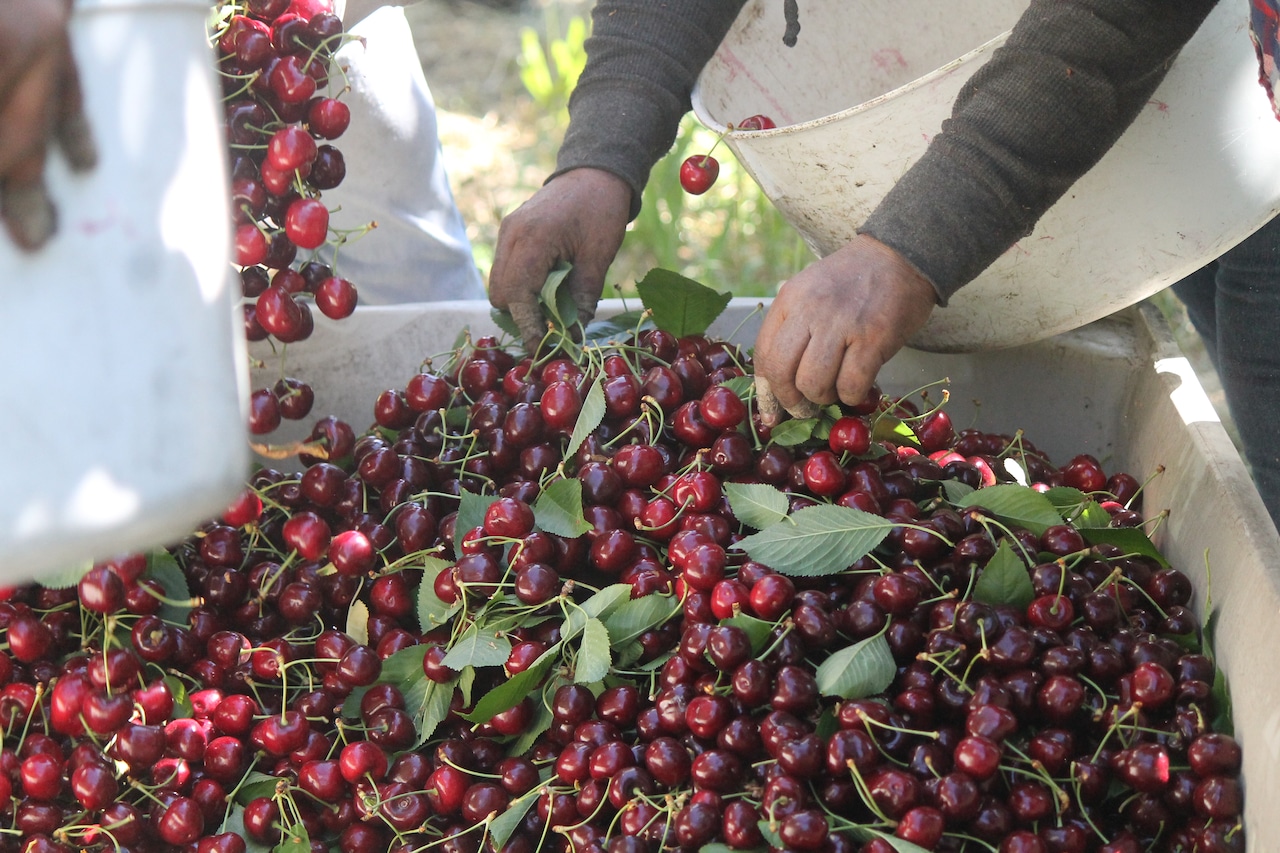
More than a dozen farmworkers pick round, dark red cherries from the trees in front of them, rapidly filling white buckets hanging from their chests. Occasional comments, mostly in Nahuatl, music playing from a phone in someone’s pocket and the metallic clang of ladders as workers move between branches punctuate the rhythmic plunk of the picked fruit.
The pickers are quickly moving down a row of Skeena cherry trees in an orchard in The Dalles, one of Oregon’s most fertile areas for sweet cherries. The work began at 5 a.m. to beat the 90-degree heat coming later, helping to ensure the ripe fruit wouldn’t sit on the branches for too many days.
Nearly all of Ian Chandler’s employees are working this Sunday morning in July — picking, counting buckets, moving containers full of the fruit.
This year’s cherry crop is high quality, and his team is working well. Even so, Chandler — chair of the Oregon Sweet Cherry Commission — said Oregon’s small cherry farmers are suffering again this season.
Two years ago, Oregon cherry growers hoped that above-average yield and creative marketing would end a string of damaging seasons largely caused by snow and heat devastating the fragile crop. But the cherry market crashed that year and was so harmful to Oregon cherry farmers that they received federal aid as a result.
This year may prove to be just as challenging for farms growing Oregon’s fourth most valuable fruit, after wine grapes, blueberries and pears.
“It’s going to be a disaster of a year,” Chandler said, “but not a natural one, a manmade disaster.”
Many cherry farmers started the summer harvest last month with a labor shortage, as farmworkers delayed traveling to Oregon out of fear of immigration crackdowns.
Chandler, for example, said he had only half his typical workforce of 120 in June.
But even those who launched fully staffed faced challenging market conditions, with cherries bringing them very little profit, if any. Farmers worry that this season could have long-lasting implications for the sustainability of Oregon’s sweet cherry business.
“It’s scary right now,” Chandler said. “I would not tell my children to go into this industry.”
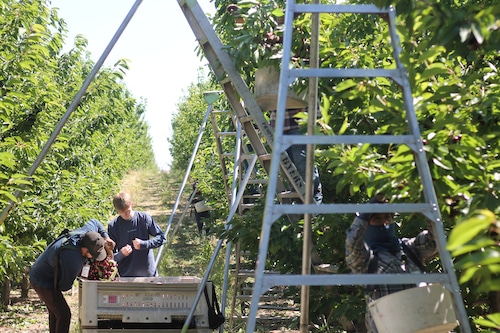 Farmworkers pick Skeena cherries at CE Farm Management’s orchard in The Dalles on Sun., July 6. Farmers said this season has been devastating for small cherry farms after labor shortages and challenging market conditions.Eddy Binford-Ross/The OregonianFear of immigration crackdowns
Most of the people picking Oregon’s cherries are migrant workers or immigrants who live in the state. Approximately 42% of crop farmworkers, such as cherry pickers, are undocumented, according to estimates from the United States Department of Agriculture.
A rise in immigration crackdowns since the start of President Donald Trump’s term, particularly in agricultural settings, has instilled fear in farmworker communities, said Reyna Lopez, executive director of PCUN, the state’s farmworker union. They’re afraid of being arrested, deported and separated from their families for simply coming to work.
Immigrants who have lived and worked in the community for years or even decades but who may not be citizens are still arriving for the harvests, to support their families, Lopez said. But some farmworkers coming from out-of-state, Lopez said, were hesitant to travel to Oregon.
“They’re really not wanting to take that risk of driving all the way out to Oregon and potentially being caught up by a federal agent and potentially risking that deportation,” she said.
Many people from Chandler’s typical crew fall into this category, migrant workers from Mexico who travel up the West Coast following the harvests. Chandler’s season began around the time that U.S. Immigration and Customs Enforcement began targeting California farms, where many of his employees work before Oregon’s cherry season. He thinks this drove his June labor shortage.
Oregon hasn’t seen large immigration crackdowns like California has, Lopez said, and cherry farmers haven’t reported seeing ICE officers or a raid. But the fear remains.
These days not even proper papers protect workers, said Ken Polehn, vice president of Polehn Farms in The Dalles.
“Even if they’re documented, that doesn’t mean they won’t get detained,” Polehn said.
Polehn Farms didn’t have significant labor problems, Polehn said, but one of the neighboring farms was expecting 50 workers and only 10 arrived. Other farmers who were expecting foreign farmworkers on H-2A visas faced barriers when those employees were stopped and stuck on the U.S.-Mexico border due to administrative holds.
Cherry harvesting requires skill — workers need to know how to pick cherries quickly without damaging the tree or the fruit — so Chandler stays in touch with his employees year-round to encourage them to return each season.
“It’s heartbreaking to me to see these good hardworking people feeling afraid,” Chandler said.
A high quality crop, that no one wants to buy
When they did have enough labor to get the cherries off the trees, farmers said the season saw one positive: the high quality of the fruit. Many of the cherries harvested this year are exceptionally shiny and firm, bursting with the sweet flavors for which these varieties — Bings, Skeenas, Chelans, Lapins and more — are famous.
Dave Meyer, co-owner of High Rolls Ranch, another cherry farm in The Dalles, said that most growers across the state were happy with what was on their trees. Some said it was their best crop in years.
“The fruit should have been marketable and sellable,” Meyer said.
But it hasn’t been.
After cherries are harvested, most farmers send their fruit to a packing facility. These packing houses sort and process the cherries, separating the good fruit from the bad and packaging them into containers to sell to grocery stores and retailers for consumers to buy. At every step of the process, farmers are running into problems, they told The Oregonian/OregonLive.
Farmers said that many packing houses are being exceptionally picky in what cherries they’ll accept, with some turning away entire varieties altogether. At the same time, farmers are finding that stores will pay far less for the fruit than it costs to grow and pick.
Polehn, who both grows and packs cherries, sells directly to grocers. In a good year, he said that he’d be selling an 18-pound box of cherries for $60 to stores. This year, they’re going for $25.
“We’re operating in a hole,” Polehn said.
Many of the farmers, like Polehn, were frustrated by how the season’s fruit could achieve many of the ideals of a cherry — juicy, firm, shiny, not too small — and then be sold at a loss.
He’s considering ending Polehn Farms’ season this week, he said. Even though he has two weeks worth of crop left to harvest, he’s not sure it’s worth the money they’re losing.
“This is the best fruit we’ve raised in years,” Polehn said. “It’s a real disheartening thing to watch.”
Part of the problem, farmers said, is the cost of cherries in grocery stores. The high price tag — driven by factors outside farmers’ control, such as rising retail wages — means fewer Oregonians are buying them. As a result, farmers struggle even more to sell their cherries, according to Timothy Dahle, who owns Dahle Orchards and has farmed cherries in The Dalles for more than 40 years.
“It’s not that people will not eat more cherries, it’s that they won’t eat more cherries at $5 or $6 a pound,” Dahle said.
A series of challenging seasons
Oregon is the country’s third largest producer of sweet cherries, according to Oregon State University, but farmers said this popularity hasn’t translated into enough money for their orchards or their employees since 2020.
In 2023, cherry farmers sought a disaster declaration from Gov. Tina Kotek after the price retailers paid them per pound dropped to about 55 cents. This request was granted in the spring of 2024 and allowed Oregon cherry farmers to seek federal aid and loans after losses from the year before.
This year, cherry farmers are estimating they’ll make 30 or 40 cents per pound, said Ashley Thompson, an associate professor of horticulture at Oregon State and a cherry expert. That’s less than half of what they need to break even for the cost of picking and processing the fruit.
She doesn’t know how much longer some of the smaller family farms will be able to stay in business.
“One of the incredible things about Oregon is that we still have a lot of family farms,” Thompson said. “When people start leaving the business we lose the community, I don’t know what that community looks like going forward.”
Meyer said he’s also worried about what this year, and the last several, mean for the future of family cherry businesses. He said he’s spent his life trying to make High Rolls Ranch a generational farm, positioning it for his daughter to take over. He said he’s not sure it’s sustainable for her after the last few years.
Even with the challenges, there’s a history of resilience in cherry-farming communities, where crops are delicate and highly dependent on the weather, the farmers said.
“Us cherry farmers are a hardy bunch,” Polehn said. “We never have guarantees over anything.”
— Eddy Binford-Ross covers education and local politics for The Oregonian/OregonLive. Reach her via email at ebinford-ross@oregonian.com
If you purchase a product or register for an account through a link on our site, we may receive compensation. By using this site, you consent to our User Agreement and agree that your clicks, interactions, and personal information may be collected, recorded, and/or stored by us and social media and other third-party partners in accordance with our Privacy Policy.