
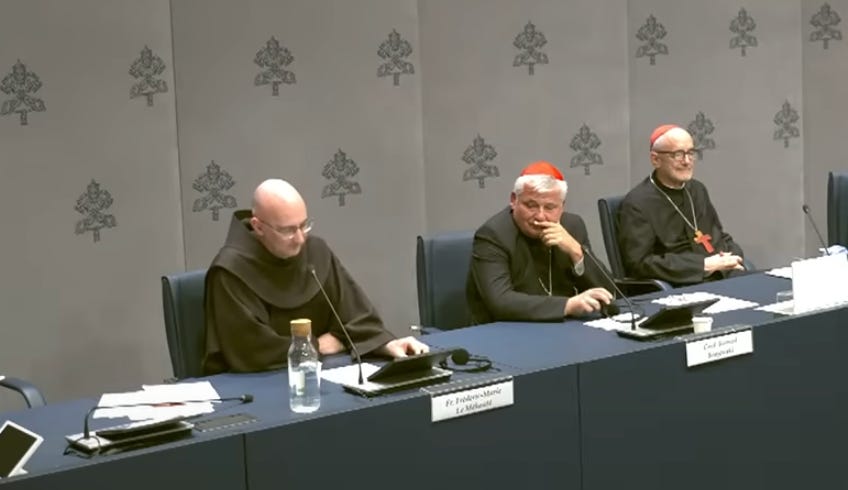
Pope Leo XIV on Thursday published Dilexi te, the first major document of his pontificate.
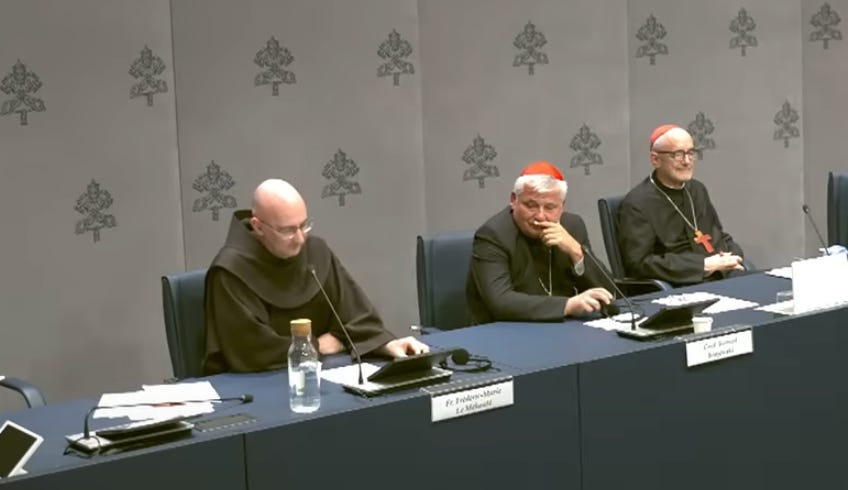 Bishops present Dilexi te at an Oct. 9 Vatican press conference. Credit: Vatican Media.
The roughly 20,000-word apostolic exhortation follows Pope Francis’ October 2024 encyclical Dilexit nos (“He loved us”).
In the text, Leo acknowledges that he worked from a draft already prepared by Francis. But media reports indicated that Leo rewrote several sections of the original draft, which had allegedly been written by Archbishop Vincenzo Paglia, former president of the Pontifical Academy for Life and the John Paul II Institute.
So how are bishops and cardinals receiving the first major document of Leo’s pontificate?
The Pillar spoke with bishops and cardinals around the world, for their first public reactions to Dilexi te.
Some comments have been translated from Spanish and Portuguese and have been edited for clarity and length.
Dilexi te is a moving meditation on our tradition — going all the way back to Jesus — and consistent with it, the more recent magisterium on the place of the poor in the mission of the Church. It’s a good reminder that the preferential option for the poor wasn’t invented by Pope Francis and Pope Leo XIV! Let’s join Pope Leo in praying that Dilexi te helps the Church to serve the poor and helps bring the poor to Christ!
I believe it is very important to make an effort to show that caring for the poor is a choice that forms part of the great Tradition of the Church, from the Scriptures, the Fathers, and throughout its entire history. On the other hand, it is important to highlight the explicit connection [made] with Dilexit nos in such a way that the supernatural meaning of this choice is clear.
Human existence today, marked by productivity and consumption, is absorbed by activity. Even free time becomes something functional within production. Without the recognition and conditions necessary for rest, an ideology is imposed that reduces human beings to a function. The acceleration of life gets us used to seeing and judging what is truly at stake in a partial, if not erroneous, way. [We are called to see] the poverty of those who have no rights, no place, no freedom; of those who do not have the means to give voice to their dignity and their abilities; of those who experience material, moral, spiritual, cultural, and human poverty in their daily lives!
Recognizing and being willing to welcome with respect all those who are wounded and deprived of their dignity, freedom, and identity is an ethical imperative, a call to conscience, particularly for Christians.
To carry out this mission, [the pope] calls us to move from the world of ideas and discussions to concrete actions and gestures, uniting the best forces of society for this purpose. The commitment to the common good of society and the promotion of the weakest and most disadvantaged commits every man and woman of good will.
Pope Leo follows in the footsteps of Pope Francis. He shows us the true face of the Church as Mother of the Poor and Destitute. He reminds us of our vocation to love and venerate the Poor just as Jesus did.
Although I have not yet had the opportunity to study Dilexi te sufficiently, it is quite clear that the apostolic exhortation is consistent with the teaching of the Church through the centuries. It is faithful to the writings of Fathers of the Church and, indeed, with the Gospel.
Part of its intention is to shake those in a bubble of luxury and who live an elitist lifestyle disconnected and unconcerned about the vulnerability and suffering of others, or who even treat others as a “throwaway” commodity. The appeal is to live the teachings of the Gospel in terms of respect of human dignity, equality and solidarity.
It is a document that challenges not only personal lifestyles but, as did Pope Francis, denounces the dictatorship of an economy that favours the wealthy. It is a document that should make us question the status quo we so easily take for granted and to be a neighbour to the weak and vulnerable following the example of the Good Samaritan.
Pope Leo has given us a beautiful and profound reflection on a theme that is at the very heart of the Gospel: love for the poor. This exhortation highlights how, throughout history and in various social and cultural contexts, the Church, through various forms of service to the most needy and vulnerable, has shown, and continues to show, the profound unity between love of God and love of neighbor.
It takes up some of the themes of Pope Francis’ teaching on the faces of poverty today and its causes in the structures of sin that generate it. It carries with it a call to contribute to transforming these realities.
This exhortation confirms us as a pilgrim Church in Latin America in “the preferential option for the poor” and in the desire to be a “poor Church among the poor.”
It is a pastoral program for the Church and a prophetic sign for today’s world.
What was expressed in No. 120 of the exhortation immediately caught my attention: “By its very nature, Christian love is prophetic: it works miracles and knows no limits. It makes what was apparently impossible happen. Love is above all a way of looking at life and a way of living it. A Church that sets no limits to love, that knows no enemies to fight but only men and women to love, is the Church that the world needs today.”
I think the content is something that needs to be read calmly and prayerfully. There is nothing new [in the document] in the sense that the Church has indeed from the beginning lived with the poor, for the poor, and among the poor.
I also would like to emphasize that the pope also says in this text that Jesus lived poor, died, was born, lived, and died poor.
So it is important to emphasize this spiritual, inner poverty. It is very important as a virtue for all Christians. You cannot be a saint, you cannot be very Christian if you do not live the virtue poverty. It is about generosity, about being free from the things of the world to have a heart free to love and clean eyes to see our brothers.
My church in Helsinki is an example of a poor church, so I know what the Pope is talking about and I know what poverty is. There are many types of poverty. Here, we may not be starving, but there is poverty among many immigrants and refugees, poverty in a diocese without money, where we cannot make ends meet in several parishes and cannot build churches or find places of worship because we have no money. I fully sympathize with this text in this apostolic exhortation.
There is also loneliness, spiritual poverty in our countries, and that poverty must also be accompanied, helped, and solutions must be found. Spiritual poverty sometimes carries a sadness and despair that is different from that of those suffering from material poverty.
But anyway, it is a text that must be read calmly, prayed over, and can help us to seek solutions. The solutions are not easy because it affects social structures, states, companies; it is not an easy task but is something that the Church promotes.
It’s a fantastic text and a good doctrinal start for this pope, who is going to bring us much joy.
One thing that struck me during the first reading of this rich text is its section on monastic life. In an inspired reading of the Rule of St Benedict, the Holy Father says that the monks of antiquity enabled the formation of a ‘pedagogy of inclusion’ by ‘forming consciences and transmitting wisdom’ through a sharing of culture.
The word ‘inclusion’ is bandied about a lot these days, often without a clear idea of what anyone’s proposing to include others in. The notion that inclusion is a form of hospitality born of a community covenant with a view to producing a transformed society is valuable, constructive.
Dilexi te is a wonderful document. Perhaps we see here and there the influence of an American pope, who does not primarily emphasize the government’s role in this, but rather everyone’s duty not to forget charity.
I am particularly impressed by the comprehensive overview of the Church’s commitment to the poor over the course of two thousand years. This is important, not so much to pat ourselves on the back, but above all to see that care for the poor is an essential aspect, central to the mission of the Church in this world.
The document surely does emphasize the government’s duty to ensure a just society and to enable the poor to become agents of their own development, and a society that cares for the poor, but it focuses primarily on our mission as Christians to stand alongside the poor, including by giving alms.
Among the many thought-provoking themes, I focused on two points.
One is immigration. In Japan too, discussions about immigration have become more frequent in recent years, and momentum is building to formulate an “immigration policy” that still does not clearly exist. From the Catholic Church’s perspective, within Japan’s ultra-minority Catholic population (0.3% of the total population), the proportion of catholic workers from countries like the Philippines, Latin America, and Vietnam is steadily increasing.
In some regions, young foreign families with children now outnumber Japanese believers, whose numbers are declining due to the low birthrate and aging population. How to pastorally care for these believers is one of the challenges facing the Catholic Bishops’ Conference of Japan, which launched a dedicated department for this purpose this year. Looking at the bishops themselves, the number of foreign-born bishops has increased over the past decade; currently, 5 out of 17 bishops are foreign nationals (from the United States, Spain, Argentina, and Italy).
I would like to learn more about the two saints mentioned in Dilexit te: Saint John Baptist Scalabrini and Saint Frances Xavier Cabrini.
Another point concerns work. As a member of Opus Dei, I recognize that sanctifying work is important for all people. Pope Francis’ words quoted at the end of Dilexit te (No. 115), “By working we become a fuller person, our humanity flourishes, young people become adults only by working.”, apply to everyone, including the poor.
A Mexican priest who had worked in Japan for decades once told me: “Do you know the difference between Mexico and Japan? In Mexico, you have to tell people, ‘Work properly.’ In Japan, you have to tell them, ‘Rest properly.’” Japan has a culture of overwork. Consequently, the poor who are not working (or cannot work) are often viewed harshly, and a culture of giving struggles to take root. Of course, there is also a positive aspect: the spirit of volunteering, working without pay for those in need, is very strong.
I want to carefully read this apostolic exhortation and use it for the benefit of the Church in Japan and society as a whole.
I am glad about Dilexi te because we are a small church in a small country. We are on the periphery of the Church, in a country that lives in fear of losing peace, independence, and freedom.
The lack of personal or collective security is a widespread poverty today. It is part of this moral poverty that Dilexi te speaks of. Moral and spiritual poverty is a great poverty in Europe and in Estonia. Without peace and security, it is difficult to discover Christ.
We will have the opportunity to explore Dilexi te in greater depth these following days. This is what really stands out to me right now: Fear is a great poverty. Only Christ can heal that poverty.
Dilexi te seems to be a text already planned by Pope Francis: it is positive that Leo XIV shows that he is continuing the work of his predecessor. I am particularly touched by his references to St. Augustine and the Church Fathers, but also to great religious foundations such as that of the Daughters of Charity of St. Louise de Marillac and St. Vincent de Paul, who was parish priest in my diocese.
This meditation, at the same time social and spiritual, will be fruitful for the Church.