
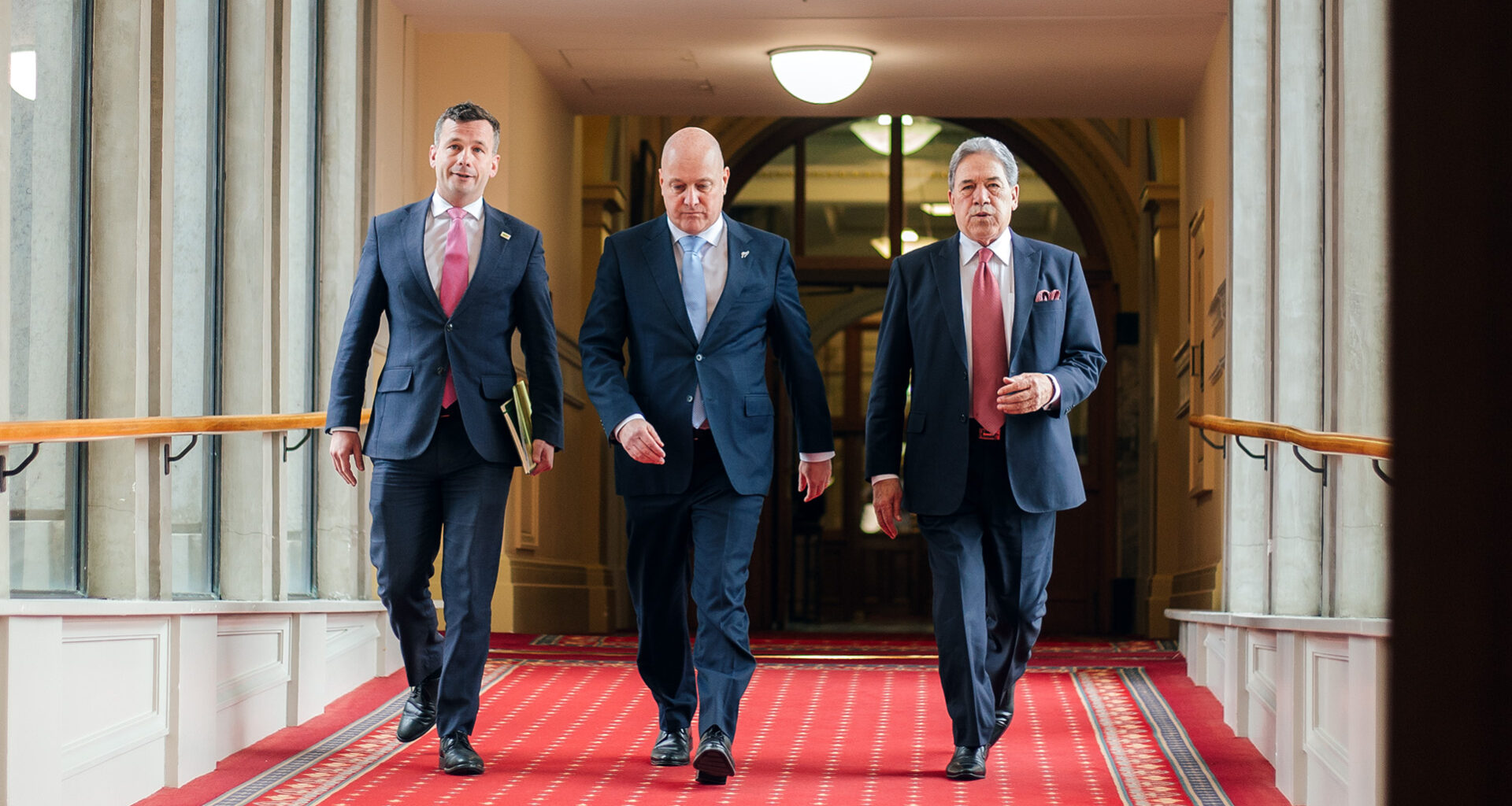
Winston Peters and New Zealand First was the coalition partner nobody wanted in 2023.
Labour’s Chris Hipkins ruled it out and National’s Christopher Luxon said he would only make the call if he absolutely had to, while pleading with voters to back National and Act alone.
After the pandemic and high inflation, voters were fed up with Labour and wanted a change in government but many also wanted an insurance policy against extreme neoliberalism.
Analysis by Newsroom found 51% of NZ First’s 2023 voters had supported Labour in the previous election, compared to just 25% who had switched from National and Act.
The party scooped up 6.1% of votes on Election Day and Luxon had to pick up the phone.
Initially, there were hopes it would just be a fling. A marriage of inconvenience while National and Act built enough support to win a majority in 2026. Those hopes are fading fast.
NZ First is the only coalition partner that has grown its support this term. It is flirting with 10% support in Interest.co.nz’s polling average, up almost four percentage points.
Meanwhile, National and Act have shed almost nine points between them. If this trend holds through the election, it could radically change the balance of power in the coalition.
National currently makes up 72% of the governing bloc, with Act contributing 16.5% and NZ First the remaining 11.5%. On current polling, Act would fall to 15%, NZ First would rise to 20%, and National’s share would drop to 65% — no longer a super majority.
Whatever authority Christopher Luxon currently holds over Cabinet would be reduced and Winston Peters would not need to share the office of Deputy Prime Minister.
But the bigger problem is that the bloc wouldn’t be governing at all. Labour would almost certainly have enough votes to form a majority, backed by the Greens and Te Pāti Māori.
Chris Hipkins could form a government made up of 67% Labour votes, 24% from the Greens, and 9% from Te Pāti Māori. Like on the right, power would be spread thinly across the three.
In some ways, this is more of a problem for Hipkins than Luxon. The Prime Minister has at least proven his three-headed Cerberus is capable of getting the job done, for better or worse.
Meanwhile, the Green and Māori parties have had a terrible term in opposition and have not demonstrated they are ready to govern a country.
National Party MPs are betting their electoral fortunes will improve as the economy picks up and voters start to scrutinise the opposition parties as a government-in-waiting.
Something similar happened in Australia this year. Polls predicted the conservative opposition would topple the Labor Government, but when voters got a closer look at Peter Dutton they changed their tune.
Chris Hipkins and finance spokesperson Barbara Edmonds seem to be hedging this risk by distancing themselves from opposition allies and shuffling closer to National.
In speeches to more conservative audiences, they promise to keep any Coalition policies that are working and avoid the disruptive uncertainty that comes with a change in government.
Businesses have been crying out for bipartisan plans to tackle major problems. They want a consistent infrastructure pipeline, predictable government spending, and enduring resource management rules.
National and Labour have made positive noises about bipartisanship but usually are unwilling to meet each other on specifics. Labour’s blank policy slate allows them to signal good will for now, but that may only last until the manifesto needs writing.
That said, rarely do you see Labour and Green MPs doing much together. There’s no sign that Hipkins and Chlöe Swarbrick are kindred spirits. That relationship can only cool if (or when) Labour rules out the wealth tax her ideas are dependent on.
Meanwhile, Te Pāti Māori is seemingly on a mission to get itself ruled out of a future governing arrangement. After recent controversies, Hipkins has said it would be “very, very difficult” to work with the party if they don’t clean up their act.
The Māori party promised a “reset” this week but it has underwhelmed. The co-leaders aborted their press conference after three minutes when a reporter asked about allegations an MP had overspent her taxpayer-funded travel budget.
Tākuta Ferris has not apologised or withdrawn controversial comments about different ethnicities involvement in politics, and it is not clear the party has control over its MPs.
It must be tempting for Hipkins to declare his intention to form a minority Labour government (assuming he secured the numbers) forcing Te Pāti Māori and the Greens to support from the outside with limited confidence-and-supply agreements.
Legislative reform would have to be painstakingly negotiated individually, but without formal coalition partners some bipartisan reforms could be passed with support from the National Party.
Edmonds hinted at this during the Mood of the Boardroom debate: “There will be say [80% of things] that we agree on … we are the middle, National and Labour, we have the majority of votes.”
When Willis challenged her to live up to this rhetoric and back National’s efforts to secure gas supply to protect the country from dry year electricity shortages, the bipartisanship faded.
But still, playing hardball in coalition negotiations is surely an option for both major parties.
Would the Act Party ever willingly let Labour take back power? How could Te Pāti Māori face its supporters after handing National another term? The big parties can call their bluff.
The exception to this rule is NZ First. It is wedded to the right for now but its deputy leader (Shane Jones) and newest recruit (Stuart Nash) were both Labour ministers — it could swing left once again.
If the party secures more than 10% of votes on Election Night 2026, you can be sure it would only sell them to either coalition at a handsome price.