
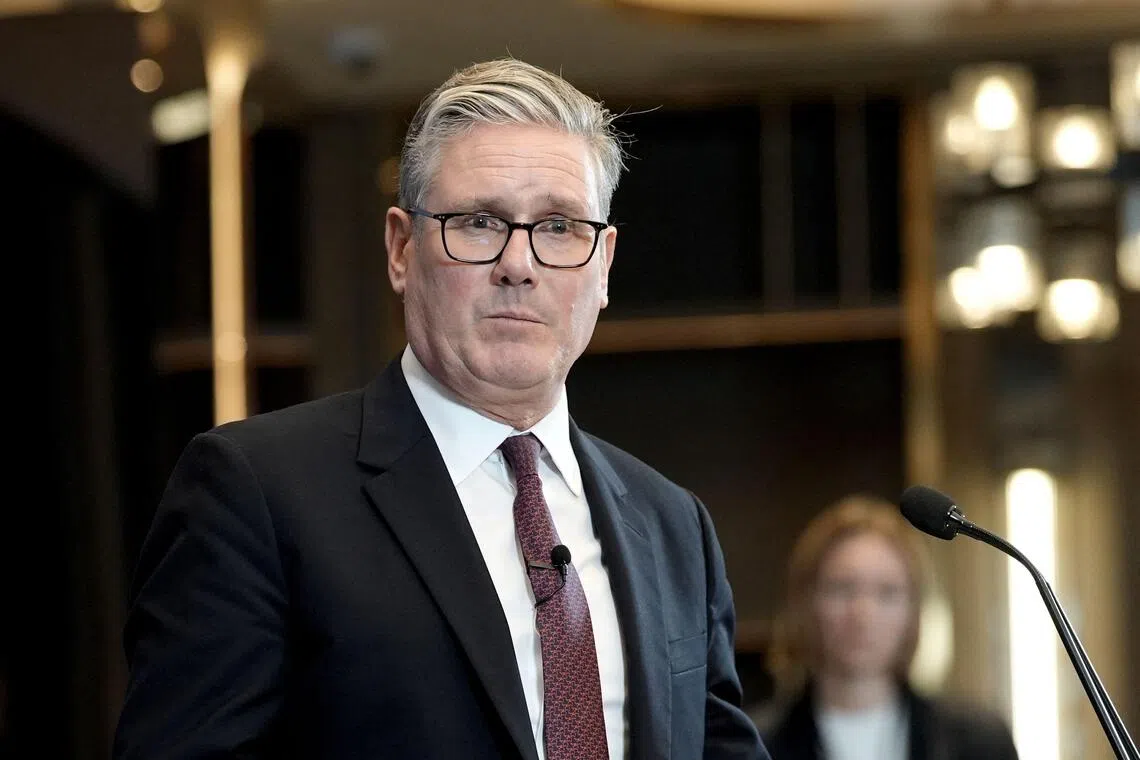
LONDON– British Prime Minister Keir Starmer is being urged by senior members of his government to reassess his policy toward China and take a tougher stance on the risks it poses to UK national security in the wake of a collapsed espionage case.
Several Cabinet ministers are concerned that Mr Starmer has taken too generous an approach to Beijing and want him to commit clearly to prioritising national security over any economic benefit from the relationship, according to people familiar with their thinking.
At least two Cabinet members also want the premier to decline permission for China to build a new mega-embassy near the City of London on security grounds, the people said.
They spoke on condition of anonymity discussing internal deliberations over government policy.
Mr Starmer has sought to improve diplomatic relations with China since entering office in 2024, an effort to reverse the cooling of ties under the previous Conservative administration that came following a series of allegations that the Chinese state was behind high-profile espionage attempts and cyberattacks in Britain.
The prime minister met Chinese President Xi Jinping at the Group of 20 summit in Brazil in 2024 as part of a broader drive to increase investment and economic growth in the UK.
However, that shift has come under intense scrutiny in recent days after the
aborted prosecution of two men
accused of spying for China.
The Crown Prosecution Service has blamed the government for the case falling apart, taking the extraordinary step of publicly stating that it couldn’t proceed with the prosecution because Mr Starmer’s administration did not provide a statement that labelled China as a national security threat, something it said was necessary to secure convictions.
The accused men denied the charges.
Former national security officials including former Cabinet secretaries Simon Case and Mark Sedwill, and Mr John Sawyers, the former head of the UK’s foreign intelligence service MI6, have all said they do not understand why the case was allowed to fail.
Mr Starmer has been accused by Conservative opposition leader Kemi Badenoch of deliberately sabotaging the trial in order to avoid upsetting Beijing, a charge 10 Downing Street has denied.
Speaking for the government this weekend, Cabinet minister Bridget Phillipson insisted Mr Starmer was “very disappointed” that the prosecution had collapsed, denying media claims that ministers or National Security Adviser Jonathan Powell had influenced the case.
The Sunday Times newspaper reported that President Donald Trump’s White House was unhappy it did not go to trial.
Jingye Group, the owners of British Steel, had offered to waive its £1 billion (S$1.73 billion) compensation claim if China’s plan was approved, the paper also reported.
Downing Street also flatly denied a claim in the paper that the Treasury sought to nix the case.
Ms Badenoch wrote to Mr Starmer on the night of Oct 12 urging him to come to Parliament to answer questions from lawmakers, but the premier is travelling to Egypt to attend the signing of
the Trump-brokered Gaza peace plan
on Oct 13, where former premier Tony Blair will also be in attendance.
Ministers are expected to address the allegations in the House of Commons in Mr Starmer’s absence.
The furore has led to unease in Cabinet, which comes at a particularly dangerous time for Mr Starmer as he trails Nigel Farage’s Reform UK in opinion polls and faces widespread criticism about his leadership.
There has been speculation within the governing Labour Party that he could face a leadership challenge next year if his performance does not improve.
This has led some senior ministers to feel like they’ve been kept in the dark by Downing Street about the case, people familiar with their thinking said.
One minister has told colleagues they don’t know if the government deliberately obstructed prosecutors or if the case fell apart by error.
They also said it was unclear who in the government was ultimately responsible for responding to prosecutors’ requests for support.
The government’s denials that there was any ministerial involvement or pressure from Mr Powell meant it would be a major problem for Mr Starmer if it was to later emerge that there had been political interference, one of the people said.
There is also increasing scepticism in Cabinet about China’s application to
build a large new embassy
in London’s historic Royal Mint Court.
Chinese pro-democracy activists have argued the site could be used as a spying hub or to expand China’s intimidation of dissidents in Britain.
The decision was expected to be reached imminently but has now been delayed.
The file has not yet come through the government system to the desk of Communities Secretary Steve Reed, who will formally make the judgment, according to a person familiar with the matter.
New Home Secretary Shabana Mahmood is known to hold a long-standing hawkish position on China.
If the government approves the new embassy, it risks drawing further criticism that it is soft on China and angering the Trump administration, a person close to a Cabinet minister said.
“It would have been unthinkable to allow the Soviet Union to build the largest embassy in Europe in London during the height of the Cold War. Yet, despite clear national security risks, the green light is likely to be given under heavy diplomatic pressure from China,” said Mr Luke de Pulford, executive director of the Inter-Parliamentary Alliance on China, a think tank. BLOOMBERG
Keir StarmerBritainChinaSpying