
 © Jonathan Nackstrand/AFP/Getty Images
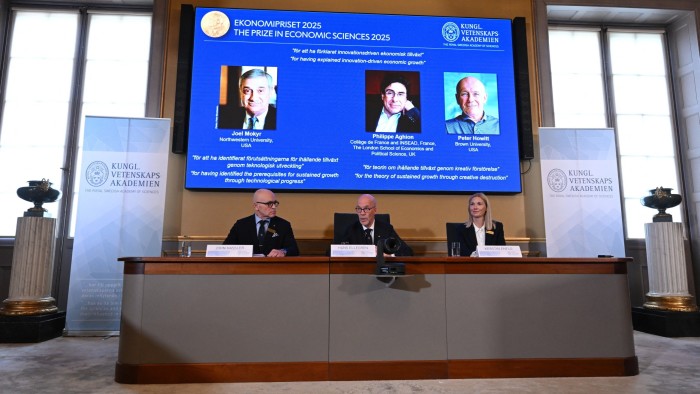
Congratulations to all three for “having explained innovation-driven economic growth”, in the words of the Riksbank committee.
Joel Mokyr, an economic historian at Northwestern University, won it “for having identified the prerequisites for sustained growth through technological progress.” He has specialised in the 1750-1914 period and the links between industrialisation and economic growth and welfare.
The best way to check out his work is probably to buy his 2016 book A Culture of Growth: The Origins of the Modern Economy, which was discussed by John Burn-Murdoch in a column last year, and reviewed in the FT by Diane Coyle. She wrote:
Mokyr’s new book seeks to identify the conditions that turned the inventions of the late 18th and early 19th centuries into sustained, modern economic growth. There had been earlier significant waves of invention in China and the Islamic world, for example, but none snowballed into a world-changing industrial revolution.
Mokyr argues that in western Europe at the time of the Enlightenment, a set of conditions happened to coincide to create a “Republic of Letters”, a ferment of public debate and innovation we might now label as “open science”. Knowledge, from deep scientific insight to more practical technological know-how and tinkering, became a common resource. Leading scientists and thinkers corresponded with counterparts around the continent, and were helped by the political fragmentation of Europe, which led to rulers competing to attract the most prominent intellectual stars to their own territories.
FT Alphaville’s old podcast Alphachat (RIP) interviewed Mokyr back in 2019 as well, and you can listed to his chat with Brendan Greeley here.
Philippe Aghion, of the College de France, INSEAD and the London School of Economics won it “for the theory of sustained growth through creative destruction”, according to the Swedish Riksbank.
In 2021 FT’s Martin Wold explored Aghion’s The Power of Creative Destruction — co-written with Céline Antonin and Simon Bunel — and called it “lucid, empirically grounded, wide-ranging and well-argued”. Martin even selected it as one of his best beach side reads for 2021, which for an economist is probably close to winning a Nobel.
Aghion has also written a book titled Endogenous Growth Theory with the third laureate, Peter Howitt, a professor at Brown University, who specialises in macroeconomics and monetary economics.
Brown’s biography says that Howitt is one of the fathers of the modern “Schumpeterian” approach to the theory of economic growth, and that he “has been active in the search for new foundations to macroeconomics and monetary theory, and has written extensively on the subject of Canadian monetary policy”.
Professor Kerstin Enflo of Lund University, one of the committee members that selected the winners, said that the laureates had done seminal work on “one of the largest questions in social sciences”.
It’s about what drives economic growth, and why doesn’t it stop when it has started . . . We tend to think about economic growth as something that some people have taken for granted, at least in the developed world We think of economic growth as something that happens at 1-2 per cent annually. But it’s actually quite amazing that growth can be so sustained over a long run.
And when you think about it there’s a lot of turbulence going on underneath this pattern. So for example, in the US 10 per cent of firms leave the market every year, and 10 per cent enter the market every year. So when you think about it, how is it possible that such a disruptive process can also generate these stable growth patterns that we also see.
They have worked with different methods. Joel Mokyr is an economic historian who has worked with historical methods, to ask the fundamental question of why did growth even occur in the first place. When we think about it, through most of history there was no growth basically, even though there was innovation and technological change.
We tend to think about innovation and technological change as the drivers of economic growth, but we need to understand how did that start to feed into economic growth. And that is something that Joel Mokyr has studied in depth. Philippe Aghion and Peter Howitt have made a mathematical model to explain how this disruptive process with firms entering and leaving the market, competing with each other, how that can actually generate economic growth.
Here’s the FT’s news story on the winners, which will be updated with more information.