
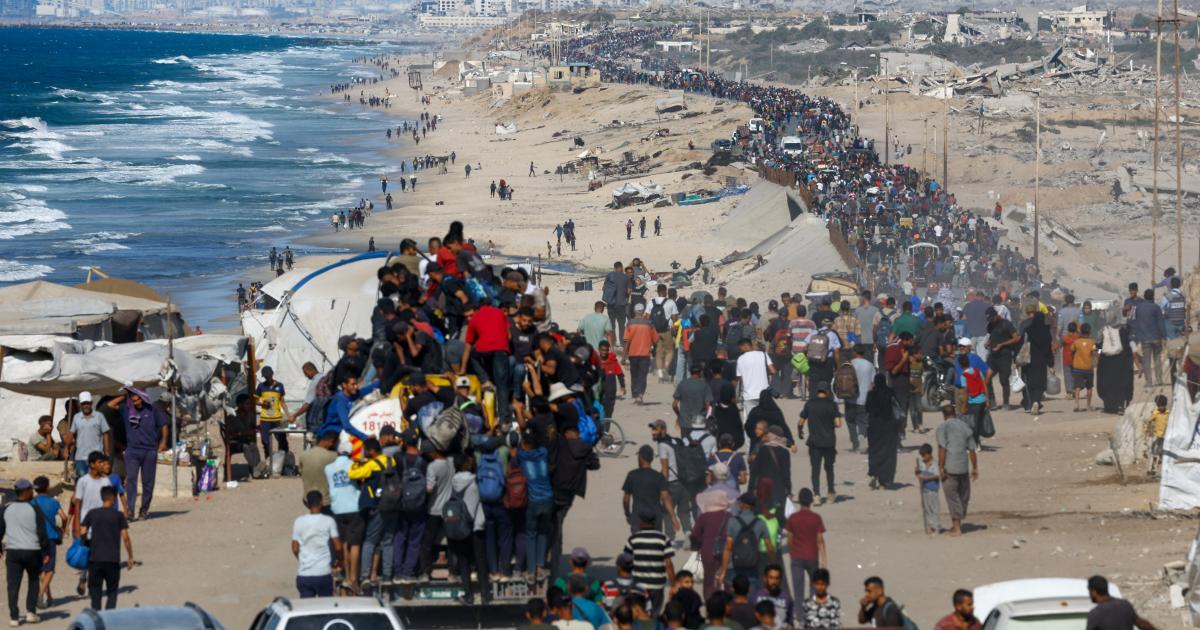
As Western and international leaders take stock of the cease-fire agreement between Israel and Hamas that was signed in Egypt on October 9, many have raised doubts about the deal’s phased structure. According to the 20-point plan announced by U.S. President Donald Trump, the initial stage that is now unfolding calls only for a partial or limited Israeli withdrawal from Gaza and the release of nearly 2,000 Palestinian prisoners in exchange for the release of the remaining Israeli hostages held by Hamas. The deeper issues, including questions over the postwar governance of Gaza and the stabilization force that will provide security in the territory, have been relegated to subsequent phases. To critics, the fact that these crucial issues have not been fully addressed at the outset suggests that the plan is bound to fail.
But the Trump plan’s gradualism is hardly novel in the context of crisis diplomacy in the Middle East. On the contrary, a phased approach, addressing the challenges of both immediate de-escalation and long-term transitional management, has for decades been the most viable strategy to ending conflicts in the region. Indeed, for more than 75 years, many of the most crucial peace agreements, including the armistice that ended the 1948 Arab-Israeli war and the Egyptian-Israeli peace treaty of 1979, have depended on such a structure. In both of these cases, preliminary agreements were followed by implementation phases, which required international or regional sponsorship to mobilize the political and technical tools needed to ensure compliance.
A close study of these historical examples shows that under the right conditions, phased agreements can not only withstand difficult challenges but also provide the incremental trust building and opportunities for negotiation that are necessary for more durable arrangements to take hold. The real challenge for the Trump plan, then, is not its phased structure. Rather, the overriding question is whether Washington and its international and regional partners can ensure that the necessary mechanisms, incentives, and penalties are in place to allow the subsequent steps the plan calls for to succeed.
LIMITED AIMS, GREATER DURABILITY
Phased peace agreements have a long history in the Middle East. Take the 1949 armistice agreements between Israel and Egypt, Jordan, Lebanon, and Syria. The agreements were not final peace settlements but arrangements to halt fighting and establish Israel’s de facto border, the so-called Green Line. The main function of the agreements was to provide space for de-escalation so that the groundwork for a transition to broader diplomatic arrangements could be established. Yet the agreements also contained practical mechanisms—field committees, UN monitoring, rules for prisoner exchanges, and provisions for humanitarian assistance.
In short, the armistice agreements created a temporary structure for the peaceful management of conflict in the Middle East, one that could either evolve or collapse depending on internal pressures and external guarantees. The 1949 agreements established a relative peace between Israel and its Arab neighbors that lasted until 1967, with the exception of the Suez crisis of 1956, in which France, Israel, and the United Kingdom invaded Egypt following the nationalization of the Suez Canal. The agreements’ long-term success owed to the fact they were was backed by France, the United Kingdom, and the United States and monitored by UN missions, including a peacekeeping force at the Egyptian-Israeli border.
Phased agreements became even more important in the wake of the 1973 Arab-Israeli war. It was in that era that mediation efforts became faster and more active: the shuttle diplomacy pursued by U.S. Secretary of State Henry Kissinger led to successive disengagement agreements between Israel and Egypt and later between Israel and Syria. Each of these agreements was limited in military scope, involving only troop withdrawals, the creation of demilitarized zones, and measures to open communication channels and exchange prisoners. These steps resulted not from getting the belligerents to agree on an overarching settlement for a postwar order but rather from active U.S. sponsorship and technical enforcement of the agreements’ aims.
In the case of Israel and Egypt, the disengagement agreements laid the groundwork for subsequent peace negotiations that culminated in the Egyptian-Israeli peace treaty of 1979. In the case of Israel and Syria, the disengagement agreement signed in 1974 became a pillar of talks between the two parties in the early 1990s, when the United States and the Soviet Union launched the Madrid Peace Process for the Middle East, and is now once again at the core of the de-escalation negotiations between the Israeli government and Damascus.
In each of those instances, the United States did not stop mediating the moment an agreement was signed. Since U.S. officials were strongly invested in these deals and knew that American influence was at stake, Washington followed up with negotiation teams, diplomatic pressure, and aid or security packages to make sure the agreements did not collapse and could be reinforced in subsequent phases. The peace agreement between Israel and Hamas can be read in this light: the prominent involvement and leadership of the Trump administration in drafting and announcing the deal increases the likelihood that the United States will do what is necessary to ensure that the first phase leads to sustainable progress in successive stages.
THE SLOW PATH TO PEACE
Phased agreements can also lead to major breakthroughs. Among the most significant peace agreements since World War II were the Camp David accords, which led directly to the Egyptian-Israeli peace treaty. The accords did not seek an immediate resolution of all issues. Rather, they offered two frameworks, one for comprehensive peace between Israel and Egypt and another to address the Palestinian question and set the stage for future negotiations for Palestinian self-governance in the West Bank and Gaza. Although the latter was never fully implemented, by separating out these two tracks, the accords dialed down internal pressure in both countries and enabled the treaty to move forward.
Crucially, the accords were also accompanied by a U.S. commitment to facilitate negotiations, furnish aid to both countries, and ensure the parties’ compliance. The treaty that followed the Camp David talks was, notably, implemented in stages, beginning with gradual withdrawals and territorial exchanges. American sponsorship of the treaty went well beyond the signing of the deal. To induce compliance, Washington provided not only diplomatic support but also extensive economic and military assistance to both sides. U.S. troops also participated in a multinational peacekeeping force along the border.
As the case of Egypt and Israel in the years after the 1973 war demonstrates, when phased agreements are coupled with concrete international commitments—including economic and security guarantees and the deployment of international peacekeeping or monitoring forces—an initial de-escalation and stabilization phase can lay the foundation for a broader and enduring transformation. Today, peace between Egypt and Israel remains one of the pillars of stability in the Middle East.
Phased agreements can lead to major breakthroughs.
Another example of successful phased diplomacy is the 1994 Wadi Araba Treaty between Israel and Jordan. As with the Egyptian-Israeli treaty, it was carried out not in a single stroke but in successive stages. These phases included border demarcation; the reduction of each side’s military presence along their shared border; arrangements for water sharing in the Jordan and Yarmuk Rivers and in the Araba region; economic cooperation, including the establishment of a free-trade zone; and successive security arrangements. Throughout this process, the United States acted as both the guarantor at the signing of the treaty and as an ongoing provider of guarantees and incentives to both sides. The success of the Wadi Araba Treaty was relative; in some areas, such as water-sharing arrangements and economic cooperation, its achievements have been limited. But overall, it demonstrated that bilateral agreements, when undergirded by long-term cooperation mechanisms and clearly articulated subsequent phases, can evolve into a sustainable system for managing complex conflicts—even ones that contain issues that resist final resolutions.
Of course, not all phased agreements have been successful. Consider the Oslo accords. When Israel and the Palestine Liberation Organization signed the accords in 1993, the goal was to establish a multistage plan for enduring peace. Mutual recognition was to be followed by an interim stage, in which the newly created Palestinian Authority would govern the West Bank and Gaza, and Israeli troops would redeploy as Palestinian civil and security control gradually expanded. No later than the third year of the interim stage, permanent-status negotiations were to tackle issues such as borders, Israeli settlements, Palestinian refugees, and the status of Jerusalem. But the plan soon fell prey to shifting internal dynamics on both sides. Hard-line groups in Israel and in the Palestinian territories rejected the deal, and provocations led to renewed violence, causing the accords to unravel.
The larger lesson, however, was not about phasing but about implementation. The accords lacked the kinds of international commitments and effective enforcement tools necessary to ensure their survival under intense countervailing forces. The United States was not proactively involved in guaranteeing a good faith implementation of the plan, and there was no framework of incentives and sanctions to ensure compliance and progression. In the end, the Oslo accords largely failed not because they envisioned a gradual process but because that process was not sufficiently supported by the kinds of mechanisms, incentives, and pressure needed for success. Similarly, the January 2025 cease-fire between Israel and Hamas, a phased agreement that was meant to end the war in Gaza, also failed because of the absence of sustained U.S. involvement and the lack of regional and international pressures on Israel not to restart the war.
ENFORCED FLEXIBILITY
As Israel and Hamas undertake the first steps of the cease-fire, there is enormous hope that a more lasting settlement for Gaza can emerge. As these examples make clear, however, such an outcome is unlikely to happen on its own. As with previous phased agreements, the Gaza deal will require several decisive factors for continued success.
The first of these is sustained international and regional sponsorship. This means not merely the presence of the United States during the signing and the opening phase but also a clear commitment from Washington over the coming weeks that it will follow up, provide incentives, and impose sanctions when one or the other side fails to comply.
The presence of effective monitoring mechanisms is also critical. These may include joint committees, international monitoring missions, and possibly international peacekeeping forces. The Trump plan envisions an international stabilization force that will be tasked with various security duties, including overseeing the disarmament of Hamas. This force will also need to coordinate with humanitarian organizations to ensure the rapid provision of urgent relief. Without such concrete forms of international engagement, the deal may quickly erode.
Equally important, the United States and its international partners should tie specific incentives and sanctions to each phase of the deal. These could include postwar reconstruction, economic aid, security guarantees, and long-term diplomatic promises offered as inducements for compliance. Washington and its international and regional partners will need to manage local expectations, including by reassuring or accommodating influential domestic actors within both Israel and the Palestinian territories.
The Gaza deal will require sustained international and regional sponsorship.
Finally, as past agreements have shown, flexibility is the key. Given the complex nature of regional conflicts, an overly rigid plan is not likely to yield long-term success, whereas a plan amenable to modification would allow for further negotiation, mediation, and corrective measures in the face of implementation impasses or failures. Each side may be tempted to use negotiations to avoid going forward with the more difficult phases of the deal, but the flexible nature of the agreement can allow international and regional mediators to create new incentives for compliance.
International and regional guarantors of the Gaza agreement must work to transform it into a detailed road map with measurable timelines, joint monitoring committees, reporting mechanisms for violations, and international peacekeeping forces. This will require sustained diplomatic engagement from Washington; regional actors such as Egypt, Qatar, and Turkey; and European countries and UN agencies.
To ensure successful transitions from one phase of the agreement to the next, the United States and its partners should offer both Israel and the Palestinians a broad array of incentives for compliance—and threaten significant sanctions for violations. For example, they can offer to reduce Israel’s current diplomatic isolation in the Middle East and threaten to impose greater restrictions on arms sales. With regard to Hamas, disarmament can go hand in hand with a gradual rehabilitation of its rank and file (not the leadership), integrating them in the medium and lower strata of the newly built civilian administration for Gaza. To avoid Hamas’ noncompliance with the provisions of the agreement, the United States and its partners can threaten a more immediate and aggressive destruction of the movement’s remaining military and financial capabilities.
By adopting a phased agreement, the Trump administration has been able to get both sides to halt a terrible conflict and come to the table. The challenge now is to galvanize the deal’s international backers to put in place what is necessary to sustain the agreement, regardless of the resistance it may face in both Israel and the Palestinian territories. Having fought a brutal war, both sides need to understand that the cost of failure is too high—and the benefits of compliance, however messy, too great—for the deal to collapse. But it will have to happen one step at a time.
Loading…