
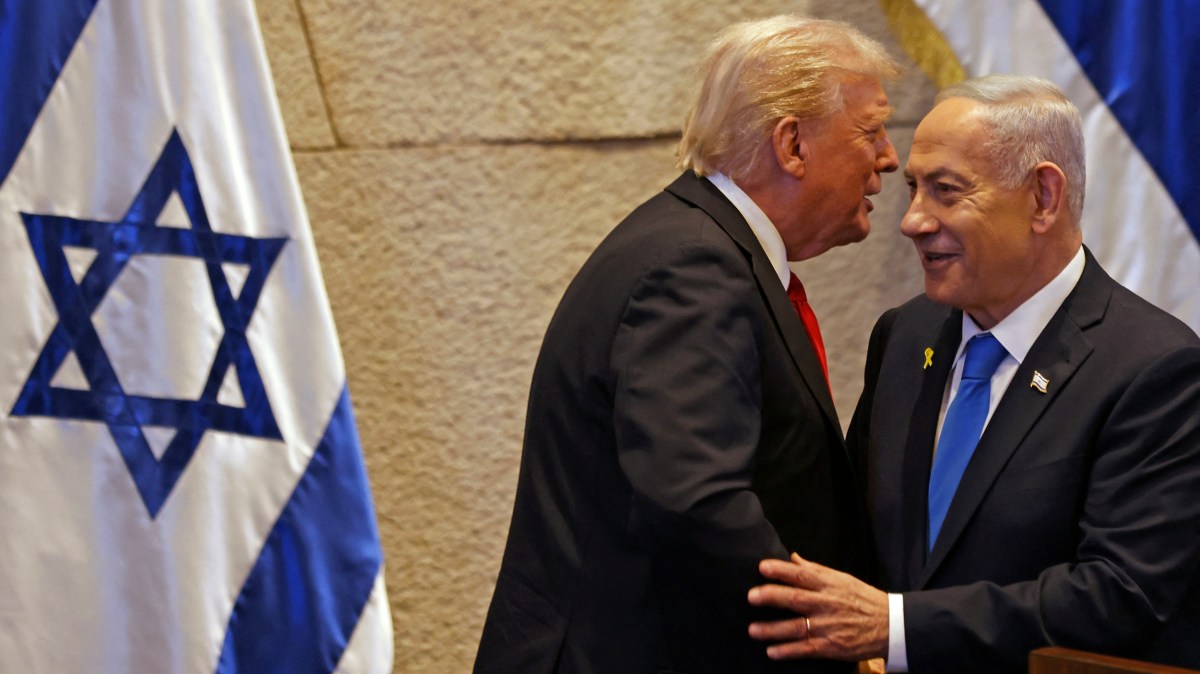
As President Trump neared the end of his speech to the Knesset, he turned to the Israeli president and made an unconventional plea on behalf of the prime minister.
“Mr President, why don’t you give him a pardon?” Trump asked Isaac Herzog, prompting applause from Binyamin Netanyahu’s supporters. “Who the hell cares about these charges?”
It was a reminder that for much of the conflict in Gaza, Netanyahu has been battling not only low approval ratings but a corruption case over charges that he and his wife, Sara, accepted more than $260,000 in luxury goods including cigars, jewellery and champagne.
• Israeli hostage release: Trump has addressed Knesset — follow live
“This is one of the greatest war-time prime ministers,” Trump said. “Who cares about cigars and champagne?”
Trump has made the suggestion before, drawing criticism from the Israeli opposition for meddling in their country’s domestic affairs. Throughout the Gaza conflict, Netanyahu has cited affairs of state in efforts to avoid hearings on his corruption charges. His next hearing is scheduled for Wednesday, although he is still seeking to have it postponed, citing a visit by the Cypriot president. While Herzog could pardon Netanyahu, the prime minister would first have to acknowledge guilt.
Netanyahu’s corruption trial has dogged his wartime leadership. Critics have accused him of prolonging the war against Hamas in Gaza for fear that he will end up in jail if the conflict ends. Politically, however, he has also walked a tightrope, as his far-right coalition partners insisted the war should continue until Hamas was completely defeated.

Demonstrators at a rally against Netanyahu during his trial on corruption allegations in Tel Aviv in December 2024
JACK GUEZ/AFP/GETTY IMAGES
At the same time, he has faced mounting popular opposition led by the families of hostages who accused him of prioritising his own political survival — as well as his personal freedom — over a deal with Hamas to bring their loved ones home. Some argue that his fears of his coalition collapsing were overblown, becoming an excuse for his own inaction and paralysis.
When Hamas attacked Israel on October 7, 2023, Netanyahu was also under popular pressure over his attempts to neuter the Israeli Supreme Court, and hundreds of thousands were taking part in regular mass protests. He is also accused, along with much of the security establishment, of having failed in his duty to protect the country from the attack itself.
Even the families of soldiers in Gaza have joined the protests against him, saying that their loved ones were being deployed unnecessarily because of Netanyahu’s commitment to an unrealistic, absolute military victory against Hamas.
When Trump’s peace envoy, Steve Witkoff, addressed a crowd of 500,000 in Hostage Square in Tel Aviv on Saturday evening, he could barely get out his thanks to Netanyahu for the booing that greeted it. It was Trump the crowds cheered, loudly and repeatedly, and it was Trump’s face that was emblazoned on posters across Tel Aviv thanking him for the deal.
Having opposed the ceasefire deal that Trump then forced on him, Netanyahu is now “trying to make us all believe that it was out of his own volition”, Amir Oren, a senior Israeli analyst said.
Such a repositioning may require him to kick out his right-wing partners before he seeks re-election. “They will either leave or be booted,” Oren said. “They conditioned staying in the government by saying they are there in order to monitor the return to fighting after the hostages are released. This is not going to happen. The war is over. They have no pretext to stay in.
“If they persist, Netanyahu will find the right time and circumstance to kick them out and go to early elections as the advocate of peace, rather than war.”
However, he does not foresee such a change to Netanyahu’s fortunes that he could wriggle free of the need for coalition partners altogether. “The electorate, after this joyous day, will revert to its regular divide — yes Bibi or no Bibi,” he said. “Let me dare a prophecy — this is his last hurrah.”
Still, new polls taken after the deal was struck last week gave Netanyahu a modest boost that may help him at the general election that must be held in the next 12 months. Asked who they would vote for, respondents gave his Likud party 27 of the Knesset’s 120 seats — up from 25 seats forecast a week before. The party now has 32, won in the 2022 election.
The party of Netanyahu’s far-right security minister, Itamar Ben Gvir, had a projected drop in seats from nine to six, which may reflect anger at his opposition to the popular hostage deal.
Almost half of Israelis believe there should be an election as soon as the deal is completed and the hostages are returned. Whether Netanyahu can spin that euphoria into lasting political support remains to be seen. Having decried his negativity over reaching a deal before, Trump now seems more than willing to give Netanyahu a boost.