
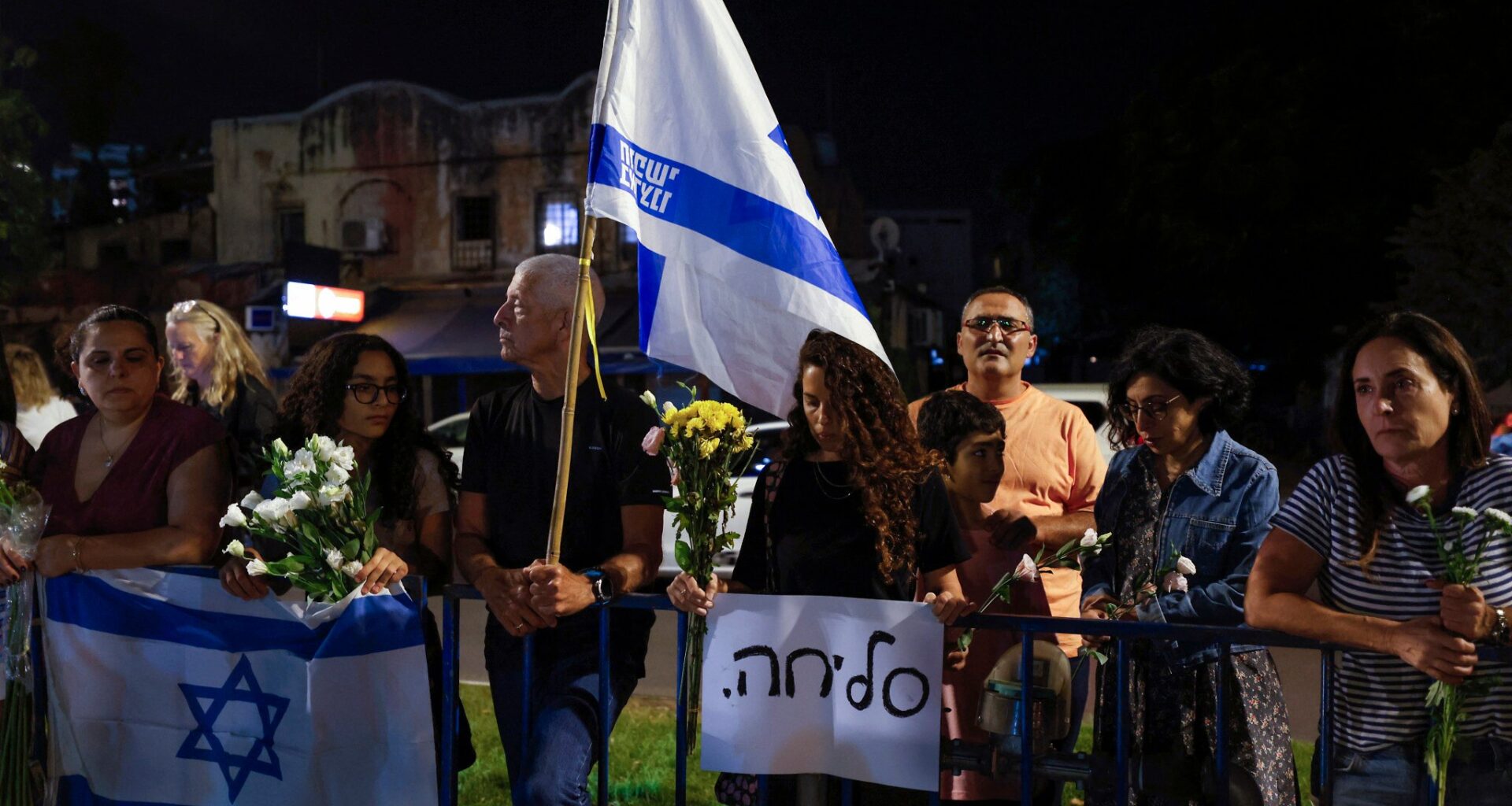
Yael Adar, the mother of slain hostage Tamir Adar, on Monday night delivered a searing criticism of the Israeli leadership’s handling of the issue of the return of hostages’ bodies, telling Channel 12 that the government “betrayed” families like hers whose loved ones were killed in captivity and have not been returned.
Adar said she had asked officials ahead of the hostage deal announced last week what leverage Israel would have to recover the bodies of the 28 dead hostages held by Hamas, only four of whom were returned Monday.
Hamas was supposed to return all 48 hostages, living and dead, by Monday, but had warned that it would have trouble locating some of the dead bodies.
“They told me that a live hostage is worth 100 Palestinian prisoners, including life-termers,” she said. “But a dead hostage is worth 15 Palestinian bodies. Why not 100 dead Palestinians?”
Hamas did not breach the agreement, she said, arguing that, because of the way it was drafted, “Israel agreed there was no [absolute] deadline.”
Get The Times of Israel’s Daily Edition
by email and never miss our top stories
By signing up, you agree to the terms
The terms of the deal were not definitive as regards what might happen if Hamas failed to return all the bodies, with some leeway for ongoing searches for the bodies, which she said might go on for months or years.

Yael Adar, mother of slain captive soldier Tamir Adar, speaks at a memorial event at Hostages Square in Tel Aviv, February 20, 2025. (Alon Gilboa/Pro-Democracy Protest Movement)
“I fought for Tamir’s return and in the end I will receive a coffin, not someone I can hug, or look at. Now our mission is to find him as quickly as possible and then begin to cope with the loss and the mourning process. Difficult days are ahead,” she said.
Adar also criticized Knesset Speaker Amir Ohana for removing his hostage pin ahead of US President Donald Trump’s speech in Knesset Monday, saying it symbolized an attitude that the hostage issue “is over.”
Her remarks come as questions mount over Hamas’s compliance with the “Comprehensive End of Gaza War” document signed last Thursday in Egypt. The deal stipulated that Hamas had to release within 72 hours of the ceasefire — by noon Monday — all 20 living hostages, as it did, and the bodies of all dead hostages it holds or can locate.
But the document also leaves open the possibility that if Hamas has information about the whereabouts of deceased hostages whose bodies it cannot retrieve within that timeframe, those details will be transferred to mediators for follow-up at a later stage.
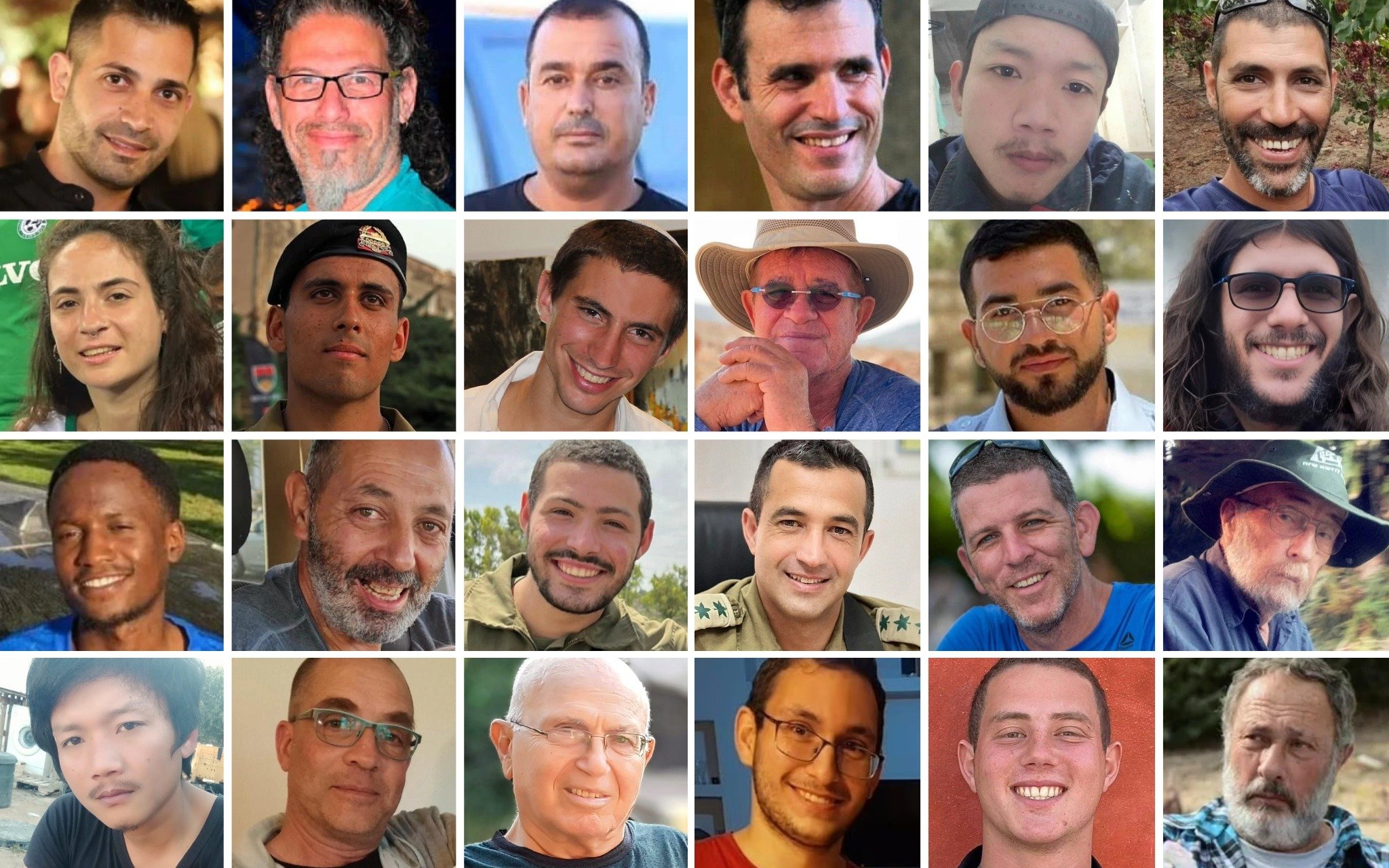
The 24 fallen hostages still held in the Gaza Strip, as of October 14, 2025. Top row, from left: Uriel Baruch, Ronen Engel, Muhammad Alatrash, Dror Or, Sonthaya Oakkharasri, Tamir Adar. Second row, from left: Inbar Heiman, Sgt. Oz Daniel, Lt. Hadar Goldin, Manny Godard, Sgt. First Class Ran Gvili, Sahar Baruch.
Third row, from left: Joshua Mollel, Eitan Levy, Sgt. Itay Chen, Col. Asaf Hamami, Tal Chaimi, Aryeh Zalmanovich. Bottom row: Sudthisak Rinthalak, Maj. Lior Rudaeff, Amiram Cooper, Tamir Nimrodi, Omer Neutra, Eliyahu Margalit. (Times of Israel combo; courtesy)
According to a CNN report published last week, three Israeli officials confirmed that Hamas may not be able to find all of the 28 dead hostages. Prime Minister Benjamin Netanyahu has known for months that this is the case, according to the officials. One official said that seven to nine bodies might not be retrieved, while another put that figure at between 10 and 15. There had been no suggestion ahead of today’s deadline that Hamas might release as few as four of the 28 bodies.
After Adar’s interview, Channel 12 reports that Qatari officials had informed Israeli representatives in Sharm el-Sheikh last week that Hamas held 15 to 16 hostages’ bodies ready to return, and was looking for more.
According to Tuesday morning reports in Hebrew media, Israel set the end of Tuesday as a deadline for progress on the issue.
Mediators have said the terror group will have trouble locating all of the bodies; however, according to the Kan public broadcaster, Israel believes Hamas is already holding some of the bodies, but did not hand them over.
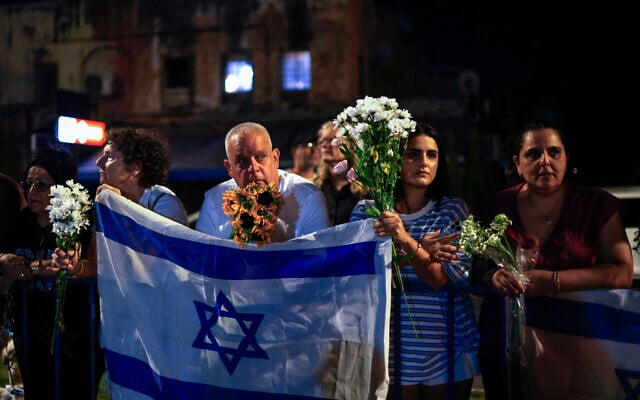
People carry flowers and Israeli flags upon the arrival of vehicles transporting the bodies of four hostages, in front of the National Center for Forensic Medicine in Tel Aviv on October 13, 2025. (Jalaa Marey/AFP)
A source familiar with the matter told Kan that “the writing was on the wall, but only now are we discussing in any significant way the options for response.”
The source said that Israel does not have enough effective leverage on the issue.
According to Channel 12, Israel is already threatening sanctions on Hamas if the group does not return all the bodies in its possession in a timely manner, though the report did not specify what type of sanctions Israel could deploy.
An Arab diplomat from a mediating country told Haaretz that mediators are working on the issue, and do not believe that the Gaza agreement is in jeopardy.
Late Monday, after the last 20 living hostages were returned to Israel, Hamas handed over four caskets, which the group said contained the bodies of Guy Illouz, Yossi Sharabi, Bipin Joshi and Daniel Perez.
The caskets were taken to the Abu Kabir forensic institute in Tel Aviv, where they will undergo identification. Hamas has in the past sent back unrelated bodies instead of hostages.
Is The Times of Israel important to you?
If so, we have a request.
Every day, even during war, our journalists keep you abreast of the most important developments that merit your attention. Millions of people rely on ToI for fast, fair and free coverage of Israel and the Jewish world.
We care about Israel – and we know you do too. So today, we have an ask: show your appreciation for our work by joining The Times of Israel Community, an exclusive group for readers like you who appreciate and financially support our work.
Already a member? Sign in to stop seeing this
You appreciate our journalism

You clearly find our careful reporting valuable, in a time when facts are often distorted and news coverage often lacks context.
Your support is essential to continue our work. We want to continue delivering the professional journalism you value, even as the demands on our newsroom have grown dramatically since October 7.
So today, please consider joining our reader support group, The Times of Israel Community. For as little as $6 a month you’ll become our partners while enjoying The Times of Israel AD-FREE, as well as accessing exclusive content available only to Times of Israel Community members.
Thank you,
David Horovitz, Founding Editor of The Times of Israel