
It’s Monday, October 13. This is The Front Page, your daily window into the world of The Free Press—and our take on the world at large. Today: Woody Allen remembers Diane Keaton. María Corina Machado on Honestly. And much more.
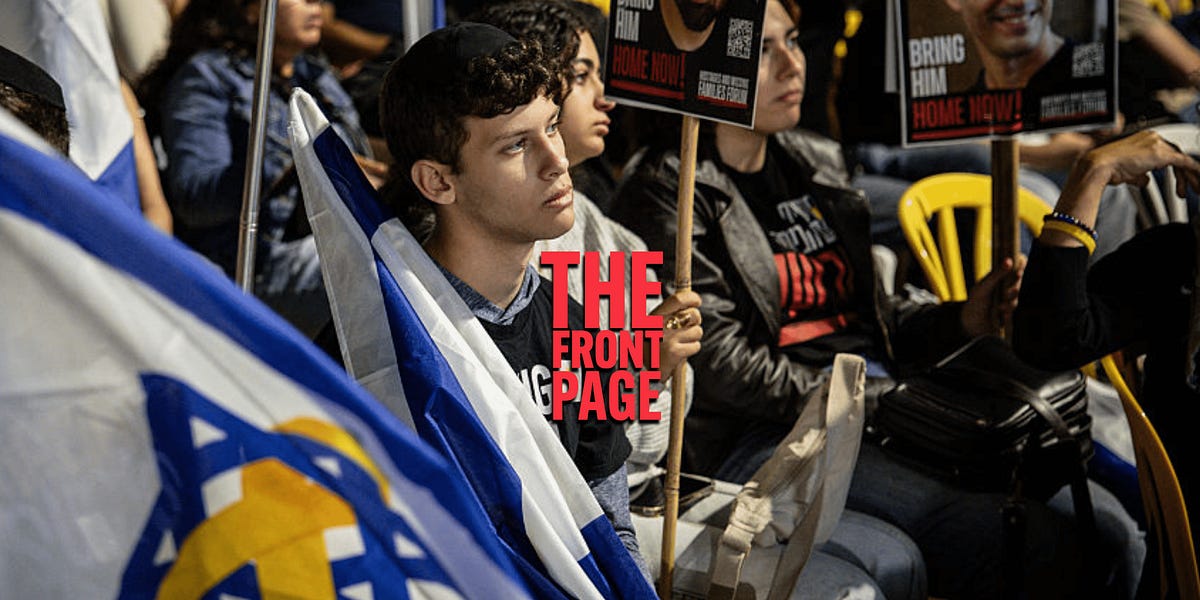
But first: The hostages are free.
At 3:22 a.m. ET on October 7, 2023, I texted my producer: “Candace there’s war in Israel. We should record ASAP.”
At that moment, Hamas terrorists still roamed southern Israel and the details were far from clear. What we knew was that Israel had been attacked and that videos were beginning to make their way from Telegram to X. Scenes of dozens of Palestinian terrorists breaking through the security fence and rushing into Israeli territory; clips of Hamas militants, with AK-47s slung over their chests, driving white pickup trucks through the streets of southern Israel; blurry videos of Israelis running for their lives in roundabouts and fields.
We were only beginning to understand what was unfolding, and there was a lot we did not know. We did not know yet that 251 people would be kidnapped that day, including more than 30 children. We did not know yet that what was unfolding was the worst mass murder of Jews since the Holocaust, only this time streaming live on social media. We did not know it was the start of a war of survival Israel would fight on seven fronts, or that it would take two years of war against Hamas to bring Israel to this moment.
Within 48 hours of October 7, we had interviewed more than a dozen people. We published many of those firsthand accounts on Honestly. A pregnant woman named Shaked told us about 11 family members who were taken hostage, including her 3- and 8-year-old niece and nephew. Survivors of the Nova music festival, Amit and Chen, watched the murder of their friends. We talked to a mother whose daughter was killed at the music festival. We talked to a grandmother who hid in her safe room for hours with her 10-day-old grandson as terrorists shot at the door.
And we spoke to a father named Jon Polin whose son, Hersh, was kidnapped. Little did we know that the entire world would soon know his name.
More than two years later, the hostages are finally coming home.
We are under no illusions about what comes next. Hamas’s tragic determination to bring death and destruction down on Gaza as a war strategy has been a terrible aspect of the past two years. Had Hamas been willing at any point to release the living and the dead they dragged into captivity on October 7, and lay down their arms, a great deal of suffering on both sides might have been avoided. Instead, a long war was necessary to arrive at this moment of diplomacy. And this is only phase one of Donald Trump’s 20-point peace plan. Today, the president is meeting regional leaders in Egypt to finalize an agreement to end the war. Serious—perhaps intractable—challenges lay ahead. There are many, many outstanding questions. As Free Press Middle East analyst Haviv Rettig Gur put it, “Everything that matters for Gaza’s future is in phase 2 and beyond.”
But none of that detracts from the meaning of this day—a day that Matti Friedman explains the significance of in our lead essay this morning.
“For the past two years,” Matti writes:
Israelis have been walking around with the feeling that some unknown muscle is tightly and involuntarily clenched. This is evident in the set lines on the faces of passersby, in the way people hunch their shoulders as if against the cold, in brittle and combustible interactions at the supermarket or gas station. The feeling intensifies when the war news is particularly awful, like the day last summer when a hostage I knew, Hersh Goldberg-Polin, was murdered by his Palestinian captors with five other Israelis in a tunnel under Rafah.
But even on “quiet” days, the ones when we don’t have to rush our children to the safe room because of a missile alert, or steer them away from the news, it doesn’t go away.
It’s a sensation so protracted that many of us stopped noticing—until the moment, this weekend, when the muscle relaxed.
Read Matti on when the call to “bring them home” was finally answered:
Our newsroom has been working hard to cover the story of the hostages since those early hours of October 7. Now that the surviving hostages are finally free, we’ve collected some of the stories we’re reminded of in one place. Click below to read, listen, and watch the story of the hostages:
—Bari Weiss

For the latest on the hostage release and what comes next, join Haviv Rettig Gur and Ahmed Fouad Alkhatib at 9 a.m. ET this morning on the Free Press livestream. Tune in here at 9, or watch it on our home page. Livestreams like this are for paying subscribers, who’ll be able to join the Q&A. Not a subscriber yet? Become one here.
On Honestly: María Corina Machado’s Nobel—and Her Fight to Free Venezuela
María Corina Machado was awarded the Nobel Peace Prize on Friday for stubborn opposition to Venezuelan autocrat Nicolás Maduro. Bari sat down with Machado for the latest episode of Honestly to discuss why she’s choosing to risk her life by staying in Venezuela, her message to democratic socialists in America, why she dedicated her prize to President Trump, and more. Click play below to listen to their conversation, catch it wherever you get your podcasts, or watch it here.
And for more coverage of the Nobel, read our editorial on why Machado is such a worthy winner:

The brilliant, charming, Oscar-winning actress Diane Keaton has passed away at 79, it was announced Saturday. Today in The Free Press, Woody Allen remembers his co-star, lover, and lifelong friend: “When we first met, I thought she was so charming, so beautiful, so magical, that I questioned my sanity. I thought: Was it possible to fall in love so quickly?”

The latest guest on Conversations with Coleman is Nicholas Wade, a former science writer for The New York Times and author of several books on human evolution, including A Troublesome Inheritance: Genes, Race, and Human History and his new book, The Origin of Politics: How Evolution and Ideology Shape the Fate of Nations.
Coleman wanted to talk to Wade about some of the toughest topics in modern science: the controversial territory of race and genetics, and whether there are fundamental genetic differences between right-wingers and left-wingers. They also dig into the fertility crisis, what evolutionary psychology tells us about foreign policy, and much more. Whether you find Wade’s evolutionary framework persuasive or not, the conversation raises questions that most political leaders and academics prefer to ignore.

Readers may remember the name Devon Horton from Frannie Block’s March story on “How One Town Turned a Child’s ‘Cry for Help’ Into a Hate Crime.” He was the school superintendent who unleashed the unfounded vilification of two white students in Evanston, Illinois, when he erroneously described three nooses found in a schoolyard as “a deliberate and specific incidence of an outwardly racist act.” In a follow-up to that story, Frannie reports that Horton has been indicted for fraud. Federal prosecutors accuse Horton of steering school contracts to friends and pocketing over $80,000 in kickbacks.





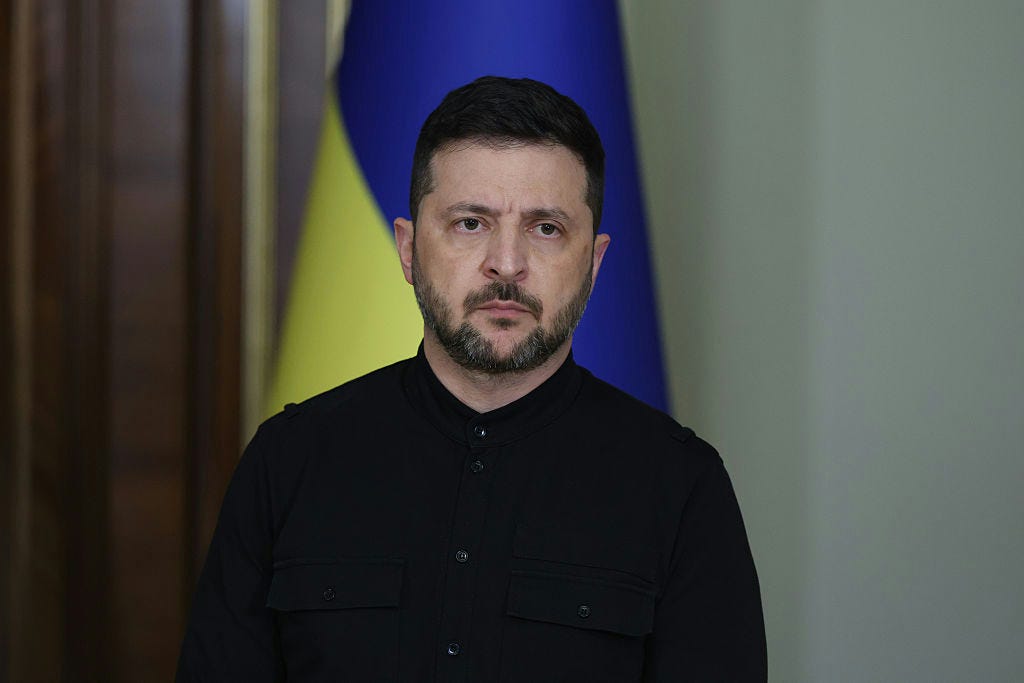 Ukrainian president Volodymyr Zelensky gives a media briefing on Russian strikes on October 10, 2025, in Kyiv, Ukraine. (Viktor Kovalchuk/Global Images Ukraine via Getty Images)
Ukrainian president Volodymyr Zelensky urged President Trump over the phone Saturday to broker a peace deal in Ukraine following the Gaza ceasefire agreement. “If a war can be stopped in one region, then surely other wars can be stopped as well—including the Russian war,” Zelensky wrote on X. Trump says he is considering supplying Tomahawk missiles to Ukraine if Putin does not resume peace talks.
President Trump threatened a new 100 percent tariff on China after China placed export controls on rare earth minerals. The Chinese commerce ministry responded yesterday, vowing that “We do not want a tariff war but we are not afraid of one.” Both the United States and China have accused each other of violating the spirit of the current truce in the trade war by imposing new trade restrictions. Stocks dropped sharply in response to the controls on Friday and are braced for more turmoil today.
Despite the government shutdown, troops will receive their regularly scheduled wages on October 15, President Trump announced on Saturday. The Pentagon will shift approximately $8 billion in funding for military research to pay salaries. The White House says it has also begun mass layoffs of federal workers in response to the shutdown. More than 4,000 employees at government agencies have received layoff notices, according to a court filing late Friday.
Federal prosecutors met on Saturday to finalize charges against John Bolton, former national security adviser under Trump’s first term. The possible indictment relates to Bolton’s handling of classified records, and comes after a spate of recent charges against Trump’s other political adversaries, including former FBI director James Comey and New York Attorney General Letitia James.
The Labor Department acknowledged that the Trump administration’s immigration crackdown risks sending food prices higher. In an obscure document filed with the Federal Register, where proposed rules are made public, the department said the “near total cessation of the inflow of illegal aliens” threatens “the stability of domestic food production and prices for U.S consumers.”
 The Free Press earns a commission from any purchases made through all book links in this article.