
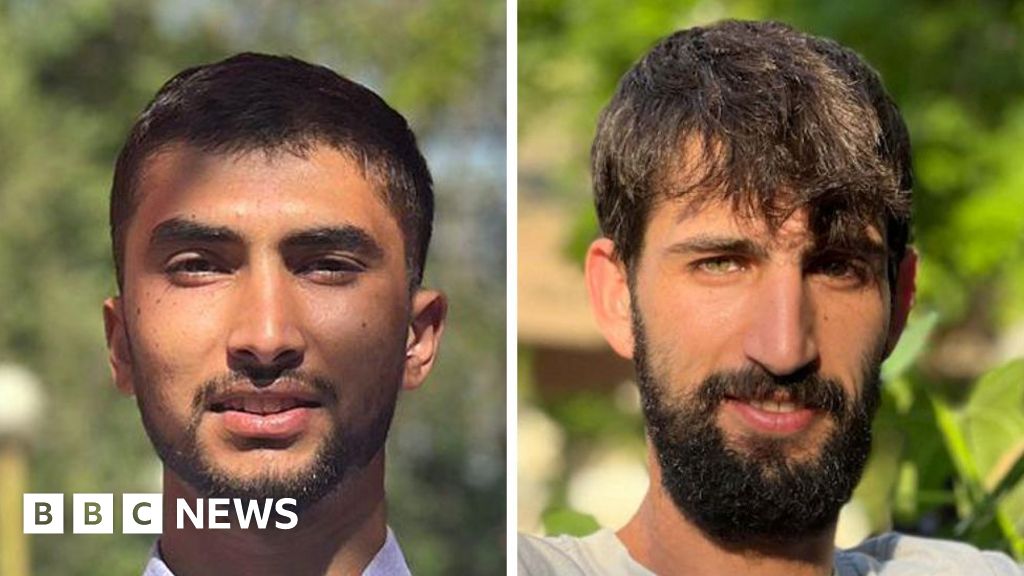
The Israeli military says it has identified the bodies of four deceased hostages which were returned by Hamas as part of the Gaza ceasefire agreement.
It named two of the hostages as Guy Illouz, a 26-year-old Israeli, and Bipin Joshi, a 23-year-old Nepalese citizen whose death in captivity had previously not been confirmed.
The other two hostages’ names have not yet been cleared for publication by their families, the military said.
Bereaved families of the 24 other dead Israeli and foreign hostages have expressed anger that their remains were also not handed over by Hamas over on Monday, when the 20 living hostages were released in exchange for almost 2,000 Palestinian prisoners and detainees.
Hamas has said it could take time because not all the hostages’ burial sites are known.
But Israel’s defence minister has warned the Palestinian armed group that “any delay or deliberate avoidance will be considered a gross violation of the agreement and will be responded to accordingly”.
A statement put out by the Israel Defense Forces (IDF) on Tuesday morning said that, following forensic testing, representatives had informed the families of Guy Illouz, Bipin Joshi and two other hostages that they had been brought back to Israel for burial.
The IDF cited intelligence and other information as showing that Illouz was “injured and abducted alive” by Hamas gunmen, after he escaped the attack on the Nova musical festival near Reim on 7 October 2023 and headed towards the Tel Gama area.
“Guy died from his wounds after not receiving proper medical treatment while held captive by Hamas,” it added.
The IDF said the available intelligence and information showed that Joshi was abducted from a shelter in Kibbutz Alumim by Hamas gunmen two years ago.
“It is assessed that he was murdered in captivity during the first months of the war,” it added.
The IDF said final conclusions about the deaths of both men would be determined after the completion of the examination of the circumstances of death by the National Centre of Forensic Medicine in Tel Aviv.
The IDF expressed condolences to their families and pledged to continue to make every effort to return the remains of the hostages in line with the ceasefire agreement.
“Hamas is required to fulfil its part of the agreement and make the necessary efforts to return all the hostages to their families and to proper burial,” it warned.
Joshi was an agriculture student who had only been in Israel for a few weeks when Alumim was attacked.
According to Israel’s Hostages and Missing Families Forum, he “fled to a shelter in the kibbutz with other foreign students, deflected a live grenade with his bare hands, and through his bravery saved many lives”.
His family received no signs of life for a year, until the Israeli military shared a video showing him in captivity around November 2023.
The family described the footage as “proof of life” just hours before the ceasefire deal was agreed. However, Joshi’s name was on the list of four people whose remains Hamas said it was returning to Israel on Monday.
Illouz, who was also named by Hamas, was a well-known sound technician in the Israeli music industry from the central town of Raanana.
His family said he was kidnapped by Hamas gunmen after being shot twice during the attack on the Nova festival.
“According to released hostage Maya Regev, he was kidnapped unconscious and lay alone for a whole week, tied to his bed,” the Hostages and Missing Families Forum said.
“A day and a half before his death, she was brought into his room at the hospital, where he told her that his mother was the strongest woman in the world, and that the moment he returned home he would hug her and never let go.”
The Hostages and Missing Families Forum said: “The return of Guy and Bipin, may their memories be a blessing, together with two additional deceased hostages, brings some measure of comfort to families who have lived with agonising uncertainty and doubt for over two years.”
“We will not rest until all 24 hostages are brought home.”
The Israeli military launched a campaign in Gaza in response to the Hamas-led attack on southern Israel on 7 October 2023, in which about 1,200 people were killed and 251 others were taken hostage.
At least 67,869 people have been killed by Israeli military operations in Gaza since then, according to the territory’s Hamas-run health ministry.