
Tuesday, October 14, 2025
Media Contact:
Desa James | Communications Coordinator | 405-744-2669 | desa.james@okstate.edu
A new study led by College of Engineering, Architecture and Technology researchers
is helping shape how NASA collects and preserves rock samples from Mars. The work
intends to ensure that the most scientifically valuable materials return to Earth
intact.
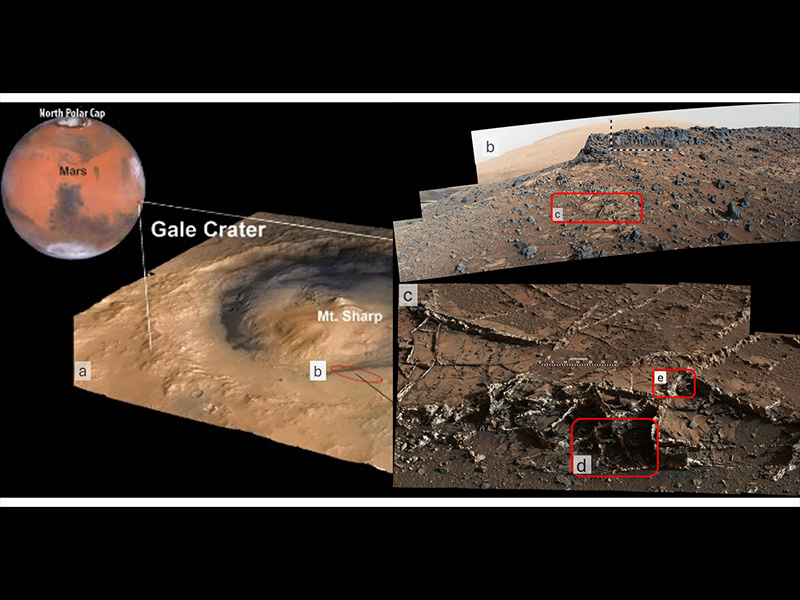
Dr. Ali Ettehadi, research assistant professor for the School of Chemical Engineering, investigated the fragile nature of sulfate-filled fractures in Martian rocks to
better understand how these materials respond to drilling and coring during planetary
exploration. The research published in Planetary and Space Science combines mineralogical analysis and nano-mechanical testing to identify the weak points
that could cause samples to fragment under stress.
“Sulfate-filled fractures are one of the most common mineralogical features we see
in Martian rocks, especially in areas explored by rovers like Curiosity and Perseverance,”
Ettehadi said. “These veins are essentially natural archives of water-rock interactions.
They record the chemistry of fluids that once moved through the Martian crust, which
gives us direct clues about the planet’s past habitability.”
The findings have direct implications for NASA’s Mars Sample Return mission, which
aims to bring pristine Martian samples back to Earth for the first time. The study
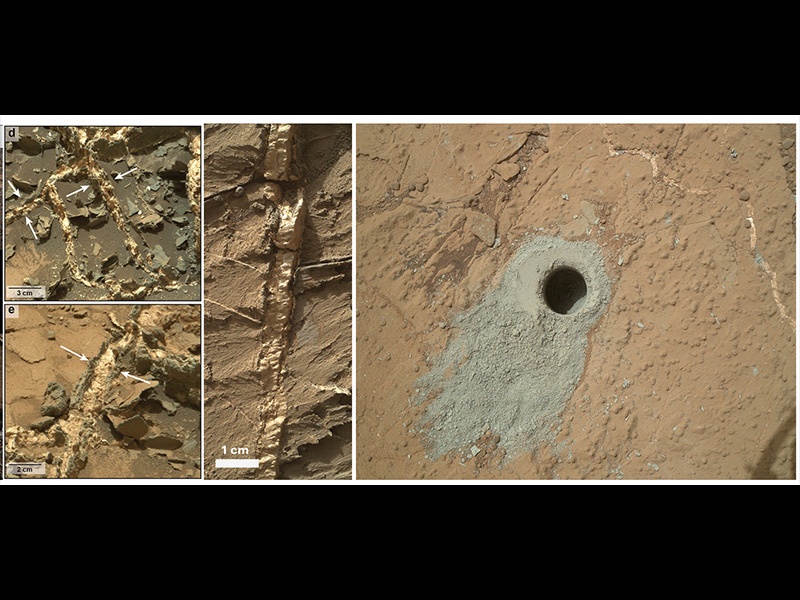
reveals that the fractures, often filled with gypsum, are mechanically fragile and
prone to breaking apart during drilling.
Ettehadi’s team worked to find a solution to this problem.
“By identifying the weak points and mechanical behaviors in the sulfate-filled fractures,
we were able to provide guidelines that can help engineers adapt drilling and coring
strategies,” Ettehadi said.
To conduct the study, the research team used X-ray diffractions and electron microscopy
to determine the mineral composition of gypsum-filled fractures, followed by nano-indentation
tests to measure their hardness and elasticity.
 “Sulfate-filled fractures are one of the most common mineralogical features we see
in Martian rocks, especially in areas explored by rovers like Curiosity and Perseverance,”
Ettehadi said.
“By combining the ‘what’ (composition) with the ‘how they behave under stress’ (mechanics),
we built a complete picture of why these veins are so fragile,” Ettehadi said.
The results showed that gypsum veins are significantly weaker than the surrounding
quartz-rich matrix and that the interfaces between the two are especially vulnerable
to stress.
“If samples fragment or turn into powder, we lose the structural context that tells
us how minerals are arranged in space and time,” Ettehadi said. “This context is essential
for reconstructing fluid history, deformation patterns, and even the conditions that
might have supported microbial life. Powdered samples may still tell us about chemistry,
but they erase the “geological story” written in textures and interfaces.”
The study’s mechanical data has been translated into practical engineering recommendations
for Mars drilling missions, including optimal bit materials, torque levels and drilling
speeds to minimize damage. These findings could also inform future missions to other
planetary bodies, such as Europa of the Moon, where similarly fragile materials may
exist.
In the future, the team plans to expand their work to study other Martian analog materials
as well as simulating Martian environmental conditions to see the effect on fracture
stability.
Ettehadi emphasized that this project would not have been possible without key collaborations.
The research was conducted in partnership with co-authors Dr. Mileva Radonjic, OSU
chemical engineering professor, Dr. Mehdi Mokhtari of the University of Louisiana
at Lafayette and Dr. Robert C. Anderson of NASA’s Jet Propulsion Laboratory, whose
combined expertise in geomechanics, Martian analog materials and planetary science
proved invaluable. Much of the experimental work took place in OSU’s Hydraulic Barrier
Material and Geomimicry Laboratory, founded and led by Radonjic, where the team utilized
advanced characterization tools and an interdisciplinary environment to carry out
the study.
This research was funded by Oklahoma NASA EPSCoR Research Initiation Grants under
contract number 1-523365 and Grant Code G10005406. The team acknowledges Dr. Andy
Arena, director of Oklahoma NASA EPSCoR, and his OSU team for their significant contributions.
This research contributes to Oklahoma State University’s growing role in planetary
materials science and strengthens its collaborations with NASA’s Jet Propulsion Laboratory
and other research institutions involved in the Mars Sample Return mission.
You can read Dr. Ettehadi’s paper here.
“The rocks on Mars are not just ‘rocks’ – they are time capsules of the planet’s history.
Our work is about making sure that when these samples come back to Earth, they are
as intact and informative as possible, so we can unlock the secrets of Mars’ past.”
— Dr. Ali Ettehadi