
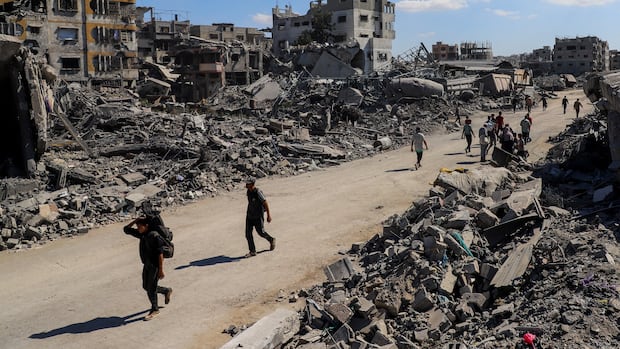
Hamas fighters tightened their grip in Gaza on Tuesday after carrying out public executions, defying any suggestions the Palestinian militant group is willing to cede control of the embattled territory.
In a stark assertion of the group’s return, fighters executed men they accused of collaborating with Israeli forces. In one video circulated late on Monday, Hamas fighters dragged seven men into a circle of people in Gaza City, forced them to their knees and shot them from behind.
A Hamas source confirmed to Reuters that the event happened. The location was also verified through satellite images.
Gaza residents said fighters were increasingly visible on Tuesday, deploying along routes needed for aid deliveries. Palestinian security sources say dozens of people have been killed in clashes between Hamas fighters and rivals in recent days.
Hamas’s resumption of power in Gaza and continued flashes of violence underscore the daunting hurdles facing efforts to move Trump’s ceasefire plan toward a longer-term resolution of the conflict.
While Trump proclaimed the “historic dawn of a new Middle East” to Israel’s parliament on Monday, some of the most difficult elements of his plan have yet to be negotiated to resolve issues that wrecked previous efforts to end the war.
Israeli forces remain entrenched across much of Gaza after their partial pullback inside the tiny, crowded territory. Promised increases in aid deliveries have not yet materialized for a population of 2.2 million people, with many facing famine.
A summit co-hosted by Trump in Egypt on Monday ended with no public announcement of major progress toward establishing an international military force for Gaza or a new governing body.
The remains of at least 23 dead hostages remain in Gaza.
No tolerance for violations: Hamas sources
Israeli Prime Minister Benjamin Netanyahu has consistently maintained the war cannot end until Hamas gives up its weapons and ceases to control Gaza, a demand the fighters have rejected, torpedoing all previous peace efforts.
When Hamas fighters appeared in the streets during the last ceasefire in January-March, Israel abandoned the truce and called off negotiations on an end to the war. But Trump, having announced the war is now over, said on Monday that Hamas still had a temporary green light to keep order.
“They do want to stop the problems, and they’ve been open about it, and we gave them approval for a period of time,” he said.
Hamas sources told Reuters on Tuesday the group would tolerate no more violations of order in Gaza and would target collaborators, armed looters and drug dealers.
WATCH | Gaza peace deal signed in Egypt on Monday:
Trump, mediators sign Gaza peace deal as Hamas, Israel release hostages and prisoners
U.S. President Donald Trump and mediators signed a deal to end the war in Gaza on Monday following the release of the remaining 20 living Israeli hostages and 2,0000 freed Palestinian prisoners.
Though greatly weakened after two years of Israeli bombardment and ground incursions, Hamas has been gradually reasserting itself, with remaining fighters moving back onto the streets since the ceasefire took hold over the weekend.
The group, which has governed Gaza since 2007, also deployed hundreds of workers to start clearing key routes needed to access damaged or destroyed housing and to repair broken water pipes.
Road clearance and security provision will also be needed for increased aid delivery. Hamas says hundreds of policemen were killed by Israel while protecting aid routes during the war. Israel said it was targeting Hamas fighters.
The ceasefire has stopped two years of devastating warfare in Gaza triggered by the Oct. 7, 2023, attack, in which Hamas-led gunmen killed around 1,200 people and seized 251 hostages, according to Israeli tallies.
Israel’s military campaign in Gaza has killed nearly 68,000 people, according to local health authorities, with thousands more feared dead under the rubble. Gaza’s Civil Defence Service said 250 bodies had been recovered since the truce began.
Swaths of Gaza are in ruins and the Integrated Food Security Phase Classification (IPC) said in August that there was famine in the territory.