
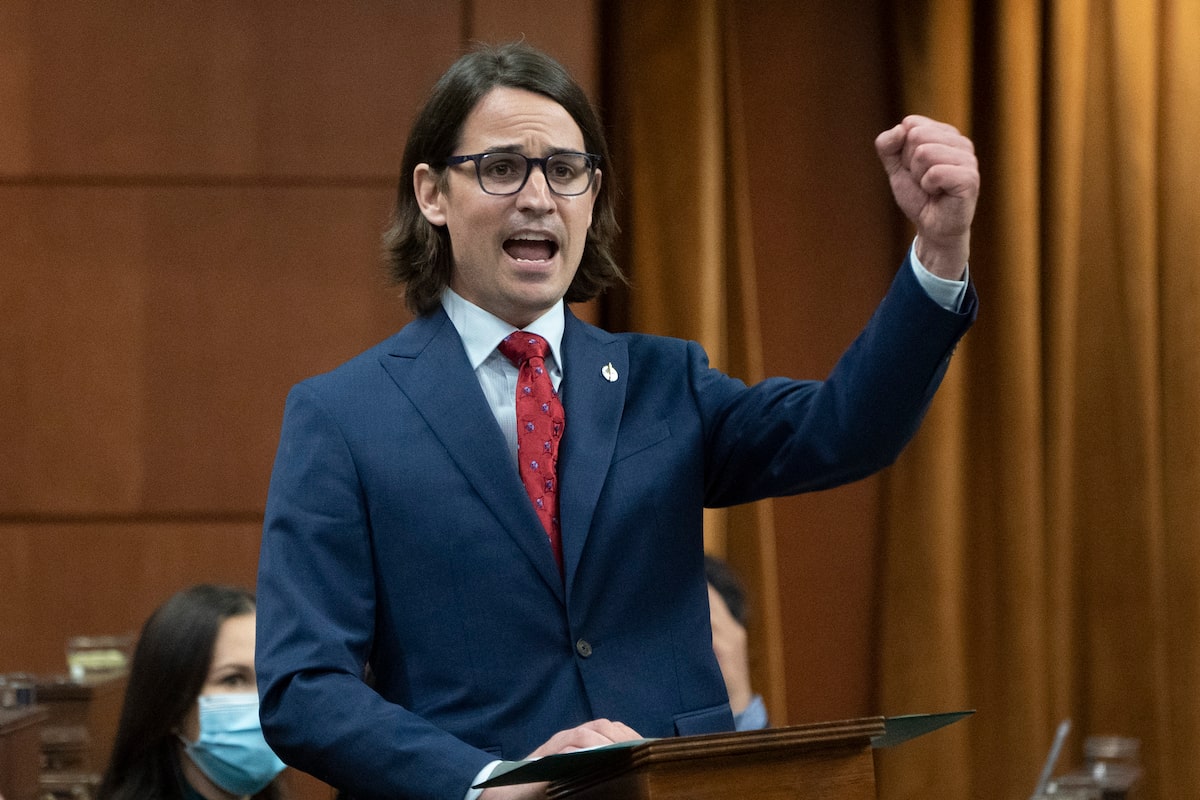
Bloc finance critic Jean-Denis Garon, pictured in 2022, outlined a list of the party’s budget demands, including $11.6-billion increase in federal health transfers to the provinces over five years.Adrian Wyld/The Canadian Press
The Bloc Québécois has announced 18 demands ahead of the release of the minority Liberal government’s federal budget, listing six as non-negotiable.
Jean-Denis Garon, the party’s finance critic, released the list Tuesday during a news conference on Parliament Hill.
The six requests the Bloc says must be met include an $11.6-billion increase in federal health transfers to the provinces over five years; extending the 2022 decision to boost Old Age Security benefits by 10 per cent to people 75 and older to those aged 65 to 74; providing Quebec with $814-million tied to Ottawa’s decision to end the federal fuel charge; launching new interest-free loans of as much as $20,000 for first-time homebuyers; increasing social housing transfers by $1.4-billion a year; and creating a new provincial transfer program for infrastructure.
Mr. Garon told reporters the Bloc’s support for the budget will be “difficult to obtain” based on where things stand at the moment.
Budget will include automatic tax filing for low-income Canadians, Carney says
The Bloc MP was asked if the government could fall over the budget, leading to another election campaign.
“Our job is to represent the consensus in Quebec,” he said. “It’s up to the minority government to reach out. At this moment, I would say there’s a lot of work to do.”
He said the cost of the Bloc’s spending requests is mostly offset by other proposals, such as eliminating support for fossil fuels and cracking down on tax havens.
In the April election, the Liberals fell three seats short of the 172 needed to form a majority government. The Conservative Party finished second with 144 seats, followed by 22 for the Bloc, seven for the NDP and one for the Green Party.
Prime Minister Mark Carney, pictured during Question Period last week, campaigned on a pledge to spend less on internal operations.Adrian Wyld/The Canadian Press
As a result, the Liberals need to convince at least one of the three largest opposition parties in the House to either vote with them or have a handful of MPs abstain in order to avoid defeat on votes that are deemed confidence matters, such as the budget.
Prime Minister Mark Carney told reporters last month that his first budget will include both investment and austerity. The Liberals campaigned on a pledge to spend less on internal operations in order to “invest more” in areas such as infrastructure projects.
While a second election in less than a year is considered highly unlikely, it is not impossible.
Progressive Conservative Prime Minister Joe Clark’s minority government was sworn in in June, 1979, and fell six months later over an austerity budget.
Editorial: The Liberals’ fiscal fog clouds the danger of rising debt
NDP Interim Leader Don Davies told reporters last week that his party will not support a budget “that takes an austerity approach.”
Mr. Davies had recently met with Mr. Carney and laid out the NDP’s priorities. He said his party wants to see “substantial investment” in jobs, housing and health care.
The NDP is in the midst of a leadership race. The next permanent leader will be announced at a convention on March 29, 2026.
Mr. Davies said he gave Mr. Carney the NDP’s “broad perspective” but stressed that his party is not making specific budget demands.
“We didn’t make any specific requests. We don’t have a shopping list. We’re not bargaining, either in public or privately. What we are doing as New Democrats is laying out our vision of what’s required for our country going forward, very transparently,” he said.
Conservative Leader Pierre Poilievre has not released a formal list of budget demands but has commented generally on what his party would like to see.
During a news conference on Parliament Hill Thursday, he said his party wants the government to bring down the size of the deficit, lower taxes and get the government “out of the way” to allow for the construction of new major projects.
“I will be sitting down with Mr. Carney with a clear plan for him to reverse course on his costly budget plans and instead go with an approach that brings stronger take-home pay, secure streets, solid borders in a self-reliant Canada,” he said. “And I hope that he will take my ideas, because Canadians are ready for them.”