
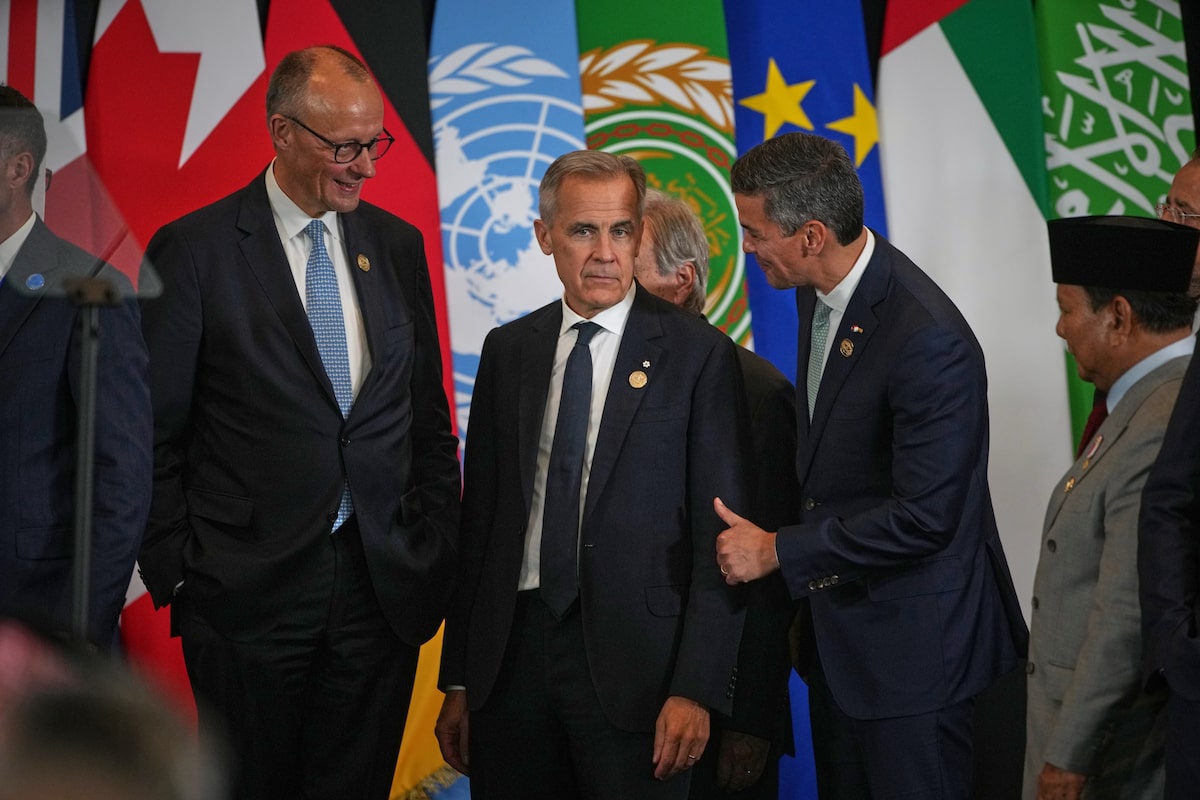
Spanish Prime Minster Pedro Sanchez, right, talks with Prime Minister Mark Carney, centre, and German Chancellor Friedrich Merz, left, during a summit to support ending the Israel-Hamas war in Gaza after a breakthrough ceasefire deal, on Monday.Amr Nabil/The Associated Press
U.S. President Donald Trump’s late arrival at a hastily called peace summit of world leaders at an Egyptian resort Monday led to spontaneous but substantive discussions among participants, including Prime Minister Mark Carney, about a path forward in Gaza.
The signing of an agreement at Sharm-el-Sheikh to support efforts to end the Israel-Hamas war was attended by more than 20 world leaders, but not Israeli Prime Minister Benjamin Netanyahu or Hamas’s political leadership.
The summit was supposed to be a photo op to mark the President’s success in brokering a ceasefire in Gaza, but it turned into a collective effort to deliver long-term regional peace.
Because Mr. Trump’s arrival was delayed by events in Jerusalem, the leaders were locked in a large conference room for hours, leading to unscripted dialogue about postwar Gaza without talking points provided by political aides, according to a senior Canadian official.
The official said Mr. Carney had back-and-forth conversations with a group of leaders on the next steps for the Palestinian people in Gaza and the West Bank.
Analysis: At leaders’ summit in Egypt, Trump unveils fuzzy commitment to ‘peace in the Middle East’
Some of those ad hoc conversations involved the leaders of France, Britain, Italy, Germany, Egypt, Qatar, Jordan and Turkey, as well as Saudi Arabian Foreign Minister Faisal bin Farhan Al Saud.
The talks were substantive and genuine, whereas ordinarily leaders read prepared statements, according to the official.
The Globe and Mail is not identifying the official so they could speak candidly about the one-day peace summit.
The official said the leaders discussed a stabilization force for Gaza that those in the room considered likely to be led by Indonesia. Canada would play a role in training a future Palestinian security force, the official said. Canada is not expected to send troops but would help provide intelligence.
At the United Nations in New York in September, Indonesian President Prabowo Subianto offered to send 20,000 troops as peacekeepers to Gaza. But no official announcement on the force’s composition has been made, and any decision would likely depend on Israel and Hamas.
Opinion: Donald Trump was the essential element for the Gaza ceasefire
Canada has already pledged more than $400-million of humanitarian assistance and is looking at how the country can increase that funding, the official said, adding Canadian officials are also in deep conversations with the Palestinians, Jordanians and Egyptians on getting more aid quickly into Gaza.
Ottawa is also working with regional leaders on how to help co-ordinate the international response on recovery and reconstruction – money that is expected to come mostly from the oil-rich Gulf states.
What most Canadians don’t understand, the official said, is how deep the web of connections runs among leaders in the Middle East – with each other and the West. The leaders of Jordan, Qatar and Saudi Arabia talk regularly with the Israelis, as they do with Europeans, Canadians and Americans. It is a collective effort to try to shape events and bring stability to the volatile region.
The official said Canada is trying to play a bigger role in the Middle East, part of Mr. Carney’s grander strategy to diversify trade away from the United States. Many Mideast countries are also trying to diversify their economies, which can have advantages for Canada, the official said.
Mr. Carney used the summit to discuss investment with the Emir of Qatar and the Saudi Foreign Minister. The official said the Prime Minister is well known in the region and has personal relations with many of these leaders from his central-banking career.
Carney joins leaders in Egypt for Gaza peace deal signing, praises hostage release
The summit invitation from Mr. Trump was not a surprise to the Canadians because Mr. Carney and Foreign Affairs Minister Anita Anand have sought to act as a go-between Arab states and Washington.
But the Prime Minister’s Office first heard about the invitation from social media. When the White House called, the Prime Minister picked up the phone to discuss the summit details with Mr. Trump.
In their many conversations, the two leaders do not just focus on tariffs but have wide-ranging discussion on the Gaza war and Ukraine, the official said.
With no Royal Canadian Air Force crews available to fly a Canadian Armed Forces jet, the PMO had to scramble to charter a private jet to take Mr. Carney, his chief of staff Marc-André Blanchard and a small retinue of aides to Egypt.
“With the summit being planned by the United States on an urgent timeline and invitations from the President being made so close to departure, overlapping existing operational needs resulted in the option of a Canadian Armed Forces airbus flight and related crews being unavailable for this transport,” the PMO said in a statement.
U.S. President Donald Trump in a speech to world leaders on Monday after the signing of the Gaza ceasefire deal said, ‘now the rebuilding begins.’
Reuters