
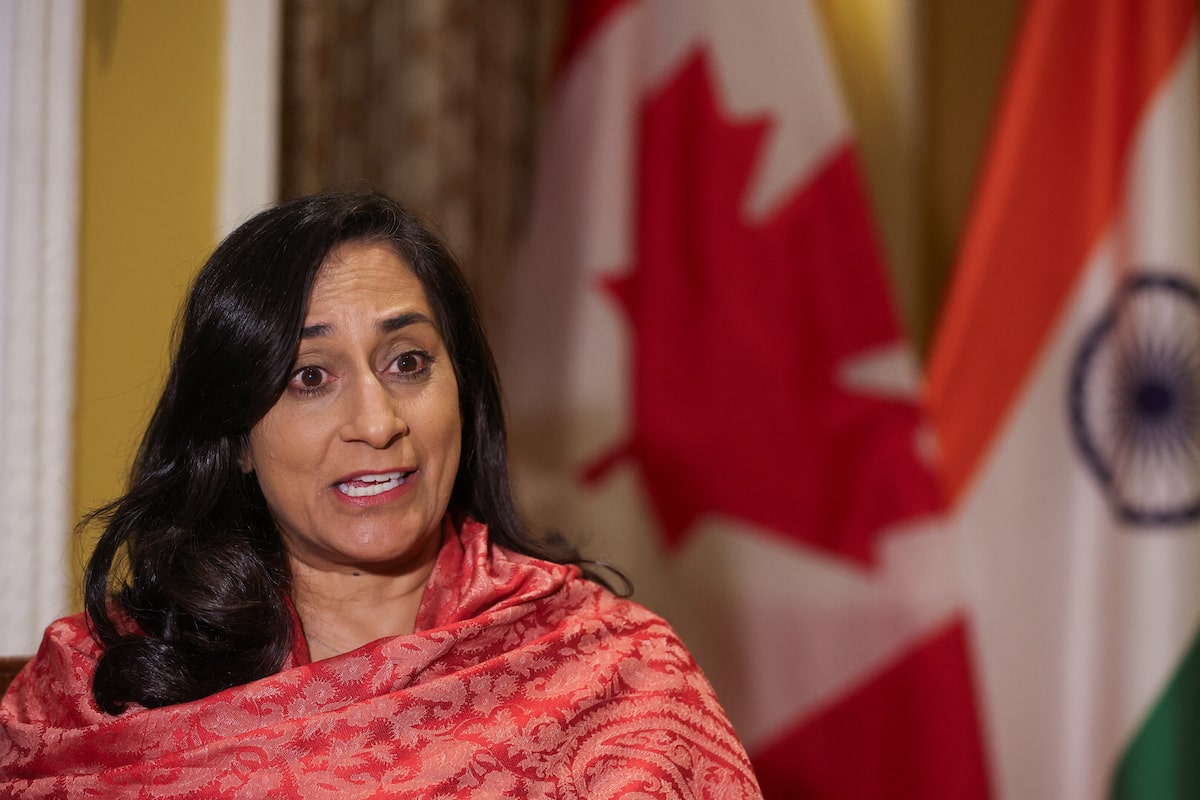
Foreign Affairs Minister Anita Anand wrapped up a trip to India on Tuesday.Francis Mascarenhas/Reuters
Foreign Affairs Minister Anita Anand says Canada is taking a step-by-step approach to normalizing relations with India, focusing first on ending New Delhi’s interference in Canadian affairs and then on a longer-term goal of freer trade.
Ms. Anand wrapped up a trip to India Tuesday, where she met with Prime Minister Narendra Modi, Indian foreign minister Subrahmanyam Jaishankar, and the country’s business leaders.
At a news conference in Mumbai, Ms. Anand said she was forceful in her meeting with Mr. Modi and top Indian politicians, stressing the importance of respecting Canada’s sovereignty and not engaging in violent and illegal acts.
“The relationship between our countries is one we are taking step by step. That approach begins with a focus on security and domestic public security in Canada,” she told Canadian reporters in a conference call. “This has been top of mind for me in every conversation, and I never hesitate to raise the importance of it.”
Canada and India set out ‘new roadmap’ for relations after Anand meets Modi
The new government of Prime Minister Mark Carney and India have been working to repair relations after a significant diplomatic rupture in 2023, when then-Prime Minister Justin Trudeau publicly accused the Indian government of playing a role in the killing of Sikh activist Hardeep Singh Nijjar in Surrey, B.C., earlier that year.
Relations were further fractured in October, 2024, when the RCMP announced they had clear evidence that Indian government agents had been linked to homicides, extortion and other violent activities in Canada. Ottawa followed up by expelling India’s high commissioner and five other diplomats.
In September, Ottawa listed India’s Bishnoi gang as a terrorist entity. Canadian police have linked the notorious gang to elements of India’s intelligence services. India has always denied any links to the group, which is known for acts of extortion, drug trafficking and murder.
“In particular I have stressed that there is an independent RCMP investigation continuing,” Ms. Anand told reporters. “We have already ensured that the Bishnoi gang is on the list of terrorist entities.”
Canadian Prime Minister Mark Carney and India’s Prime Minister Narendra Modi during the G7 Leaders’ Summit in Kananaskis, Alta., in June.Amber Bracken/Reuters
In her meeting with Mr. Modi, Ms. Anand said she was blunt about India’s targeting of the Sikh community in Canada. “I raised at all points issues relating to transnational repression, issues relating to the safety and security of every Canadian.”
She pointed out that she signed a joint declaration with India that covers issues of law enforcement and respect for the rule of law but also serves as a framework to develop stronger trade and economic ties.
India is interested in working with Canada on artificial intelligence and agri-food. It also wants Canada’s critical minerals, liquefied natural gas and nuclear energy.
Goldy Hyder, the president of the Business Council of Canada, was upbeat about the visit and the decision of both countries to revive a CEO forum. He plans to lead a business delegation to India early in the new year and is hoping Mr. Carney will participate.
India silent on how Canada’s terrorist listing of Bishnoi gang will affect warming ties
“There are still issues to work through, and they have been honest about those,” he said. “’We have had tremendous interest on the part of Canadian companies that are looking to invest in India, and frankly we would like Indian companies to invest in Canada.”
However, Ms. Anand said it was far too early to talk about negotiating a free trade pact with India, now the world’s most populous country and fastest-growing economy.
“We will see increased interaction between Canada and India in order to jointly achieve the objective of greater trade resilience,” she said. “That does not include the work of a free trade agreement at this time.”
Freer trade negotiations are predicated first on India respecting Canada’s sovereignty and allowing Ottawa to fully staff its diplomatic missions, she said.
In June, after Mr. Carney invited Mr. Modi to the G7 Summit in Alberta, the two countries agreed to reinstate their high commissioners. But Canada’s embassy and consular offices are still not fully staffed.
Canada, India appoint new envoys in sign of improving relations
Dan Stanton, a former senior manager at the Canadian Security Intelligence Service, said the Carney government should be cautious in its dealings with India. He noted that CSIS released a report last summer that concluded India remains a significant national security threat.
“The ongoing investigation and evidence collection related to the murder of Mr. Nijjar could surface some distasteful revelations such as other homicides linked to India,” he said.
Danish Singh, the president of the the World Sikh Organization of Canada, expressed concern that the Canada‑India joint statement signed by Ms. Anand and her Indian counterpart did not offer forthright assurances that New Delhi would stop its transnational repression in Canada.
The statement outlines a “New Roadmap” based on “mutual respect for shared democratic values, the rule of law, and a commitment to upholding the principles of sovereignty and territorial integrity.”
“Canadian Sikhs continue to face ongoing threats and criminal activity being directed by India. Our government cannot pretend that everything is back to normal while transnational repression is ongoing,” Mr. Singh said.
He said Ottawa must ensure that any Indian diplomats accredited in Canada are not intelligence or security operatives and will not engage in the surveillance or intimidation of Canadians.