
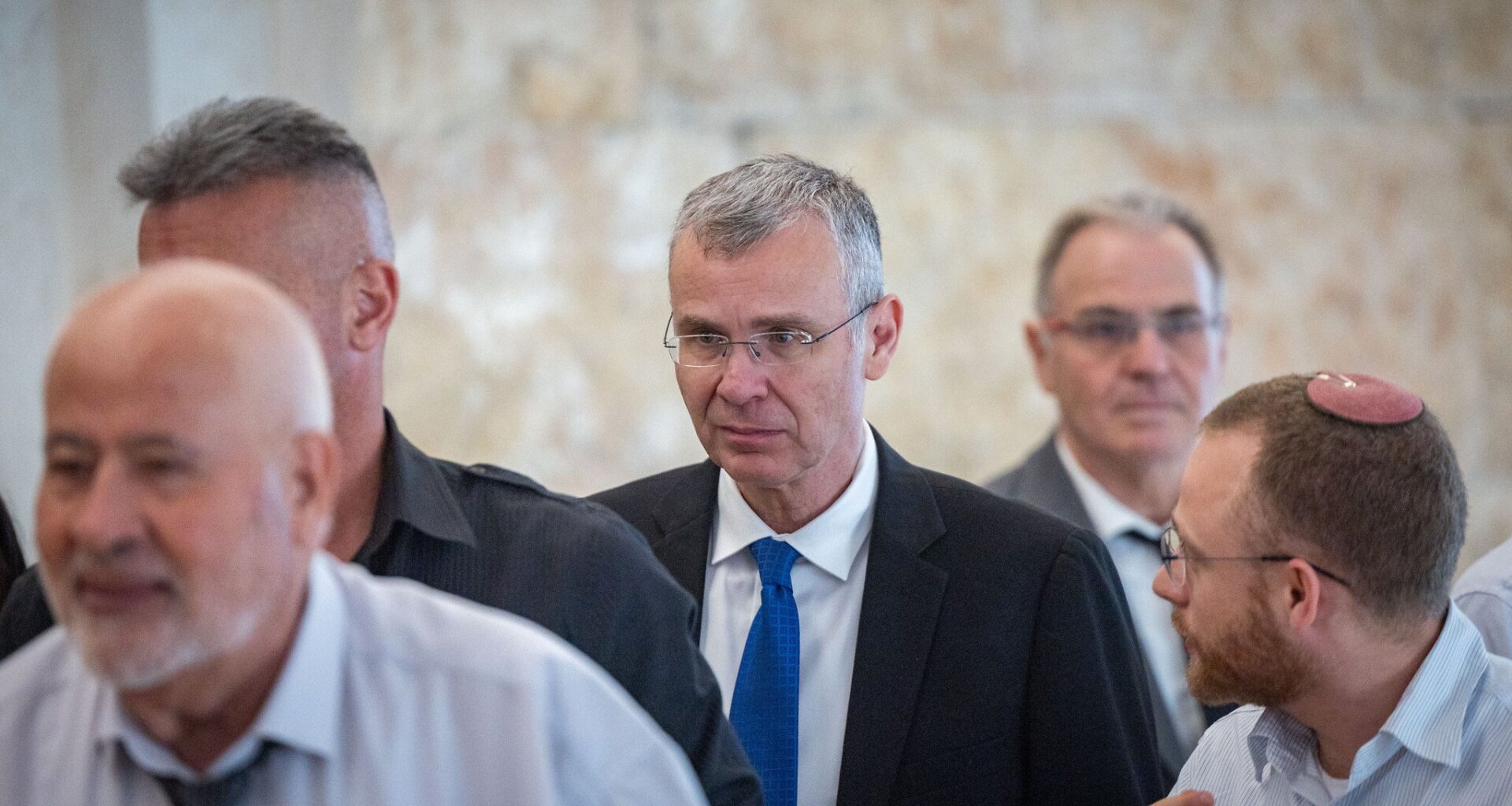
Justice Minister Yariv Levin announced on Wednesday morning that he would support a contentious bill that would enable the defense minister to reduce or limit the number of hearings for Prime Minister Benjamin Netanyahu’s ongoing criminal trial.
Levin maintained that the bill would enable Netanyahu to focus his time on matters of state instead, and said the premier should never have been put on trial in the first place.
But opposition leaders denounced the move as an effort by the coalition to end Netanyahu’s trial and revive the government’s judicial overhaul agenda to weaken legal restraints on executive power.
Levin made his comments after Netanyahu’s trial on corruption charges resumed in the morning in the Tel Aviv District Court, where several Likud ministers and MKs arrived in a coordinated show of support for the prime minister.
Netanyahu’s testimony had been scheduled to last until 4:30 p.m. but he complained of suffering from a cough and cold and the judges agreed to end the hearing several hours early.
Get The Times of Israel’s Daily Edition
by email and never miss our top stories
By signing up, you agree to the terms
The bill Levin said he would back was drafted by hardline Likud MK Ariel Kallner, although it has yet to be submitted to the Knesset.

Prime Minister Benjamin Netanyahu arrives at the Tel Aviv District Court for his corruption trial, October 15, 2025. (Reuven Kastro/POOL)
The legislation would enable the defense minister to reduce or limit the number of hearings in a criminal trial during a time of war or emergency, should such a step be deemed necessary for security purposes and after consultation with the justice minister.
“This morning, instead of continuing the difficult struggle to [secure the] return of all the slain hostages, to disarm Hamas, and to expand the circle of peace, Prime Minister Benjamin Netanyahu was forced to appear in court and answer bizarre questions about dolls and cigars,” said Levin, referencing some of the allegations against Netanyahu, who faces charges of taking a bribe, along with fraud and breach of trust.
Levin said he will bring Kallner’s bill for approval in the key Ministerial Committee for Legislation, which decides whether the government will back legislation, as soon as it is submitted to the Knesset.
But opposition politicians denounced Levin for supporting the bill and vowed to oppose it.
“Whoever thinks they will take us from the war in Gaza to a civil war has not learned the lesson, and disgraces the sacrifice of the best of our sons and of all the people of Israel over the two hard years,” said head of the National Unity party Benny Gantz.
And Democrats leader Yair Golan said that Levin’s comments meant the country had “returned to October 6,” a time of deep political and social divisions in the country before the government stalled parts of its judicial overhaul agenda in light of the war against Hamas.
“The struggle will end only once we have established a new government and a commission of inquiry [into the October 7 Hamas invasion and massacres],” said Golan.
Earlier on Wednesday, Likud cabinet ministers and MKs made their way to the Tel Aviv District Court to publicly show their support of Netanyahu upon the resumption of his trial, now in its sixth year.
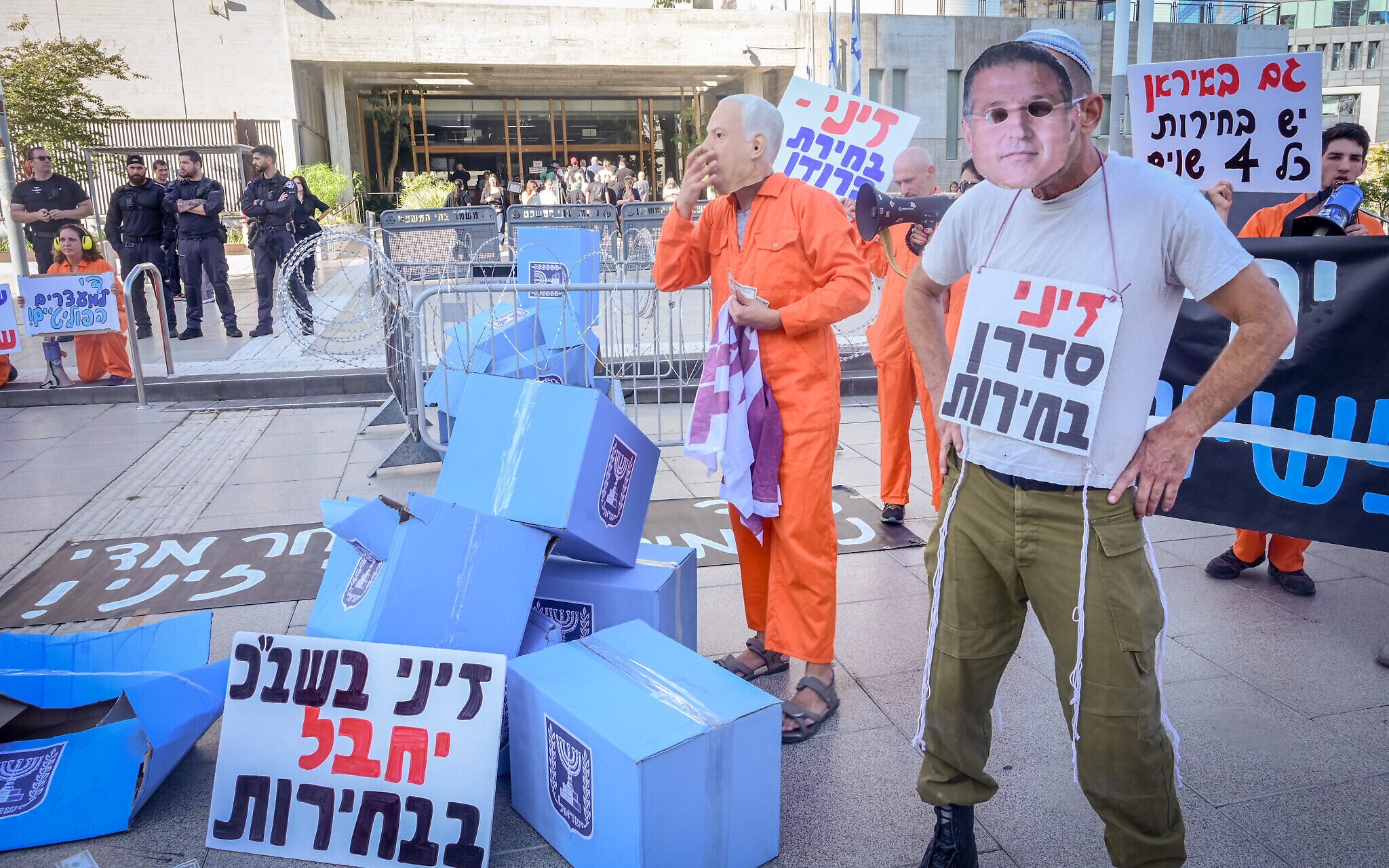
Activists display signs charging the new Shin Bet chief David Zini will “sabotage” democratic elections, in a protest against Prime Minister Benjamin Netanyahu outside the Tel Aviv District Court, where the premier is supposed to testify in his corruption trial, October 15, 2025. (Avshalom Sassoni/Flash90)
Their arrival in court came in response to a call put out within the Likud party on Tuesday night for their presence at the trial, Hebrew media reported.
It also came two days after US President Donald Trump asked President Isaac Herzog to pardon Netanyahu during a speech to the Knesset.
Economy Minister Nir Barkat, Environmental Protection Minister Idit Silman, Communications Minister Shlomo Karhi, and MKs Osnat Mark, Nissim Vaturi and Kallner turned up at the court in Tel Aviv, after having run the gauntlet of a gaggle of veteran protesters against Netanyahu who demonstrate outside the courthouse every day that hearings are held.
During the course of the hearing, Netanyahu was seen coughing. He said his cold had “refused to get better” and that his doctor had recommended he take several days’ rest or at least shorten his workday.
The hearing had been scheduled to end at 4:30 p.m. but Netanyahu requested at around midday, and the judges agreed, that he testify for just another hour or two.
Is The Times of Israel important to you?
If so, we have a request.
Every day, even during war, our journalists keep you abreast of the most important developments that merit your attention. Millions of people rely on ToI for fast, fair and free coverage of Israel and the Jewish world.
We care about Israel – and we know you do too. So today, we have an ask: show your appreciation for our work by joining The Times of Israel Community, an exclusive group for readers like you who appreciate and financially support our work.
Already a member? Sign in to stop seeing this
You appreciate our journalism

You clearly find our careful reporting valuable, in a time when facts are often distorted and news coverage often lacks context.
Your support is essential to continue our work. We want to continue delivering the professional journalism you value, even as the demands on our newsroom have grown dramatically since October 7.
So today, please consider joining our reader support group, The Times of Israel Community. For as little as $6 a month you’ll become our partners while enjoying The Times of Israel AD-FREE, as well as accessing exclusive content available only to Times of Israel Community members.
Thank you,
David Horovitz, Founding Editor of The Times of Israel