
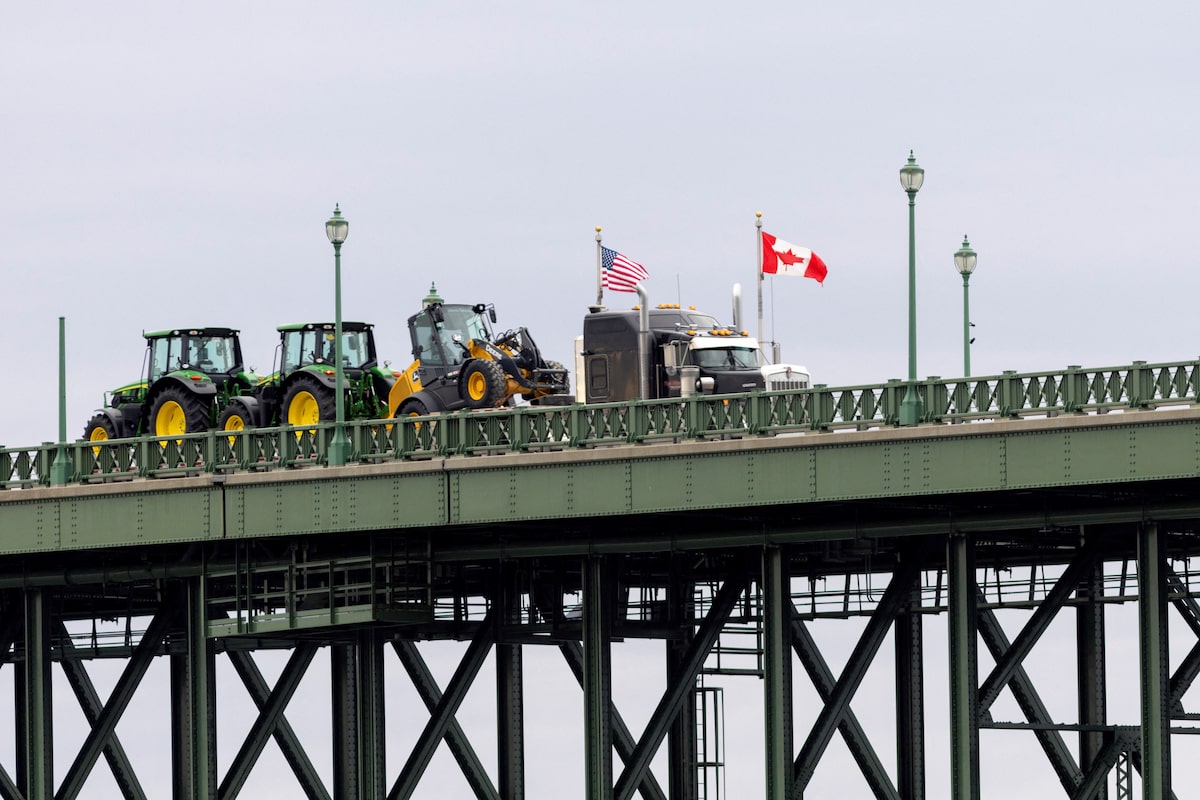
Prime Minister Mark Carney is holding a morning virtual cabinet meeting where trade talks are expected to be high on the agenda.Carlos Osorio/Reuters
High-level trade talks between Canadian and U.S. officials have resumed in Washington as a united front among the provinces has begun to unravel in the face of punishing tariffs on autos, steel, aluminum and lumber.
Privy Council Clerk Michael Sabia, the country’s top public servant, has joined Canadian Ambassador Kirsten Hillman, the chief trade negotiator, in Washington to continue talks with U.S. Commerce Secretary Howard Lutnick and Trade Representative Jamieson Greer, according to the Prime Minister’s Office.
Dominic LeBlanc, the minister responsible for Canada-U.S. trade, is also in Washington as part of the negotiating team, his communications director Jean-Sébastien Comeau said.
Prime Minister Mark Carney is holding a morning virtual cabinet meeting where the trade talks are expected to be high on the agenda.
Canadian softwood producers brace for impact from new U.S. tariffs
Ottawa has been focused on lifting U.S. sectoral tariffs, which President Donald Trump has justified under a national-security provision known as Section 232 in American trade law.
When the U.S. talks broke for the weekend, Mr. Carney said they were at an intense stage, as his negotiating team sought tariff relief on key Canadian sectors.
The latest hit to the Canadian economy came late Tuesday when Stellantis announced it was shifting a production line at its Brampton plant to one in the United States. On same day, U.S. tariffs of 10 per cent on softwood lumber came into effect, bringing the total tariff on such products to 45 per cent.
The Trump administration has imposed tariffs of 50 per cent on steel and aluminum, and 25 per cent on Canadian autos, with a carve-out for the value of the vehicle made from U.S. parts.
Stellantis shifts Jeep production to Illinois from Brampton
The Canadian premiers, who previously stood united with Ottawa, have begun to criticize the Prime Minister’s trade strategy. Ontario Premier Doug Ford has called for countertariffs, while B.C. Premier David Eby has been critical of Ottawa over U.S. softwood tariffs that are forcing lumber mill shutdowns.
Meanwhile, Saskatchewan Premier Scott Moe and Manitoba Premier Wab Kinew are calling on Ottawa to lift its 100-per-cent tariff on Chinese electric vehicles so that Beijing will once again open its doors to Canadian canola.
Brian Clow, who managed U.S. trade as deputy chief of staff to former prime minister Justin Trudeau, said the premiers are not as united as they were during the 2018 NAFTA negotiations. He said this is partly because Mr. Trump is doing more tariff damage than in his first term.
“So the premiers are feeling more pressure to save entire industries that risk dying completely without a resolution,” Mr. Clow said. “It’s not helpful to the federal negotiators when premiers are openly lobbying Ottawa to support their sectors at the expense of another province.”
Mr. Clow said China is seeking to exploit those divisions by pitting Western canola against Ontario cars.
After news broke about Stellantis moving production of the Jeep Compass to Illinois as part of a US$13-billion plan to boost U.S. production, the Prime Minister promised to help the displaced workers.
“We are working with the company to develop the right measures to protect Stellantis employees and to create new opportunities for them in and around Brampton,” he said in a Tuesday statement.
However, he warned that Stellantis’s move is a “direct consequence of current U.S. tariffs and potential future U.S. trade actions.”
Opinion: Canada’s auto industry has faced struggles before. We endured then and can endure now
“Until a more certain trade environment for the North American auto sector is established through the upcoming review of the Canada-United States-Mexico Agreement (CUSMA), decisions on new investments in the auto sector will continue to be affected,” he said.
The Prime Minister promised that the coming Nov. 4 federal budget will contain strategic investments that will transform “our economy from being overly reliant on our largest trade partner to being resilient to global shocks.”
Conservative Leader Pierre Poilievre was quick to criticize Mr. Carney for failing to reach a deal with the Americans, and leaving 3,000 Stellantis auto workers in the lurch.
“Mark Carney’s response is for auto workers to wait until he can renegotiate CUSMA. After failing to get the deal he promised three months ago, auto workers can no longer afford to wait,” he said in a Wednesday statement.
“Thousands now have to worry about paying their mortgages, putting food on the table or having to tell their kids they can’t afford to register for hockey this winter.”
Mr. Poilievre noted that 700 General Motors auto workers in Oshawa will soon lose their jobs as well, and GM has announced a US$4-billion investment in American auto plants.
Mr. Carney, who ran on a promise to defend the Canadian economy against U.S. protectionism, has been under pressure to secure relief from punitive U.S. tariffs.
Trade talks between the two countries faltered after no deal was reached by an August deadline imposed by Mr. Trump. But the relationship appeared to strengthen in the weeks leading up to Tuesday’s visit, which was Mr. Carney’s second as Prime Minister after a previous trip in May.