
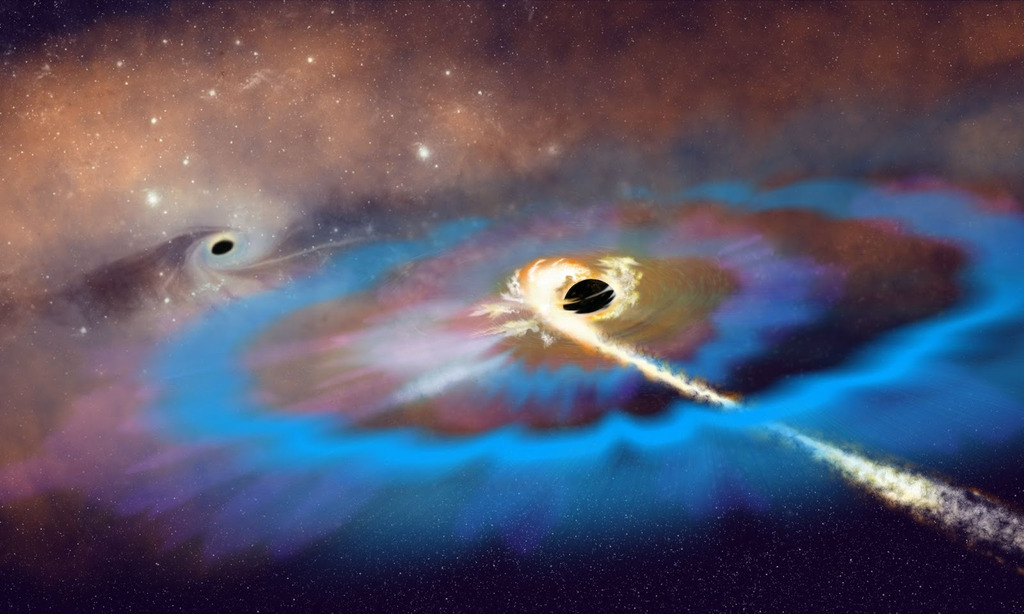
Radio observations with the Allen Telescope Array (ATA) have, as part of an international observing campaign, helped discover an unprecedented burst of radio activity from a tidal disruption event (TDE). TDEs happen when an unfortunate star wanders too close to a supermassive black hole (SMBH) and is ripped apart by its strong gravitational forces. These events light up the cosmos across all wavelengths, from visible and X-ray light to radio waves.
This particular TDE, named AT 2024tvd, stands out from others. It evolved at record-breaking speed, but also took place off-center, away from the nucleus of its galaxy.
“Tidal disruption events are usually found at the hearts of galaxies whereas AT 2024tvd was caused by an off-center black hole, the first time this has been unambiguously seen,” said Dr. Joe Bright, Radio Astronomy Researcher, University of Oxford. “It’s possible that the unprecedented rapid radio evolution is the result of its unusual position in the galaxy.”
The discovery, led by principal investigators Dr. Itai Sfaradi and Dr. Raffaella Margutti of the University of California, Berkeley, and including astronomers from the SETI Institute, represents a breakthrough in understanding how massive black holes can hide in unexpected places throughout the universe.
Most galaxies, including our Milky Way, are thought to have a SMBH at their center. These cosmic monsters pull in surrounding material and launch giant jets of material that shape how galaxies evolve. Not all SMBHs are easy to find; they can remain quiet and only become detectable when something dramatic occurs nearby. TDEs offer a way to probe the properties of SMBHs and the regions surrounding them, as well as to discover black holes in unusual locations.
Radio observations of AT 2024tvd reveal that its host galaxy hosts two SMBH: one at its expected location at its center, and a hidden SMBH offset by 2,600 light-years, which is likely the remnant of an ancient merger of two galaxies. When this off-center black hole shredded an unlucky star, it produced two rapid and powerful bursts of radio emission, offering scientists an unprecedented look at how black holes behave outside galactic centers.
“What makes this discovery even more remarkable is that it reveals a massive black hole that would otherwise be invisible to us,” said Dr. Raffaella Margutti, “The only reason we can detect this wandering black hole is because it happened to tear apart a star and produce these incredibly bright radio signals.”
“The ATA played an important role in this discovery, providing precise and time-sensitive radio measurements that helped astronomers to track the event’s radio brightness as it rose and faded over time,” said Dr. Sofia Sheikh, Technosignature Research Scientist at the SETI Institute. “The ATA’s ability to monitor changing signals from space — quickly, flexibly, and over a broad range of frequencies — made it uniquely suited to capturing the fast-evolving nature of AT 2024tvd.”
In addition to providing insight into black hole populations, radio observations of AT 2024tvd provide compelling clues into the fate of the disrupted star. Detailed modeling of the radio evolution, including observations from the ATA, reveals that this cataclysmic event launched two outflows, the first of which likely contained remnants of the shredded star.
By contributing to this research, the ATA has demonstrated its growing importance in time-domain astronomy, the study of rapidly changing cosmic phenomena, including TDEs, fast radio bursts, and supernovae.