
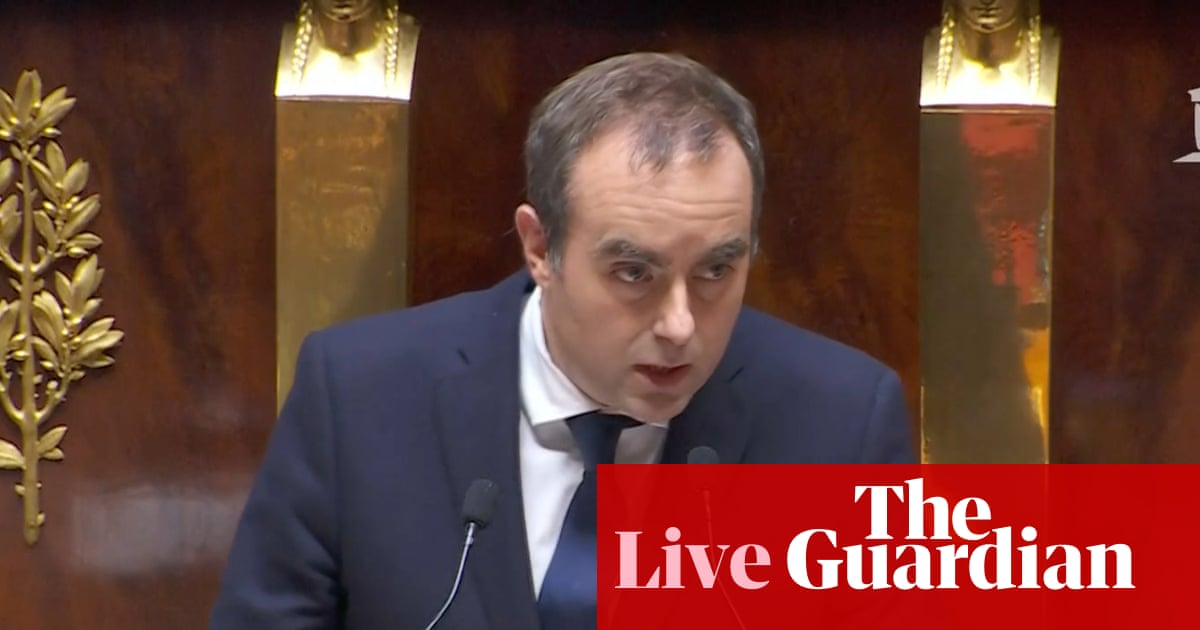
Lecornu backs suspending pension reform until 2027 French presidential vote
French prime minister Sébastien Lecornu will propose the suspension of a contested plan raising the retirement age from 62 to 64, in a move to avoid his fragile minority government being immediately toppled, reports the Associated Press (AP).
Lecornu said on Tuesday in a policy speech at the national assembly that the law, a flagship policy of French president Emmanuel Macron, would be put on pause until after the next presidential election, to be held in 2027.
“I will propose to parliament this autumn that we suspend the 2023 pension reform until the presidential election. There will be no increase in the retirement age from now until January 2028,” he promised lawmakers during his policy speech, responding to a key request from the Socialists, a swing group in parliament crucial to his cabinet’s survival.
Updated at 09.41 EDT
Key events
Show key events only
Please turn on JavaScript to use this feature
Closing summary
French prime minister Sébastien Lecornu told parliament on Tuesday he would back suspending an unpopular reform that raised the age of retirement from 62 to 64 until presidential polls in 2027.
Lecornu said on Tuesday in a policy speech at the national assembly that the law, a flagship policy of French president Emmanuel Macron, would be put on pause until after the next presidential election.
“I will propose to parliament this autumn that we suspend the 2023 pension reform until the presidential election. There will be no increase in the retirement age from now until January 2028,” he promised lawmakers during his policy speech, responding to a key request from the Socialists, a swing group in parliament crucial to his cabinet’s survival.
Lecornu also asked lawmakers on Tuesday not to use the vote on the budget as a pretext to vote his government out. “There is no longer any pretext for a no-confidence motion,” he said. Earlier in the day, Lecornu had met his new cabinet to discuss France’s draft 2026 budget that lawmakers will examine over the next 70 days.
France’s prime minister Sébastien Lecornu looks on after addressing general political remarks to members of parliament, at the French national assembly, in Paris on Tuesday. Photograph: Thomas Samson/AFP/Getty Images
Lecornu’s new government approved a draft budget in a meeting with Macron, who warned that any vote to topple Lecornu’s cabinet would force him to dissolve parliament and call fresh elections.
Far-right leader Marine Le Pen’s National Rally and the far-left France Unbowed have already submitted no-confidence motions which will be debated on Thursday.
The Socialists said they will not back those motions, giving them little chance of succeeding, but had said they would file their own if Lecornu did not immediately suspend the reform that raised the retirement age.
The French economist Philippe Aghion, named one of the three winners of the 2025 Nobel Prize in Economics on Monday, said he hoped a path out of France’s budget mess could be found. “I hope there will be a compromise because the tragedy for France is to experience political instability,” he told reporters in Paris, adding:
If there is another censure, it would be dramatic for France. Our interest rates would continue to rise, our spread would continue to rise, it would be dramatic. We must absolutely avoid censure and still arrive at a budget.
His comments came as the independent fiscal watchdog warned on Tuesday that the French government’s 2026 budget plans were based on rosy economic assumptions and its belt-tightening measures may fall short or never even take shape.
Lecornu told his new cabinet on Tuesday that the political crisis the country is going through is not yet a regime crisis, government spokesperson Maud Bregeon said on Tuesday.
She said that Lecornu had also said that “we are capable of taking action, but the government will not do just anything”.
Read John Henley’s story here:
Here are some other developments in Europe that were covered in today’s blog:
The French government will discuss an institutional reform for the overseas territory of New Caledonia by year end, Lecornu told lawmakers on Tuesday. Lecornu said: “The government will propose discussion of this text before the end of the year so that New Caledonians can be consulted in spring 2026.”
Ukrainian president Volodymyr Zelenskyy urged leaders and the international community on Tuesday to “not lose the momentum for advancing peace” after the progress made in the Middle East with the Gaza ceasefire deal. “The war in Europe can also be brought to an end,” he said, adding that the leadership of the US and Ukraine’s partners was of the “utmost importance”.
Zelenskyy announced on Tuesday that he will travel to the US this week for talks on the potential US provision of long-range weapons, after Donald Trump said he might supply Ukraine with Tomahawk missiles. Zelenskyy said he would visit Washington and meet Trump on Friday, adding that he would also meet defence and energy companies and members of Congress.
The Kremlin said on Tuesday it welcomed Trump’s desire to focus on the search for a peace deal to end the fighting in Ukraine after achieving a ceasefire in Gaza and hoped he would be able to push Kyiv towards a settlement.
Russian forces struck a UN aid convoy in the partially occupied southern Kherson region of Ukraine on Tuesday, Kyiv and the UN said, adding there were no casualties in the attack. The United Nations said its convoy of four vehicles was clearly marked and came under attack from Russian drones and artillery while delivering aid to the frontline town of Bilozerka. There was no immediate reaction from Moscow.
Thousands of workers marched through Brussels, after unions called a national strike that grounded planes and stopped much public transport in the Belgian capital. Belgium has experienced several national and sectoral strikes since a new right-leaning government took office in February pledging to cut spending, in order to curb the country’s spiralling debt.
Russia’s Federal Security Service (FSB) said on Tuesday it had opened a criminal case against exiled Kremlin critic Mikhail Khodorkovsky, accusing him of creating a “terrorist organisation” and of plotting to violently seize power. The FSB said it was investigating more than 20 other people as part of the same case, including prominent dissident Vladimir Kara-Murza, former world chess champion Garry Kasparov, ex-prime minister Mikhail Kasyanov and leading economists Sergei Aleksashenko and Sergei Guriev.
Zelenskyy revoked the citizenship of Odesa mayor Hennadiy Trukhanov on Tuesday, a source familiar with the matter told Reuters on condition of anonymity, adding that Trukhanov has Russian citizenship. Trukhanov, who has been the mayor of Ukraine’s biggest port city since 2014, has previously denied holding Russian citizenship.
The European Union is seeking to coordinate with the United States and other G7 partners a response to tighter Chinese controls on the export of rare-earth minerals, trade ministers and officials from the bloc said on Tuesday.
The Council of Europe said it was alarmed on Tuesday over the “large numbers” of people being arrested in the United Kingdom for their support of banned pro-Palestinian organisation Palestine Action. In a letter to UK interior minister Shabana Mahmood, its human rights commissioner Michael O’Flaherty said London needed to conduct a “comprehensive review” of its policing of such protests.
Moldova’s pro-European ruling party will nominate financier Alexandru Munteanu to be the country’s new prime minister, the head of the party, Igor Grosu, said on social media on Tuesday. Munteanu, an economist who also founded an investment firm, has not previously held political office.
An explosion at a farmhouse near Verona killed three police officers and injured at least 13 others, officials said on Tuesday. Police were attempting to conduct an eviction when the house blew up overnight in Castel d’Azzano, in northern Italy, in what is suspected to be an intentional act of violence.
The French government will discuss an institutional reform for the overseas territory of New Caledonia by year end, prime minister Sébastien Lecornu told lawmakers on Tuesday. Lecornu said:
The government will propose discussion of this text before the end of the year so that New Caledonians can be consulted in spring 2026.
In an opinion piece for the Guardian today, Pierre Purseigle, a French historian at the University of Warwick, writes that France’s political upheaval isn’t temporary – it’s a profound constitutional crisis. You can read his writing here:
Updated at 10.10 EDT
Lecornu backs suspending pension reform until 2027 French presidential vote
French prime minister Sébastien Lecornu will propose the suspension of a contested plan raising the retirement age from 62 to 64, in a move to avoid his fragile minority government being immediately toppled, reports the Associated Press (AP).
Lecornu said on Tuesday in a policy speech at the national assembly that the law, a flagship policy of French president Emmanuel Macron, would be put on pause until after the next presidential election, to be held in 2027.
“I will propose to parliament this autumn that we suspend the 2023 pension reform until the presidential election. There will be no increase in the retirement age from now until January 2028,” he promised lawmakers during his policy speech, responding to a key request from the Socialists, a swing group in parliament crucial to his cabinet’s survival.
Updated at 09.41 EDT
Lecornu asks French parliament not to use the budget to vote down his government
French prime minister Sébastien Lecornu asked lawmakers on Tuesday not to use the vote on the budget as a pretext to vote his government out. “There is no longer any pretext for a no-confidence motion,” he said.
French prime minister Sébastien Lecornu gives his first general policy speech in front of the parliament and the new government after by a debate at the national assembly in Paris. Photograph: Gonzalo Fuentes/Reuters
Lecornu was addressing parliament to spell out his budget priorities, in the hope of staving off losing a no-confidence vote that would plunge France further into the political mire.
Updated at 09.29 EDT
Ukrainian president Volodymyr Zelenskyy revoked the citizenship of Odesa mayor Hennadiy Trukhanov on Tuesday, a source familiar with the matter told Reuters on condition of anonymity, adding that Trukhanov has Russian citizenship.
Trukhanov, who has been the mayor of Ukraine’s biggest port city since 2014, has previously denied holding Russian citizenship.
There is a live feed of Sébastien Lecornu’s speech, which will begin shortly, at the top of the blog. You may need to refresh the page to view it. Also, note that the speech will be in French with no translation in the video.
On Tuesday, Sébastien Lecornu’s new government approved a draft budget in a meeting with French president Emmanuel Macron, who warned that any vote to topple Lecornu’s cabinet would force him to dissolve parliament and call fresh elections, reports Agence France-Presse (AFP).
Macron, who has returned from a summit in Egypt on ending the Gaza war, warned during the meeting that any no-confidence motion would be tantamount to a “dissolution motion”, government spokesperson Maud Bregeon said.
All eyes will be on the premier from 1pm GMT (2pm BST) when he gives his policy speech in parliament, especially to see if he will suspend a deeply unpopular pensions reform.
The hard-left France Unbowed party and far-right National Rally have already filed motions to topple Lecornu’s new cabinet.
The Socialists have said they will not back those motions, giving them little chance of succeeding, but will file their own if Lecornu does not immediately suspend a reform that raised the retirement age from 62 to 64.
ShareUN says Russia struck aid convoy in southern Ukraine
Russian forces struck a UN aid convoy in the partially occupied southern Kherson region of Ukraine on Tuesday, Kyiv and the UN said, adding there were no casualties in the attack.
The United Nations said its convoy of four vehicles was clearly marked and came under attack from Russian drones and artillery while delivering aid to the frontline town of Bilozerka.
The UN’s humanitarian coordinator for Ukraine Matthias Schmale said:
Such attacks are utterly unacceptable. Aid workers are protected by international humanitarian law and should never be attacked.
He added that two World Food Programme (WFP) trucks were damaged in the strike, while local authorities said the remaining two were unscathed.
The UN’s sexual and reproductive health agency, UNFPA, told Agence France-Presse (AFP) the convoy was carrying 800 individual packages “containing essential items for older persons, women and girls”. Jacqueline Mahon, UNFPA representative to Ukraine, told AFP:
The area has a very high proportion of older people, many of whom are unable to relocate due to drones and shelling and rely on humanitarian assistance for survival.
Ukrainian foreign minister Andriy Sybiga called the strike “another brutal violation of international law, proving Russia’s utter disregard for civilian lives and its international obligations”.
There was no immediate reaction from Moscow.
A senior official in the Kherson region, Oleksandr Prokudin, published a photo showing a white truck marked with the WFP emblem on fire with plumes of black smoke rising above it.
Regional authorities said on Tuesday that three people had been killed by Russian artillery in the region’s largest town, also called Kherson. One more civilian was killed by a small drone attack on a car in the nearby town of Nikopol.
Moldova’s pro-European ruling party will nominate financier Alexandru Munteanu to be the country’s new prime minister, the head of the party, Igor Grosu, said on social media on Tuesday.
Munteanu, an economist who also founded an investment firm, has not previously held political office.
Incumbent prime minister Dorin Recean, in office since February 2023, said on Monday he would step down and leave politics.
President Maia Sandu’s Party of Action and Solidarity (PAS) clinched a majority in parliament after the 28 September election, and will appoint a new government in coming weeks tasked with taking former Soviet republic Moldova further out of Russia’s orbit.
The French economist Philippe Aghion, named one of the three winners of the 2025 Nobel Prize in Economics on Monday, said he hoped a path out of France’s budget mess could be found. “I hope there will be a compromise because the tragedy for France is to experience political instability,” he told reporters in Paris, according to Reuters.
“If there is another censure, it would be dramatic for France. Our interest rates would continue to rise, our spread would continue to rise, it would be dramatic. We must absolutely avoid censure and still arrive at a budget.”
Sébastien Lecornu met his new cabinet to discuss France’s draft 2026 budget that lawmakers will examine over the next 70 days.
Far-right leader Marine Le Pen’s National Rally and the far-left France Unbowed have already submitted no-confidence motions which will be debated on Thursday.
With less than two years before the next presidential election, National Rally is urging Emmanuel Macron to call another early parliamentary vote while France Unbowed wants the president to step down.
The two parties do not hold enough seats to topple Lecornu’s government on their own, but the prime minister, who is speaking to the National Assembly shortly, could be undone if the Socialist party and Green lawmakers join forces with them.
To win them over, he may be forced to abandon an unpopular pension reform that was one of Macron’s signature policies in his second presidential term. Rammed through parliament without a vote in 2023 despite mass protests, the pension change gradually raises the retirement age from 62 to 64.
ShareLecornu attempts to rally French cabinet before addressing parliament
French prime minister Sébastien Lecornu told his new cabinet on Tuesday that the political crisis the country is going through is not yet a regime crisis, government spokesperson Maud Bregeon said on Tuesday.
She said that Lecornu had also said that “we are capable of taking action, but the government will not do just anything”.
French prime minister Sébastien Lecornu leaving after the first weekly cabinet of the new government at the Élysée Palace in Paris, France, on Tuesday. Photograph: Sarah Meyssonnier/Reuters
Lecornu will address parliament on Tuesday afternoon to spell out his budget priorities, hoping to win over enough Socialists to stave off losing a no-confidence vote that would plunge France further into the political mire.
Share Jennifer Rankin
Thousands of workers are marching through Brussels, after unions called a national strike that has grounded planes and stopped much public transport in the Belgian capital.
Belgium has experienced several national and sectoral strikes since a new right-leaning government took office in February pledging to cut spending, in order to curb the country’s spiralling debt.
Union leaders said they expected 120,000 people to join the demonstration through the centre of Brussels on Tuesday, to protest against pensions reforms, plans to reduce night-working bonuses and protect Belgium’s automatic indexation of wages to prices.
The strike is the last in a series to hit the European country since Flemish nationalist Bart De Wever took office as prime minister in February. Photograph: Nicolas Tucat/AFP/Getty Images
Teachers who work for the Brussels-Wallonia government, which is responsible for overseeing education policy in the French regions, are also on strike over money-saving proposals, including a two-hour increase in the secondary school working week.
Local TV showed a deserted check-in zone at Brussels international airport, where all flights due to depart and half of those bound for landing were cancelled, after staff who do security screening walked out. In Brussels, many buses, trams and metro lines were suspended, but the national rail service continued to function.
The Belgian General Federation of Labour (FGTB) union, which claims 1.4m members in a country of 11.8m, is protesting against planned pension reforms that would mean people would lose some money if they took early retirement at the age of 62.
A major speech where Belgium’s prime minister Bart De Wever will set out his policy priorities for the year ahead, which was due on Tuesday, has been delayed by one week, as his five-party government has so far failed to find agreement on €10bn spending cuts or new revenues, local media reported.
Belgium is required by EU law to reduce its government deficit and debt, while also meeting a Nato pledge to raise defence spending.