

Article updated: 12noon, 16th October, to include record of vote.
A government majority has overcome a bid by 100% Redress Party TD Charles Ward to overhaul the Defective Concrete Redress Scheme.
Deputy Ward brought a wide-reaching motion before the Dáil this afternoon, seeking to have the defective concrete crisis declared as a “national emergency” and mobilising the full powers of the state to vindicate the constitutional and human rights of affected citizens.
The motion was supported by Sinn Féin, Labour, the Social Democrats, People Before Profit and other independents, including presidential candidate Catherine Connolly.
The Minister for Housing, Local Government and Heritage, James Browne, counteracted the motion by deleting all text and putting forward an amendment in support of the existing scheme.
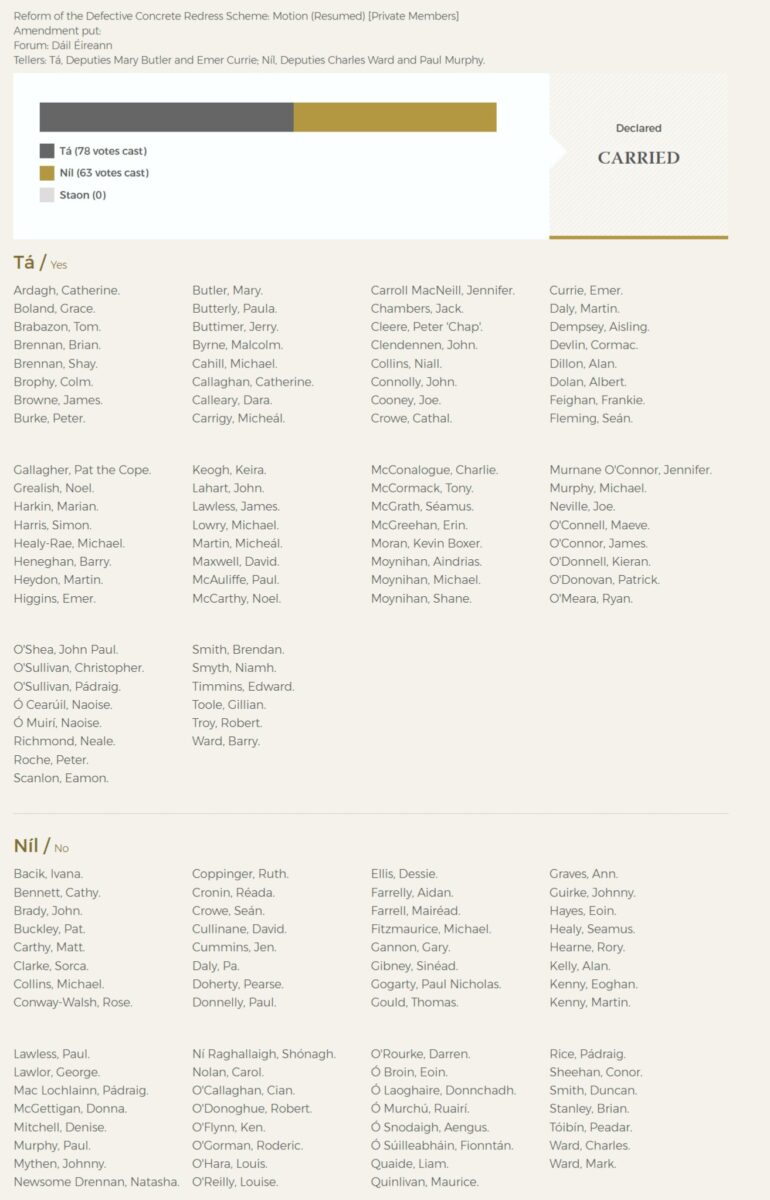
Minister Browne’s amended motion was passed by the government majority, with 78 voting in favour and 63 against. (Results below)
A Dáil debate earlier today heard that 137 homes in Donegal have been completed under the redress scheme so far, and 580 are currently under construction
Deputy Ward challenged the figures and said that, of the completed homes, 70 houses have had outer leaf remediation which retain block work.
“That is 140-odd houses, half of these houses will have to be redone again at great expense to the Exchequer,” Deputy Ward said.
He also stated that the public “cannot be fooled” by Department figures.
“You cannot live in a commencement, you live in a completion,” he said.
Anticipating the government majority, Deputy Ward blasted the government’s amended motion as an “erasure” of every word of his original motion.
“The history will remember this night,” he said.
Addressing homeowners, he said: “The cracks in your homes run deep, but the cracks in this government’s credibility run deeper still.”
To the government parties, he said: “You vote the words down in motions, but you cannot vote away responsibility.”
Deputy Ward’s motion called for the immediate suspension of all partial remediation until the latest scientific evidence on pyrrhotite, sulphate attack, and concealed structural failure is applied. It also called on government to provide an optional end-to-end State-managed remediation model to relieve families of the financial and administrative burden, as well as extending remediation supports to affected schools, health centres, community facilities, infrastructure, and cemeteries.
Housing Minister James Browne said his department continues to work to listen to homeowners as it keeps the scheme under review.
“I can say with confidence that the scheme is beginning to really deliver for homeowners,” Minister Browne said, stating that more than €193 million has been spent on the scheme to date with a commitment to more than double the level of funding for 2026 to €175 million.
His motion states that the Defective Concrete Redress Scheme is “neither a redress nor a compensation scheme, rather it is a grant scheme of last resort to enable affected homeowners remediate their homes and move on with their lives”.
It adds: “the Government remains committed to funding the full remediation of all homes affected by DCB and recognises that this may cost more than €2.2 billion (excluding inflation) and as such this scheme ranks as the most generous in the world.”
Voting results for Amendment to the Reform of the Defective Concrete Redress Scheme: Motion, 15th October 2025:
Government quashes Deputy Ward’s motion for redress reform was last modified: October 16th, 2025 by Staff Writer
Tags: