
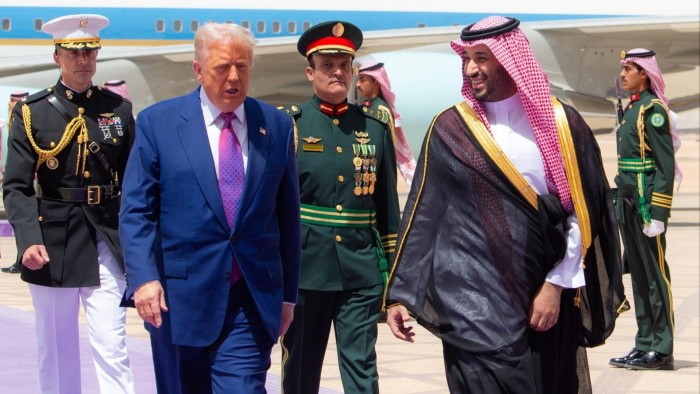
Saudi Arabia is discussing a defence deal with the Trump administration similar to a US-Qatar pact last month that pledged to regard any attack on the Gulf state as a threat to American “peace and security”.
The kingdom hopes a deal can be sealed when its day-to-day leader Crown Prince Mohammed bin Salman visits the White House next month, amid expectations it will be “robust” and include enhanced military and intelligence co-operation, people familiar with the matter said.
When asked about the potential defence pact, a senior Trump administration official said: “There are discussions about signing something when the crown prince comes, but the details are in flux.” The White House and state department declined to comment on details of the potential deal.
The state department said US defence co-operation with the kingdom was “a strong bedrock of our regional strategy”.
Washington was “committed to security of the region and will continue to work with Saudi Arabia to resolve conflicts, promote regional integration and deny safe haven to terrorists”, it added. The Saudi Embassy in Washington did not respond to a request for comment.
Prince Mohammed will arrive in the US just weeks after President Donald Trump signed an executive order stating that Washington would respond to any attack on Qatar by taking all “lawful and appropriate measures — including diplomatic, economic, and, if necessary, military”.
The order came after Israel last month launched missiles at Doha that targeted Hamas’s political leaders, triggering shockwaves across oil-rich Gulf nations that have considered Washington their security guarantor.
Saudi Arabia — which has long sought a US defence pact — spent months negotiating a defence treaty with the Biden administration alongside which it would normalise relations with Israel, but the push was upended by Hamas’s October 7 2023 attack and the war in Gaza.
Prince Mohammed, who has accused Israel of committing genocide in Gaza, made clear the kingdom would normalise relations only if a Palestinian state was established, something Israeli Prime Minister Benjamin Netanyahu vehemently opposes.
Negotiations have been continuing with the Trump administration to secure a standalone defence deal with the US, which could come through an agreement or an executive order.
 Israel’s attack on Hamas in Doha triggered shockwaves across oil-rich Gulf nations that have considered Washington their security guarantor © Jacqueline Penney/AFPTV/AFP/Getty Images
“I’m expecting, on the back end of the executive order with Qatar, that there will be similar progress on defence and security issues,” said Firas Maksad, Washington-based managing director for the Middle East and north Africa at Eurasia Group.
“They are working on something . . . I understand it’s something much more robust than what already exists,” he said.
Maksad added that, with Prince Mohammed pushing ahead with his trillion-dollar plans to develop the kingdom, “enhancing security co-operation with the US is absolutely paramount”.
“They want Qatar-plus,” said Kirsten Fontenrose, a former senior director for the Gulf at the National Security Council during Trump’s first term.
She said Saudi Arabia had a list of defence procurement requests, including F-35 jets, adding that a deal could include co-operative projects on countering unmanned threats, such as drones.
However, Hussein Ibish, a senior scholar at the Arab Gulf States Institute in Washington, said the Trump administration’s desire to see Saudi Arabia normalise diplomatic relations with Israel could be a sticking point.
“That doesn’t mean we can’t get past it — because all Trump has to do is decide it’s a good idea. But we’re not there yet,” he said.
Prince Mohammed, who has forged a strong relationship with Trump and his son-in-law Jared Kushner, is set to make his first visit to the US since 2018, during Trump’s first term.
Saudi Arabia is among the biggest buyers of US weapons, and the White House announced a $142bn arms deal with the kingdom — double Riyadh’s 2024 defence budget — during Trump’s visit to the region in May.
The White House described that as the largest defence deal in history, saying it would include air force and space capabilities, missile defence and maritime and border security.
But Saudi Arabia, like other Gulf states, has over the past 15 years become increasingly concerned about the US’s commitment to the region and the unpredictability of its policies.
Recommended

During Trump’s first term, the US did little to respond to a 2019 missile and drone attack — blamed on Iran — which struck at the heart of Saudi Arabia’s oil infrastructure, temporarily knocking out half the kingdom’s crude output.
More recently, the Israeli strike targeting Hamas’s political leaders in Qatar — which hosts the US’s biggest military base in the region — rattled Gulf states.
Qatar was also caught up in the 12-day Israel-Iran war in June, when Tehran fired missiles at the American base in retaliation for Trump bombing the Islamic republic’s nuclear sites.
Saudi Arabia last month signed a “strategic mutual defence” pact with nuclear-armed Pakistan, signalling to the US and Israel that the kingdom is willing to diversify its security alliances to bolster its deterrence.
“That was clearly a signal,” Maksad said. “There’s an understanding that there’s no alternative to the US security architecture in the region, but there are ways you can plug holes and augment the profile.”