
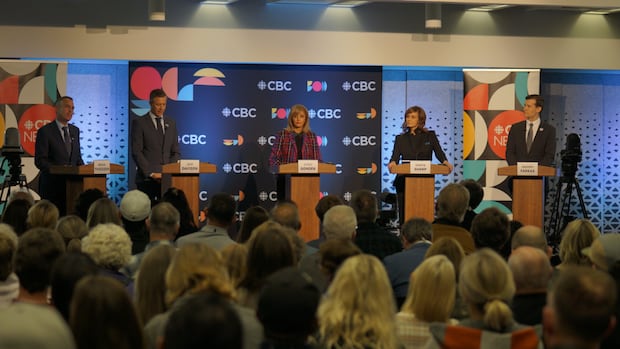
Five mayoral candidates in Calgary’s municipal election took the stage Thursday in a lively and sometimes combative debate focused on crime, growth, zoning and more.
Polls have shown a wide open race, with Jeff Davison, Jeromy Farkas, Jyoti Gondek, Sonya Sharp and Brian Thiessen polling in the top five — but also a significant number of voters still undecided. There are a total of nine candidates running for mayor.
With election day looming Monday, the clock is ticking for these candidates to draw Calgarians into their camps, which made Thursday’s debate one of their last opportunities to reach a critical mass of voters.
The debate focused on a number of topics that Calgarians have said are top of mind this election, including public safety, blanket rezoning, how best to manage growth, and more.
Loren McGinnis, host of The Calgary Eyeopener, moderated CBC Calgary’s debate at the Red and White Club at McMahon Stadium.
WATCH | The full mayoral debate hosted by CBC Calgary:
Public safety
Improving public safety and reducing crime have been key issues for voters this election season, according to a recent poll done for CBC News by Janet Brown Opinion Research.
Those concerns have come as Calgary has recently seen a decline in its crime severity index, while nearly a fifth of the city’s police are on leave or accommodation.
Sharp, who was councillor for Ward 1 and is running with the Communities First party, has won an endorsement from the police union. She has promised to hire 500 more police officers, something she said would cost about $75 million.
“To be honest, there’s not a price on safety right now when it comes to making sure we’re getting back up to the national average. There are things that need to be kind of cut at the city and redirected into things like public safety,” Sharp said.
WATCH | Calgary mayoral candidates debate how to hire and fund new police officers: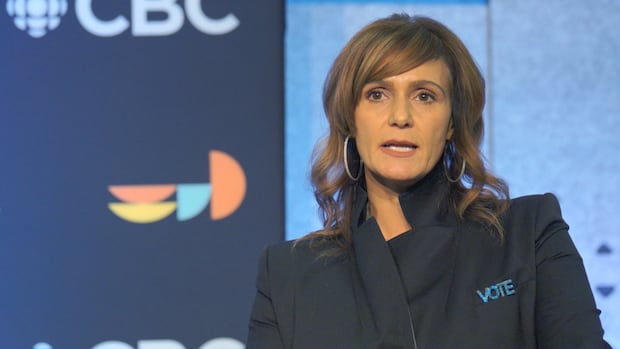
Calgary mayor candidates debate how to hire and fund new police officers
Sonya Sharp, who was endorsed by the police, and former police commissioner Brian Thiessen face off on how exactly to get more officers on Calgary’s streets.
Thiessen, a former police commission chair who is running with The Calgary Party, pushed back against that number.
“First of all, it’s not $75 million. It’s about $100 million to $150 million. And it will take you 10 years to roll it out. They can’t recruit 500 officers and train them in 10 years,” he said. “Secondly, and most importantly, the police aren’t asking for 500 more officers.”
Davison, who is running as an independent with an endorsement from A Better Calgary Party, argued that Calgary’s approach to public safety is “broken,” promising a task force and to get the federal government “on board with us on bail reform.”
Gondek, meanwhile, referred to her plan to ban open drug use as “a compassionate way to address a very real issue.”
Farkas called for pairing “compassion and enforcement,” which he said would involve “cracking down” on those “responsible for the vast majority of repeat violent offences,” while supporting initiatives in recovery and prevention.
Managing growth
From housing to taxation, so many issues in this election trace back to the fact that Calgary’s population is surging its way to two million people.
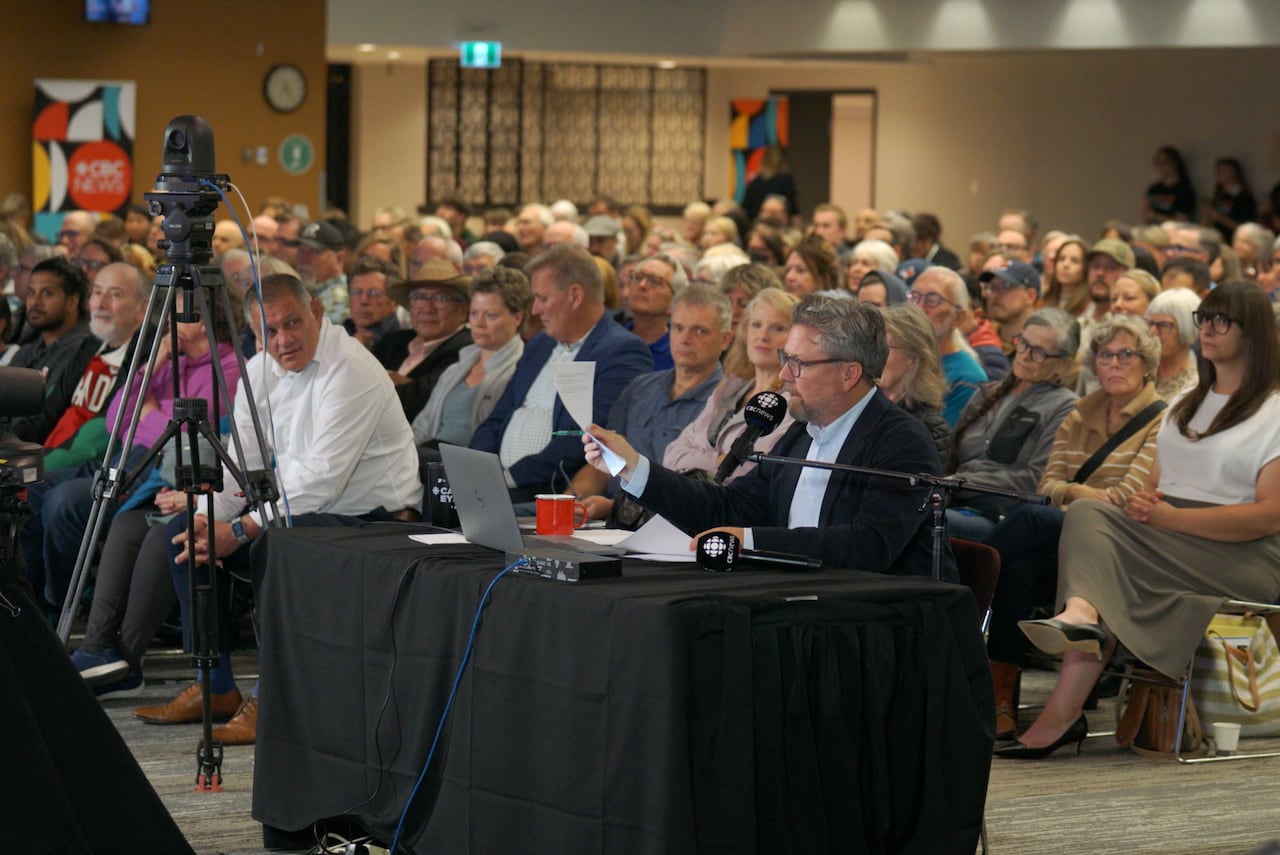 McGinnis asked candidates questions on public safety, population growth, blanket rezoning and city leadership. (Pat Carroll/CBC)
In polling done for CBC News by Janet Brown Opinion Research, 64 per cent of respondents in Calgary said the city’s population is growing too fast, 26 per cent said it was about right, and one per cent felt it’s too slow.
Gondek said one of the reasons Calgary has such tremendous growth has to do with the province’s “Alberta is Calling” campaign for bringing in newcomers without providing matching infrastructure dollars.
“When you are $437 million in the hole every year from a partner who won’t work with you, this dream of working collaboratively doesn’t work,” Gondek said.
Davison said that Calgary had “failed to manage growth.” He’s promised a four-year tax freeze to help struggling residents.
“Don’t let anybody tell you a tax freeze is not possible just because they don’t have the experience or knowledge on how to do it,” he said.
“You do not create affordability by charging people more money every year. We can manage growth in a better way.”
WATCH | Why Jyoti Gondek doesn’t believe in a tax freeze: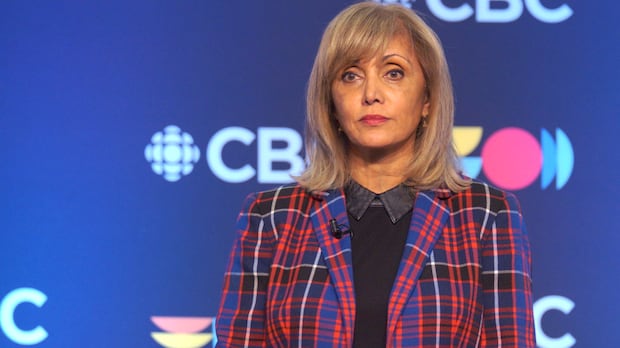
Why Jyoti Gondek doesn’t believe in a tax freeze
Calgary mayoral candidate Jeff Davison is pledging a four-year tax freeze — without cutting core services — as part of his plan to restore fiscal discipline and make life more affordable for Calgarians. Incumbent candidate Jyoti Gondek responds to the proposal.
Thiessen called that idea “dangerously naive,” noting the recent water main failure.
“Nobody anticipated the water main failure,” he said. “We have to pay for emergencies like that.”
Blanket rezoning
The polling done for CBC News by Janet Brown Opinion Research found that respondents were split about city hall’s contentious blanket rezoning bylaw, which allows townhomes and row houses in most residential areas without going through a rezoning process.
That issue has come up often on the campaign trail. Four out of the five front-runners have promised to repeal or substantially revise the policy.
Sharp vowed to repeal the policy, saying it had “caused a wedge” in communities.
“People’s voices need to come back to council,” she said.
“To me, this is about respecting the diversity of our communities and doing better to listen to people,” said Davison, who has also pledged to repeal the policy.
WATCH | What to do about blanket rezoning?: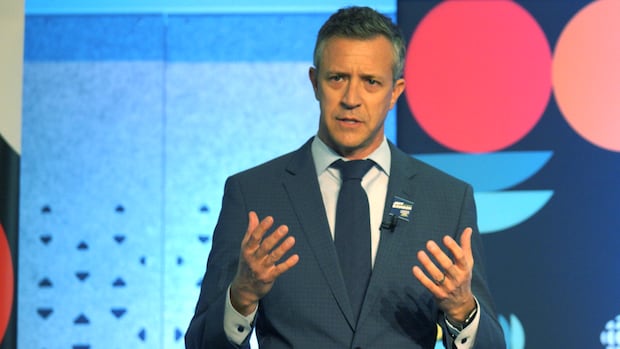
What to do about blanket rezoning?
Mayoral candidates Jeff Davison and Jyoti Gondek debate whether or not to go back to the drawing board when it comes to the city’s controversial blanket rezoning policy, which is intended to allow for more development.
Farkas agreed the policy should be scrapped, saying it reflects “a broken trust between members of council and the community.”