
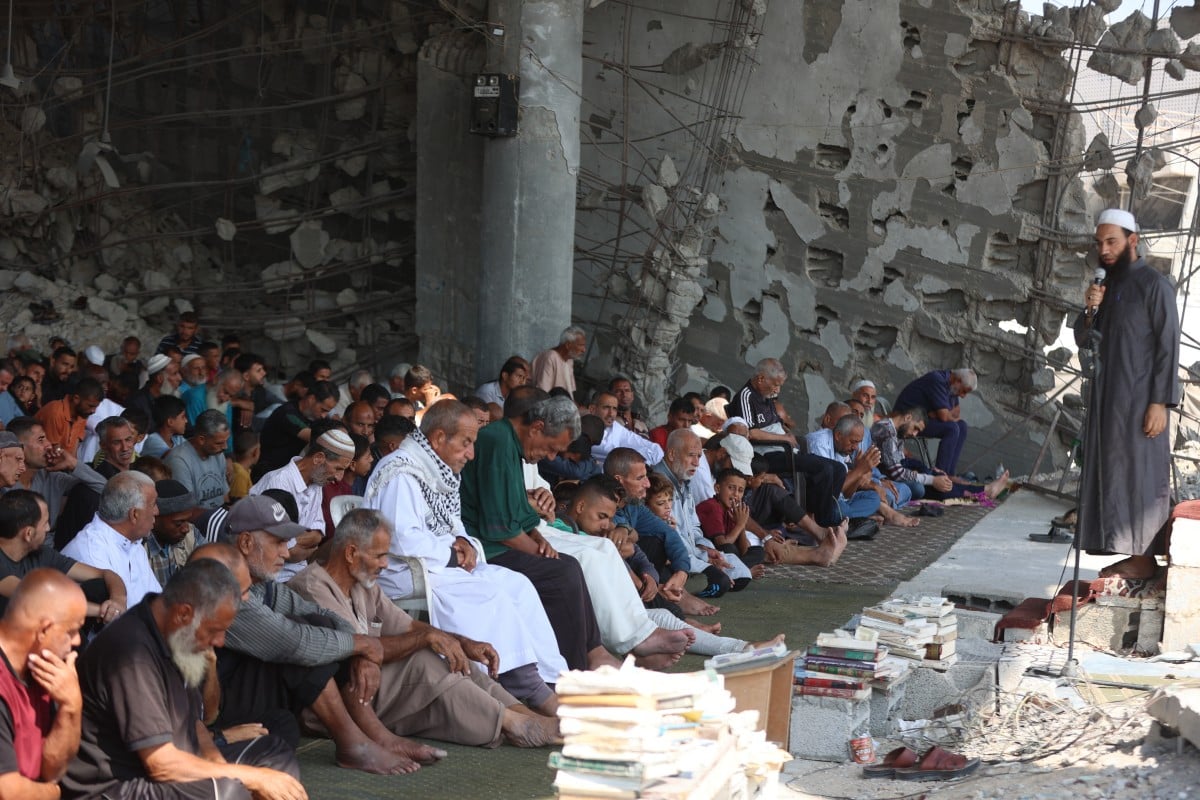
Thousands of worshipers returned on Friday to the Gaza Strip’s few intact and many damaged mosques, where for the first time in months, loudspeakers blared the Islamic call to prayer.
“God is the greatest, glory to God, Lord of worlds,” echoed through those mosques at roughly the same time on Friday, one week after a ceasefire took place in the devoutly Muslim coastal Palestinian territory.
Monday’s exchange of hostages for Palestinian prisoners marked the first phase of a 20-point plan to end the war. However, the bodies of 19 hostages were still being held in Gaza as of Friday evening, and it remains unclear whether Hamas will adhere to calls to disarm, with Israel warning it will resume fighting if the group fails to do so.
To be united for prayer again “is an indescribable feeling after two years of privation,” Ghalid al-Nimra told AFP at Gaza City’s Sayed Hachem mosque.
Sayed Hachem, one of the oldest mosques in Gaza’s largest city, was miraculously mostly spared during two years of air strikes and fighting between Israel and Hamas.
Get The Times of Israel’s Daily Edition
by email and never miss our top stories
By signing up, you agree to the terms
As he watched the hundreds of worshipers, Nimra was moved to see “such a large crowd gathered here” for the first time since October 7, when Hamas orchestrated a mass invasion of southern Israel, murdering 1,200 people and kidnapping 251, sparking Israel’s longest-ever war.
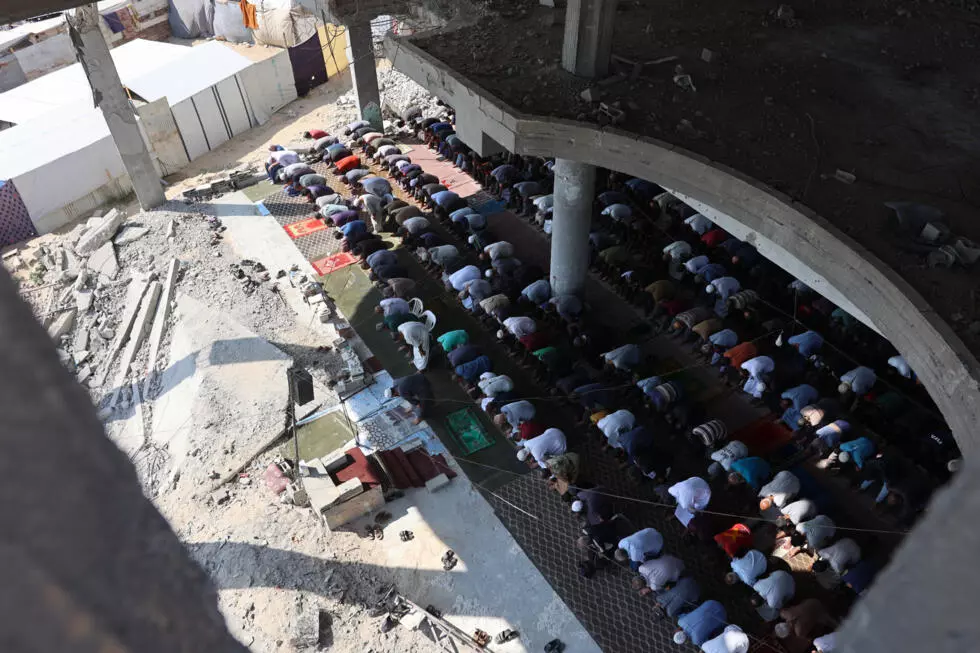
Gazans pray at a bombed-out mosque on October 17, 2025. (Omar Al-Qattaa / AFP)
As the prayer rang out at 12:30 pm (0930 GMT), many hastened as they crossed the building’s Ottoman-era door.
Old and young, many of their faces solemn, prayed together inside, where even the minbar, the imam’s raised platform, seemed intact.
Out of Gaza’s 1,244 mosques, 1,160 were partly or wholly destroyed, according to Hamas’s media office in the Palestinian territory.
While mosques and other religious buildings are protected under international law, they can be targeted if they are used for military purposes. The IDF has accused Hamas of embedding itself in civilian infrastructure, including mosques.
Dispersed prayer
Several worshipers expressed a state of spiritual confusion.
“I feel like my soul is getting lost amid all this destruction,” Abu Mahmud Salha told AFP.
The 52-year-old from northern Gaza still lives in a camp for the displaced in Al-Mawasi, on the other end of the Gaza Strip.
“We pray inside the tent, I miss group prayer and the imam’s voice,” he said.
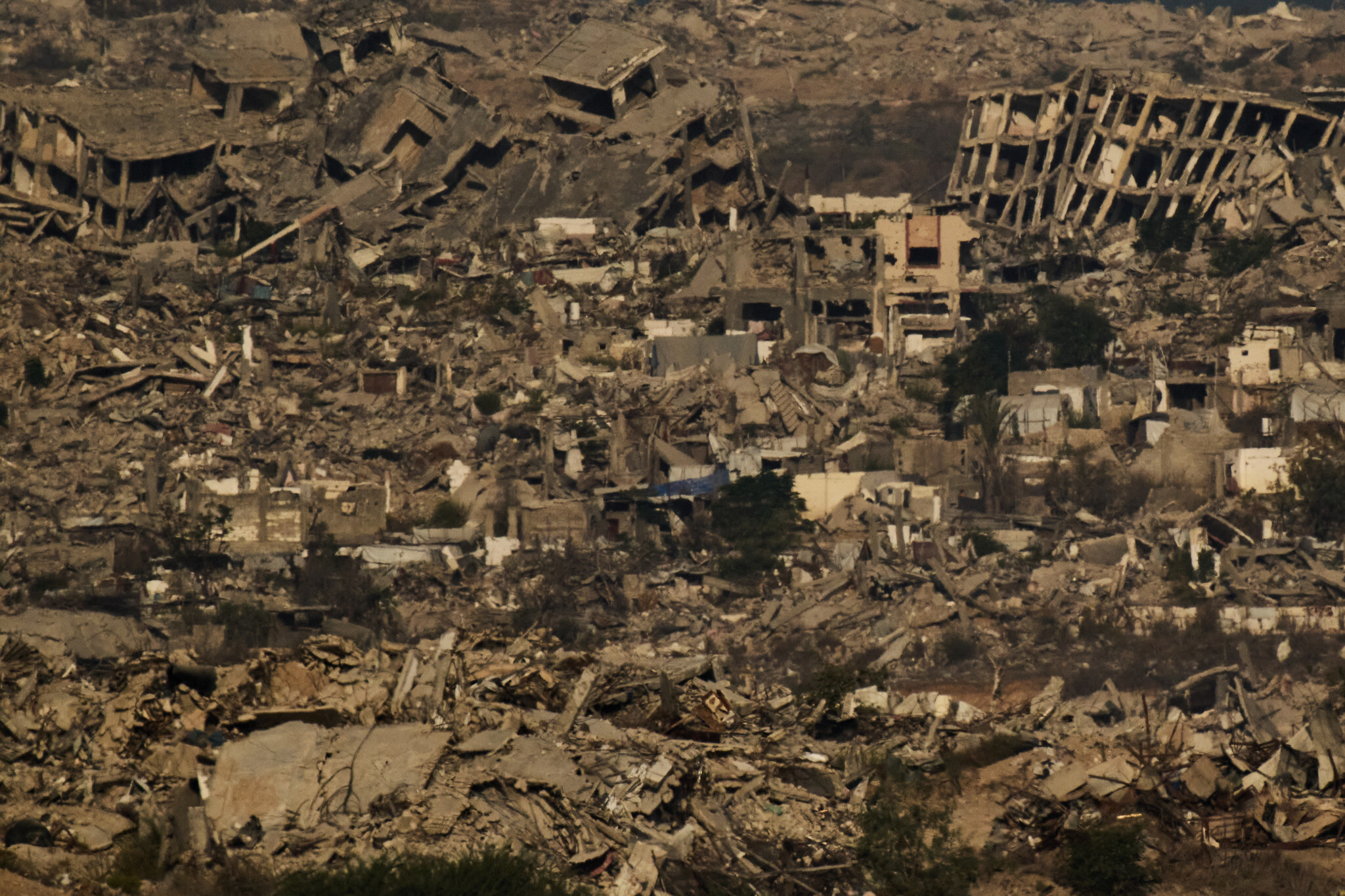
Buildings that were destroyed during the Israeli ground and air operations stand in the northern Gaza Strip during the sunrise, as seen from southern Israel, on October 17, 2025. (AP Photo/Leo Correa)
“When I hear the prayer call echoing on loudspeakers from recordings, I feel like a part of our lives was broken.”
The mosque in his neighborhood, al-Falluja, was destroyed, forcing him to pray on the street.
On Friday, most residents stuck to the habits they developed over the past few months. Some unfurled prayer mats on the road, on rubble, or in mosques with collapsed walls.
Others bowed near rows of tents housing thousands of displaced Palestinians across Gaza, in living conditions that remain difficult.
“Every Friday, we try to gather on a small patch of land under the sky, to pray,” Moataz Abu Sharbi told AFP.
“Sometimes we pray on sand or on pieces of cardboard, which is very difficult psychologically,” the 27-year-old added.
“The mosque was a pillar of life in our neighbourhoods and a precious part of our religious traditions,” said Abu Sharbi, who was displaced to the central Gaza city of Deir al-Balah.
“Losing both one’s home and one’s spiritual refuge — that’s the hardest part,” Abu Sharbi added.
“We used to find shelter for our worries in the mosque.”
Rebuilding
Speaking from Gaza City’s Al-Shati camp, Abu Mohammad al-Hattabn said “the mosque near my home was our refuge, not only for prayer, but also to find peace and remember God.”
“When it was destroyed, it felt like a piece of my heart flew away,” the 54-year-old said.
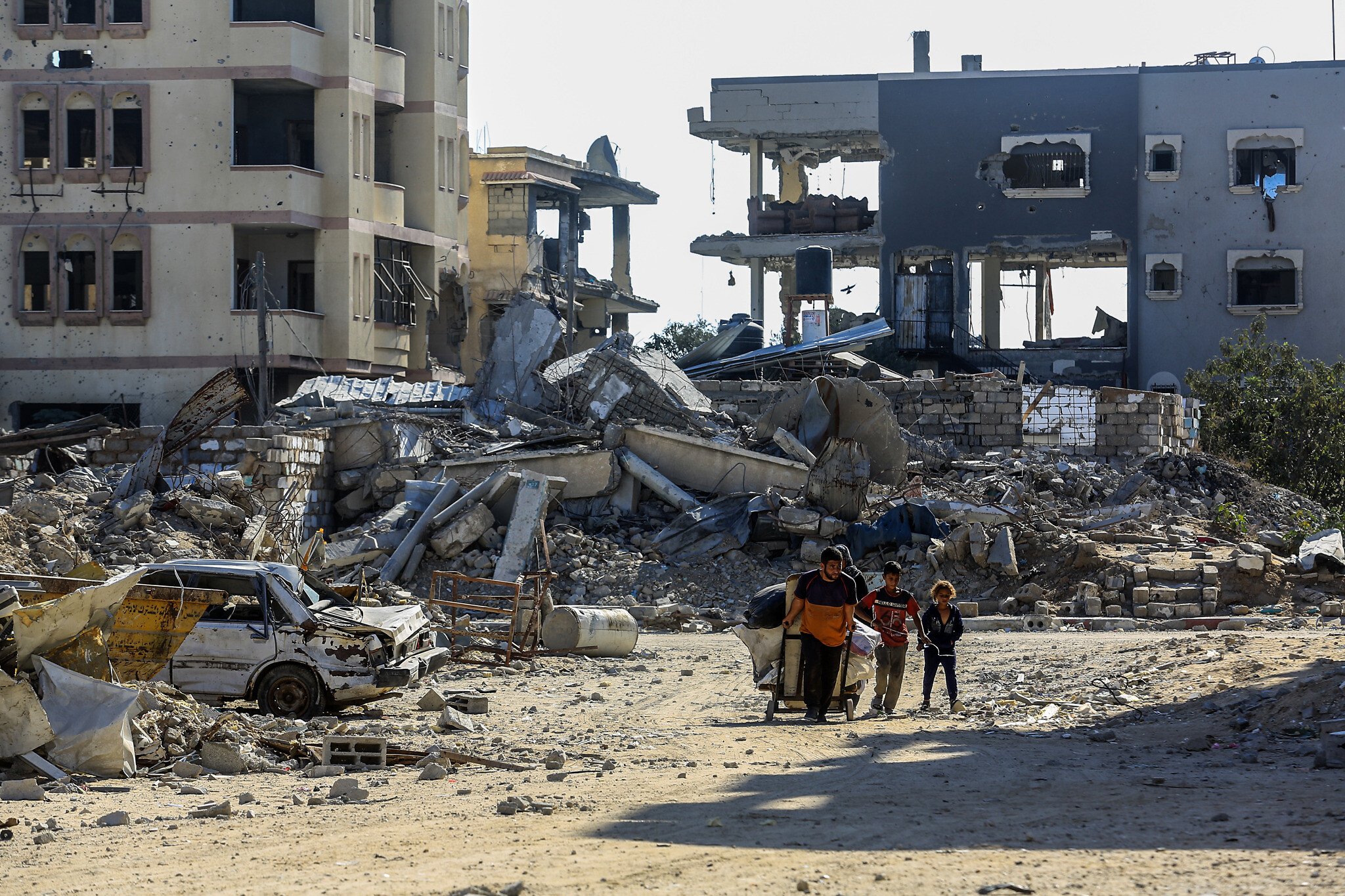
Palestinians return to their homes following a ceasefire agreement between Israel and Hamas, in Khan Younis, in the southern Gaza Strip, October 16, 2025. (Abed Rahim Khatib/Flash90)
Hundreds of Palestinians also gathered in a destroyed mosque in the southern Gaza city of Khan Yunis, an AFP photographer reported.
As an imam led prayers through a loudspeaker, the worshipers seemed absorbed in devotion, despite the mosque’s gaping walls and exposed frame.
“We hope that everything will be rebuilt in Gaza, including the mosques,” 22-year-old Salim al-Farra said.
The Hamas-run Gaza health ministry says more than 67,000 people in the Strip were killed in the war, though the toll does not differentiate between civilians and combatants.
Israel says it has killed over 22,000 combatants in battle as of August and another 1,600 terrorists inside Israel during the Hamas-led October 7 onslaught. Israeli officials have placed the civilian-to-combatant ratio at roughly two to one.
Israel’s toll in the ground offensive against Hamas in Gaza and in military operations along the border with the Strip stands at 473.