
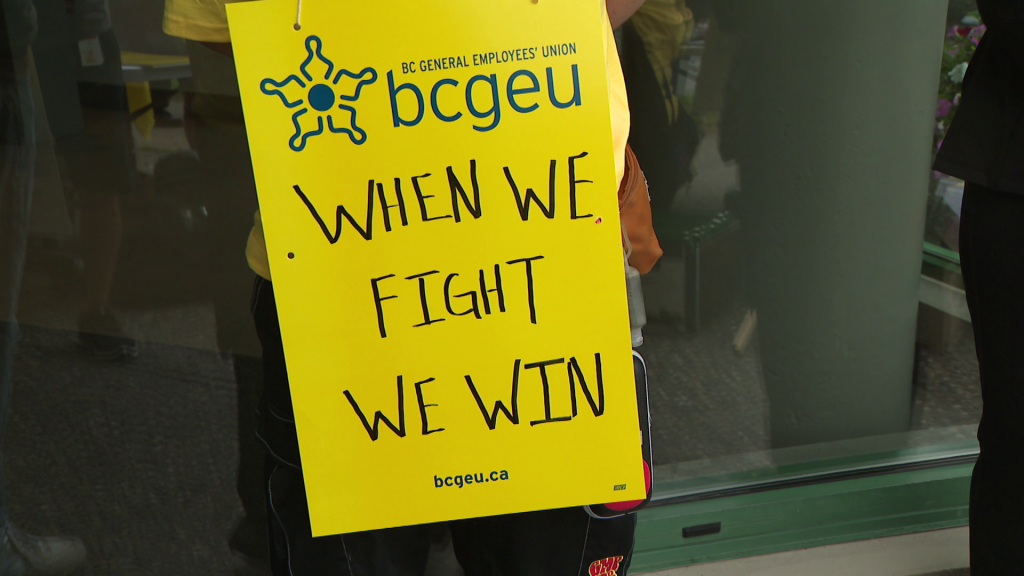
After seven weeks of strike action, B.C. public sector workers say the union and the provincial government will enter mediated talks as soon as possible.
The union announced Friday that its bargaining committee has agreed to non-binding talks with the province, mediated by Vince Ready and Amanda Rogers.
“The decision follows a request from government late Thursday afternoon and comes after seven weeks of province-wide strike action by more than 25,000 public service workers,” the BCGEU stated.
BCGEU President Paul Finch tells 1130 NewsRadio he’s optimistic.
“We think this is a potentially very good path and, obviously, as we’ve said all along, we’re looking for a resolution to this dispute. If this is going to help government come to the table, if mediation is what they need to come to the table, then of course we’re willing to do that,” said Finch.
He suspects that there’s been a shift in the province’s willingness to end the strike.
“I think the toll of the strike is quite significant. In some cases, it takes a bit of time for the full toll of the strike to be realized or understood. I talk to not just my members on picket lines every day, but I talk to British Columbians who are reeling from the withdrawal of some of these services — and I don’t just mean the liquor and hospitality industry, but far beyond that.”
The key issue in this dispute is wages.
“We’re at four per cent in each year, and the province is at two per cent in each year. We think there’s common ground between those numbers that our members will vote for. The sticking point this entire time has been the province’s unwillingness to move off [its] position.”
Finch declined to “bargain in the media,” but says, “absolutely we are willing to modify our position, and I’ll leave it at that.”
The last negotiations broke off on Sept. 29, when Finch claims the province was unwilling to budge on the numbers.
“They said their first offer was their last offer, and that’s how talks broke down.”
Finch says the strike has taken an emotional toll on the thousands of members on picket lines.
“I think the anxiety and stress of being on picket lines is incredible. Many of our membership are working second jobs to get by. The whole reason we’re striking — and this puts people in a very difficult situation — is just how low the wages are in some areas. When people are already that close to default [wages], when they’re already just scraping by, it’s incredibly stressful. When you’re on a picket line and you don’t see the end in sight, you don’t necessarily have that hope. But what I will say is our membership has been resilient.”
Finch expects the parties to reach a tentative deal within days. He says mediators Vince Ready and Amanda Rogers will turn in non-binding recommendations to both sides. If everyone agrees, a tentative agreement will be declared, and picket lines will come down.
“But we’re not going to get a deal that compromises our members’ interests.”
Whatever is agreed upon will then go to a vote before it’s finalized.
“We’re going to be reaching out closely to government to ensure that the whole thing doesn’t fall apart on a comma.”
It’s not clear exactly when the parties will meet.
Finch says the last time BCGEU members had a raise — of roughly three per cent — was April 1, 2024.
Last month, Finance Minister Brenda Bailey forecast a record-high deficit of almost $11.6 billion for the first quarter of the 2025-2026 fiscal year. But Finch says that’s no excuse for not paying workers a fair wage.
“Wages across British Columbia are going up quite a bit. Our wages have lagged behind the average wage increase in B.C. for the last decade. We have fallen behind by more than 12 percentage points. So today, the average civil servant in B.C. makes less than 2.7 per cent than the average worker in B.C. But anyone in private enterprise knows, you can’t run a business by underpaying your staff. In this job market, that doesn’t work.”
The Professional Employees Association (PEA) held a news conference Thursday morning, announcing that all government-licensed professionals in the union had joined the strike.
Finch confirms that the PEA will not be involved in the talks.
“It’s critical PEA have the same benefits of whatever comes out of this process that we do, should we agree to it. When these non-binding recommendations come out, part of our conversation with government is the critical need to ensure PEA are made whole. I’ll say, their picket lines are our picket lines. Government needs a deal with PEA because if they don’t get a deal with PEA, we’re staying out. We’re not crossing those lines.”
The Premier’s Office says the province is entering mediation to reach a fair agreement, and it won’t be commenting further at this time.
Picketing will continue while mediation proceeds.