
But when Nasser Hospital started being surrounded by the Israeli forces, we had to move our burns unit, operating theatres, various departments, physiotherapy and mental health services into a field hospital. But MSF couldn’t move the children and babies from the ICU because you can’t provide intensive care in a field hospital. It felt like we were leaving these babies behind.
But apart from attacking the hospitals, the Israeli forces make it impossible for us to work there. They give displacement orders to the population with warnings and say, “All of this area has to get out of their homes because we’re going to bomb and destroy everything within those boundaries”; it’s called a red zone. So it means you can’t go there because it’s now designated as an area that will be under attack until further notice. One of these warnings was put all around the hospital.
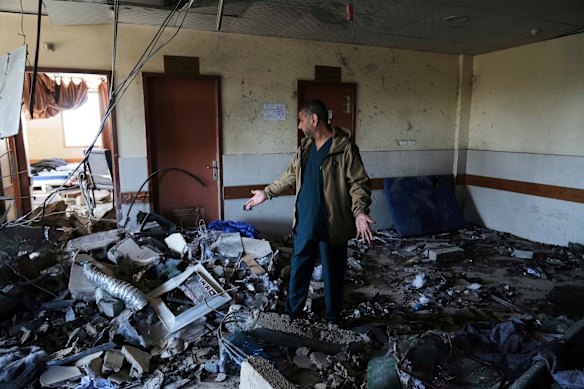
Dr Marwan al-Hams surveys the destruction inside the surgical building of Nasser Hospital in March, a day after it was struck by an Israeli airstrike in Khan Yunis, Gaza Strip, in March.Credit: AP
The Israeli authorities would tell MSF that we could go through the red zones but we had to co-ordinate with them. So we would have to tell them exactly what time we were going, and then they would tell us which road we could go on, and we’d have to wait at a checkpoint to get into the hospital, and they would make us wait for hours and hours in the middle of very busy areas where it wasn’t safe. We could hear the bombing around us. They would do this every day. That meant our staff doing 24-hour shifts would have to stay on and do 48 hours or 72 hours because we just couldn’t get in and out properly.
Sometimes there are no warnings given at all before the bombing starts. A bomb was dropped without warning in front of the MSF clinic in Gaza City. By some miracle, none of our staff were killed. Instead, the staff rushed out to the street to save the lives that they could, without even knowing if the bombing had stopped. They saved 28 lives that day.
More than 85 per cent of Gaza is now a red zone, so the population is being forced into a small area that the Israeli authorities call a “concentration zone”. I’m worried because I don’t know what’s going to happen when they have everyone in that area. It’s scary to think what they’re planning once they have people in there. It could be a way to get rid of the whole population.
Loading
What I witnessed on the ground is that every time there was talk of a ceasefire, that is when the bombings would increase and the treatment of the civilians would get worse. As soon as there could be a glimmer of hope and a diplomatic solution, more people would start to die in more ways. There’d be more bombings. There’d be tanks coming in faster and faster, destroying buildings. And the shootings, at the distribution sites as well, increase. So we were also receiving cases of people at these distribution sites that are run by the Israeli authorities, people who are shot in the head and in the chest.
You start to lose hope eventually when you can see that the world is not responding, and especially our own government. To go back and do work is easier if you know that the world is behind you and that they’re going to look at a longer solution, but otherwise it’s really heartbreaking. To keep doing that long-term is what breaks your spirit eventually. And this is what is breaking the spirit of our Palestinian staff in Gaza: you can see them becoming more and more depressed, day by day, because they know that the world is not doing anything to help them. Collectively, it’s really hard to keep going.
I’m going back in the coming months and I don’t know how I will be able to do my job and help the people of Gaza. The situation is becoming more and more unsafe.
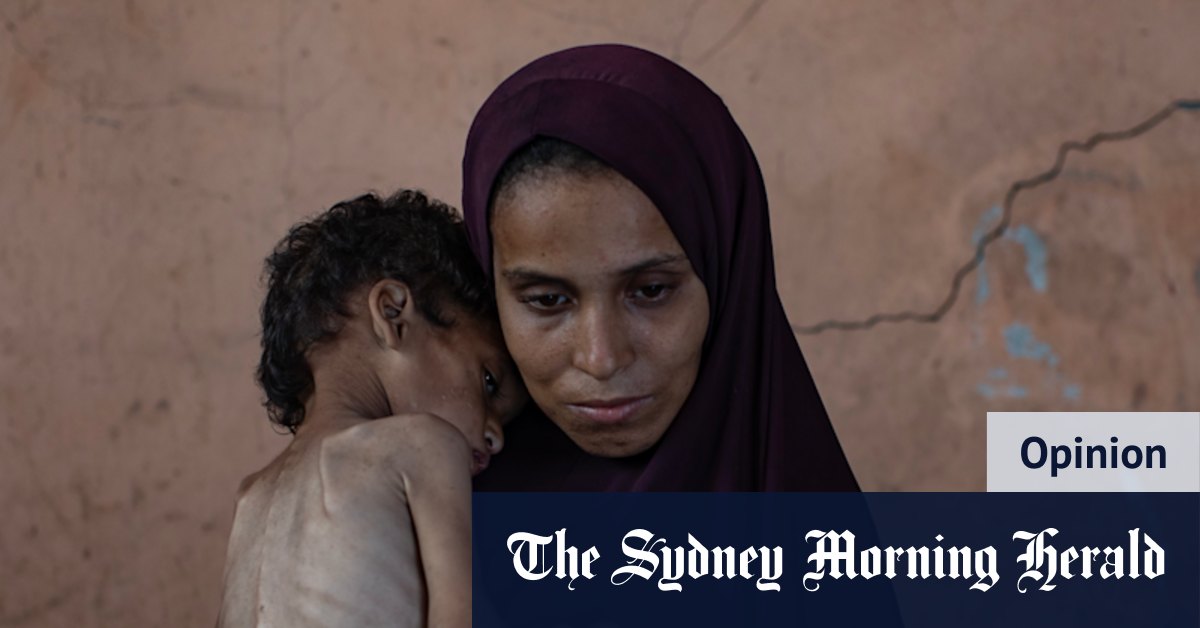
If people are appalled by these recent photos of starving children and they make their voices heard, they can make a difference and the politicians will have to act. The decision to do something is in the hands of the powers that control the weapons and the money behind it. It is urgent that we speak up now and do everything we can to prevent further deaths of innocent people.
Claire Manera is a Medecins Sans Frontieres Australian emergency co-ordinator. She has worked in conflict zones for the past 20 years, most recently in Gaza.
Get a weekly wrap of views that will challenge, champion and inform your own. Sign up for our Opinion newsletter.