
Following the declaration of a cease fire in Gaza, a complex new reality has emerged on the ground regarding the governance of the Strip. To begin with, the recent American plan for Gaza is marked by ambiguity and the absence of any clear provisions. Consequently, the most serious political and security challenge is the widening gap between the varying frameworks of Israel, the United States, and the international community for postwar governance and the future of Gaza.
Israel’s strategic outlook is to retain security control over Gaza and to control its border crossings. The United States’ approach, by contrast, advocates a gradual Israeli withdrawal under temporary international supervision, until the Palestinian Authority can take over. On the ground, developments indicate that Hamas has regained control over certain areas after Israel’s partial withdrawal, even though it signals readiness to abandon administrative authority, while retaining military capabilities in certain areas in Gaza.
The key question is to what extent can the divide be bridged between the realities on the ground, Israel’s proclaimed objectives, and international expectations.
In the aftermath of approving the latest Trump peace plan and implementing its first phase, which included a partial withdrawal of Israeli forces and a prisoner exchange, Prime Minister Benjamin Netanyahu asserted that the cease fire does not signify the end of the conflict, pledging to dismantle Hamas’s military capabilities in full. Netanyahu further hinted that the agreement does not fully restrict Israel’s operations in Gaza, affirming its right to resume military operations if Hamas does not fulfil its obligations. Official Israeli statements have also declared their intention to destroy all tunnels in Gaza by force, demanding strict security guarantees to prevent any future rearmament in Gaza. The Israeli government envisions the complete disarmament of Hamas, excludes it entirely from the administration of the enclave, and rejects any transfer of authority to the Palestinian Authority as well.
Although Hamas fulfilled the initial phase of the agreement by releasing all living Israeli captives, Israel effectively violated the ceasefire agreed upon just days earlier, after the successful prisoner exchange. Israel invoked the pretext that Hamas failed to return all the bodies of Israeli captives, something widely seen as unrealistic given the limited time and Gaza’s massive destruction. Israel also restricted the flow of humanitarian aid in subsequent days informing the United Nations that the volume of authorised aid trucks would be reduced. This current reality on the ground will further complicate efforts to move forward with the second phase of the Trump peace plan.
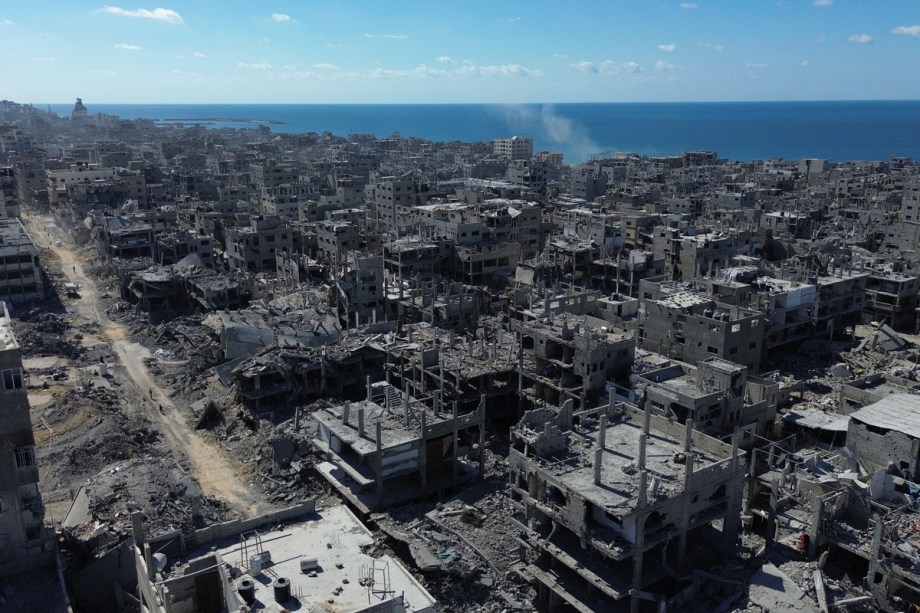
Gaza’s infrastructure is almost completely destroyed, and the delivery of aid remains limited by Israel, which continues to control the enclave’s borders and crossings, including the Rafah crossing with Egypt. Amid significant logistical and humanitarian challenges, Hamas has restored security control in the areas where Israeli forces withdrew and launched operations to restore internal order following the conflict. The plan leaves unresolved the question of who will exercise executive and security authority in Gaza after the gradual Israeli withdrawal. The agreement stipulates that Israeli forces will partially withdraw to agreed lines, and Hamas will have no role in governing Gaza after the war.
The September New York declaration stressed that governance of Gaza should ultimately be given to the Palestinians following the cessation of hostilities, contingent upon reforming the Palestinian Authority. The statement also mentioned the disarmament of Hamas but failed to outline an operational mechanism for implementation.
The Trump peace plan, which included twenty points, suggested establishing a transitional administration under temporary international supervision by donor states and institutions, with limited Palestinian participation until institutional reform within the Palestinian Authority is conducted. This structure would position the Palestinian Authority as a coordinating partner pending the gradual restoration of its control. The US plan additionally proposed creating an international or multinational force tasked with securing public infrastructure, training new Palestinian police units, and overseeing the disarmament process.
The implementation of the second phase of the Trump peace initiative faces significant obstacles due to the conflicting visions of the various stakeholders regarding the resolution of the Gaza crisis.
Israel appears unwilling to assume direct governing responsibility in Gaza, but also refusing to allow a political vacuum that could be occupied by Hamas or the Palestinian Authority. This approach effectively constrains the viability of any transitional or permanent governance structure, as such arrangements would remain subject to continuous Israeli oversight.
Although various international frameworks envision the gradual restoration of the Palestinian Authority’s role in Gaza, these concepts encounter the reality revealed during the war. This complex local reality is defined by interwoven factional and familial networks that administer the territory and resist external authority alien to Gaza’s deeply rooted social fabric. Furthermore, Gaza’s population has also lost faith in international guarantees, which failed to deliver reconstruction, justice for the Palestinians, or holding Israel accountable. There is rising concern, therefore, that any international transitional presence could amount to a form of “a soft occupation.”
READ: UNRWA: Every delay in delivering aid to Gaza means more deaths
Israel’s current measures, breaching the terms of the truce, effectively prepare the ground for the continuation of the conflict, either through direct military confrontation or more indirect means that are now widely recognised by the Palestinian public. Israel’s approach reflects its intent to maintain control after the prisoner exchange, pursuing its broader occupation goals, an outcome that is neither realistic nor acceptable, particularly following world leaders’ pledge in Sharm el-Sheikh to guarantee an end to the war. The international vision, meanwhile, falls short of the political realism dictated by Gaza’s field dynamics, the nature of the Palestinian people, and Israel’s overt and covert manoeuvres.
An interim international presence in Gaza may now be required prior to establishing a civil administration, to secure an authentic cessation of hostilities and deter Israel from continuing its assaults and violations of the ceasefire, which are already occurring.
At a later stage, after Israel is deterred from returning to war, it may prove beneficial to establish a transitional governance structure for Gaza that is fundamentally Palestinian formed through internal consensus by the Palestinian factions. Such an administration would function through coordinated international and Arab engagement, with technical oversight from the United Nations and the European Union, coupled with political and security supervision from Arab states. Such an arrangement would serve as an alternative to the imposition of an international transitional authority or a foreign “oversight council.”Such an approach may be the most practical option, avoiding any reproduction in the dynamics of occupation. Past experiences further demonstrate that any reconstruction framework lacking internal political arrangements to reinforce the legitimacy of Gaza’s Palestinian governance structure is destined to fail. This framework would advance a more substantive and pragmatic reconstruction, which reflects Palestinian society and capable of ensuring the success of this essential mission, particularly in light of the comprehensive destruction that Gaza has experienced. Accordingly, reconstruction aid and development projects should be implemented through Palestinian institutions, in joint coordination with the United Nations, guided by a holistic and future oriented Palestinian development and empowerment strategy. Such a model would ensure Palestinian ownership of the reconstruction process, transforming them from passive recipients of aid and externally imposed visions into active agents and partners in rebuilding their homeland.
There is an urgent need to revive internal Palestinian national dialogue, whether facilitated, supervised, or coordinated by Arab partners, or initiated by Palestinians themselves, to define a political order that remains absent to this day. Israel’s security centric doctrine, which has consistently subordinated political considerations to security imperatives, has failed to achieve lasting security over the past decades. This failure stems from Israel’s disregard for the Palestinian national and political context, and that has reflected in systematic efforts to undermine it. Without recognition of Palestinian legitimacy, acknowledging the right to establish an independent state with East Jerusalem as its capital, and allowing Palestinians to exercise democratic governance through free and direct elections, Israel will continue to lack genuine security and long term stability. Such an approach would establish a realistic trajectory for both the internal Palestinian affairs and in managing relations with Israeli governments.
It is impossible to achieve stability in Gaza or the West Bank under continued Israeli permanent field oversight, as the persistence of occupation inherently sustains tension throughout Palestine. The establishment of a Palestinian state, endowed with sovereign decision-making authority, could provide a more durable foundation for security than the prevailing occupation framework. A prospective trilateral security arrangement involving the Palestinians, Egypt, and Jordan, in coordination with Israel, could ensure comprehensive security guarantees for all parties.
This leads to the central international demand highlighted at the New York conference, the necessity of a two state solution and the establishment of an independent Palestinian state with full decision making authority, free from Israeli control. The recent Gaza war has served as a reminder to the international community of the risks inherent in overlooking the persistence of occupation and its policies, despite the Oslo Accords. The failure to confront Israel’s strategies, reinforced by its effective control on the ground, will not resolve the Palestinian issue; rather, continued neglect of a political settlement only increases the likelihood of future instability and renewed conflict.
The current ambiguity surrounding withdrawal and the nature of any international force remains a critical weakness that must be addressed. Accordingly, a joint declaration of principles, endorsed by the United Nations, the Arab League, the European Union, and the United States, should delineate a clear timetable for the conclusion of Israel’s combat role in Gaza, explicitly reject the concept of open ended “guardianship,” and commit to a structured transition toward a temporary governing entity.
In conclusion, The answer to the key question, simply, is that neither the Israeli nor the international framework is capable of ensuring both a sustainable ceasefire and an effective mechanism for Gaza’s governance.
An international resolution by the UN Security Council is imperative to establish explicit and long term guarantees for the protection of the Palestinian people and the realisation of their legitimate political aspiration for statehood, while mandating Israel to terminate its occupation of Palestinian territory.
International and regional organisations should provide a legitimate framework to secure justice, supporting Palestinian institutions as the leading force in building their state, instead of enforcing externally driven solutions.
Similarly, Arab states should assume the role of regional guarantors rather than transient mediators, taking on a central position in exerting collective pressure for a political resolution. Only through such engagement can a sustainable ceasefire be achieved, rather than a temporary pause destined to collapse into renewed conflict.
OPINION: Will Trump’s plan bring an end to the war in Gaza?
The views expressed in this article belong to the author and do not necessarily reflect the editorial policy of Middle East Monitor.