
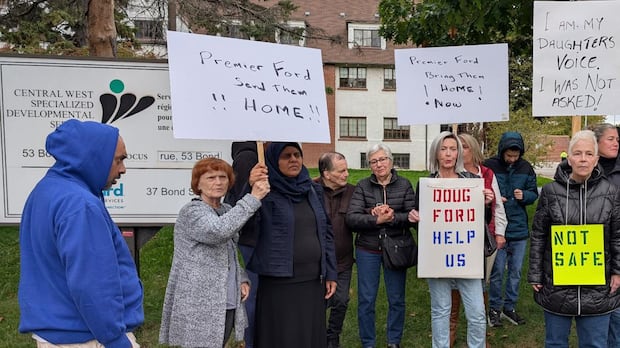
Family members of people living in Halton-area group homes say their loved ones were moved to an Oakville, Ont., facility without family consent, prompting concerns for their wellbeing. On Friday morning, about a dozen family members protested outside the facility to voice their frustration.
Central West Specialized Developmental Services (CWSDS), says the moves took place to ensure around-the-clock care in the event of a labour disruption. The charity is in the process of negotiating a new contract for the majority of its frontline workers, who are unionized with Ontario Public Service Employees Union (OPSEU) Local 249.
“We made this difficult decision with the best interests of the people we serve at heart,” CEO Patricia Kyle said in a statement to CBC Hamilton, adding that in the event of a strike, the charity would be unable to “provide 24/7 supportive living services” at individual homes in Burlington, Halton Hills, Mississauga and Oakville, but can at its central facility on Bond Street.
Kyle declined an interview and did not answer specific questions from CBC about family members’ concerns or the contract negotiations.
Family concerns include disruption and safety
Jane Juga, who lives in Quinte West, Ont., told CBC Hamilton her daughter Lori Ann Devore was moved from her Burlington, Ont., home on Sept. 30. Devore, 59, is deaf, blind and has a cognitive disability, Juga said. She’s been at CWSDS since she was a teen, Juga said, and in the Burlington home for about six years.
Devore was “thriving” in Burlington, Juga said. She could get around, help with chores and go out for van rides with staff. Juga, 77, said she has been unable to visit Devore at the new location but said she worries about how her daughter is faring.
“I can’t even imagine her frustration,” adapting to new housing, Juga said, adding she “totally” disputes CWSDS’s argument that they can better provide care this way. “I’m beside myself right now.”
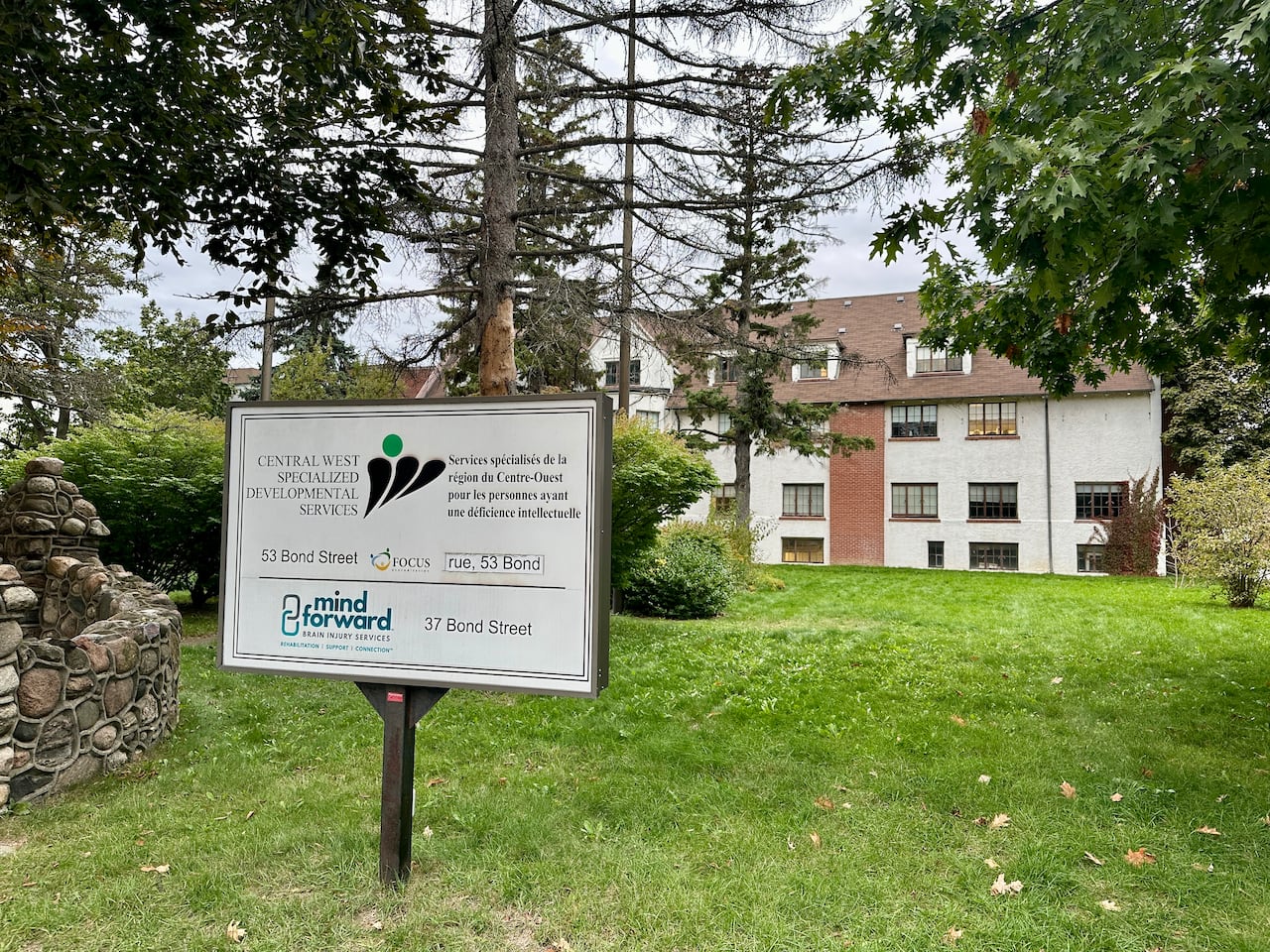 Central West Specialized Developmental Services provides services for people with disabilities, including group homes in Ontario’s Halton Region. (Conrad Collaco/CBC)
CBC Hamilton viewed a Sept. 25 email from Kyle addressed to families and caregivers. In it, Kyle said CWSDS would be suspending the respite services it usually offers in the space they are temporarily housing residents.
“CWSDS management and leadership will oversee the delivery of care with the support of qualified and trained temporary agency care providers,” Kyle said.
Juga said the people who normally care for her daughter are “absolutely fabulous,” and “love their clients.” She said she wonders about the relative skill and training agency workers might have, and worries about people who don’t know Devore caring for her.
CWSDS did not answer questions from CBC about temporary workers’ training, how many temps they may have already hired and for what work.
Union says it’s not in a strike position
OPSEU Local 249 told CBC Hamilton 241 of its members are employed at CWSDS in jobs including counsellors, support workers, therapists, cleaners and customer service.
The union declined an interview but answered questions by email, telling CBC “negotiations are not going well,” with bargaining having gone on since September 2024. After a day of conciliation — when two sides negotiate with help from a government appointed officer — CWSDS filed a “No Board” report, putting them in position to lock out members on Oct. 9.
Contrary to what CWSDS said, Local 249 is not in a legal strike position because members have not taken a strike vote, the union said.
The local said on Wednesday, its members “resoundingly” rejected a last-offer vote from their employer, with 97 per cent of voters casting a ballot. Such votes can be requested by employers in a strike or lock out position and are directed by the Ministry of Labour, bypassing the usual bargaining process.
Workers ‘deeply concerned’ about residents
“We remain committed to achieving a fair deal through negotiations and continuing to advocate for long-term funding from the provincial government,” the union said.
Local 249 said its members have had “low wage increases” for years, leading “many workers” at CWSDS to work overtime or take on second jobs. Meanwhile, the union has said Kyle received a 10-per-cent pay increase last year. Ontario public sector salary disclosure data shows that Kyle was paid $213,500.73 in 2024, up from $194,230.75 in 2023.
Members are “deeply concerned” about residents being relocated and say agency staff do not have their training, nor do they know resident needs like Local 249 members do.
The union said its members have been responsible for training agency workers and fear that once replacement staff are trained to management’s satisfaction they will be locked out. Local 249 also said agency workers are paid “significantly more” than its members.
“Our work is devalued, we are devalued, the individuals we support are devalued,” Local 249 said.
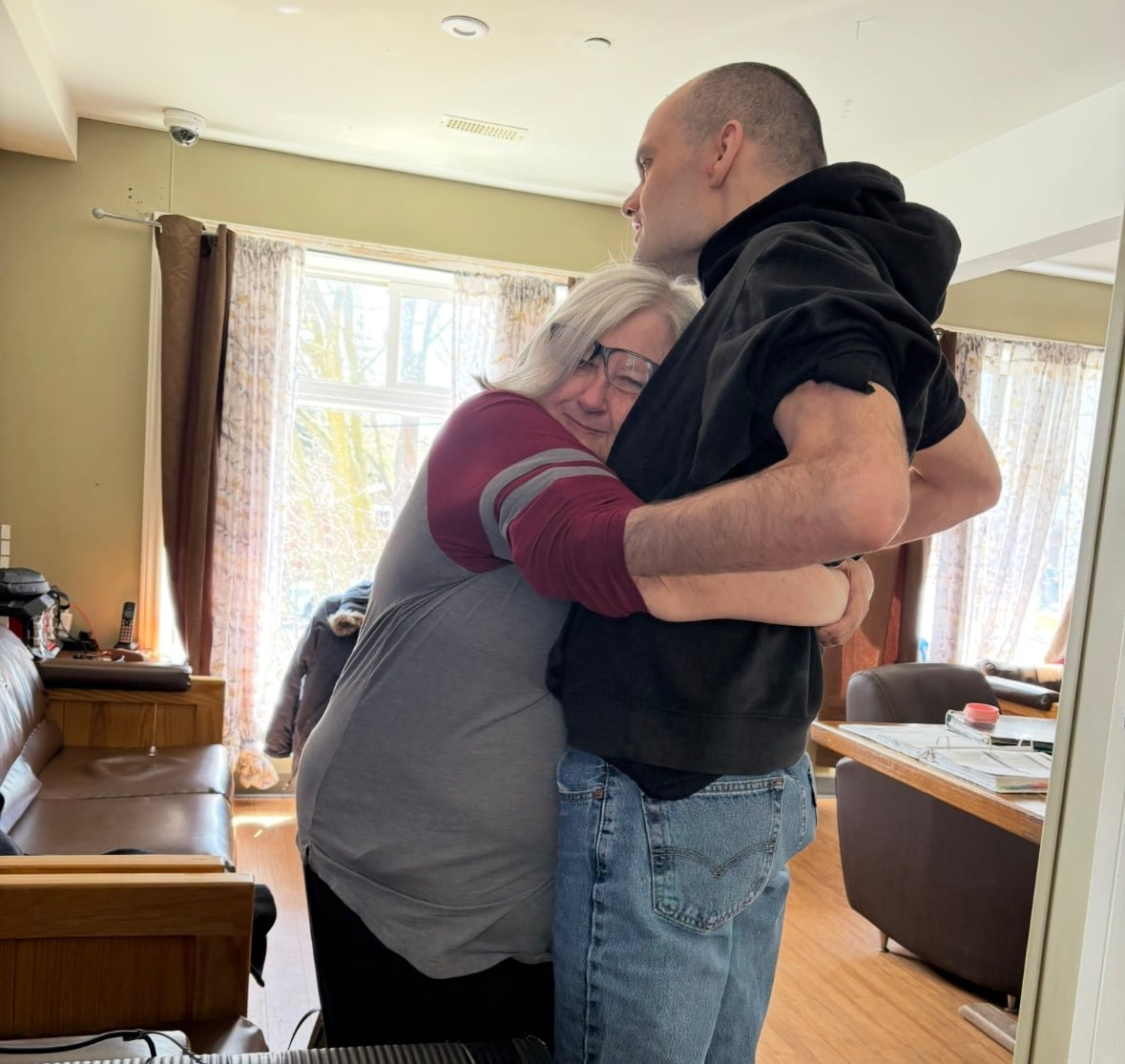 Mary Leigh, left, and her son Donald hug each other. Donald is a resident of Central West Specialized Developmental Services and normally lives in a Mississauga group home. (Submitted by Mary Leigh)
Mary Leigh is one of multiple family members speaking out. Her son Donald is a CWSDS resident who got relocated. Normally in a Mississauga group home a short drive from his mother, Donald has autism and needs a lot of support, Leigh said.
Donald’s days are scheduled in 15-minute intervals and he relies on that consistency, Leigh said. He doesn’t understand why he’s moved and now seems unsettled, she added.
Leigh also says Donald’s new accommodations are “not appropriate whatsoever.” She said he’s in a lounge that has been converted to a bedroom and has large windows and a sliding glass door. That’s problematic because Donald bangs on things to get out his frustration, Leigh said, adding any windows in his room should be partially boarded up for protection.
Leigh said she also worries Donald isn’t eating well. He doesn’t eat particular foods and the workers at his usual home know that, she said, but in Oakville, he was recently served a meal he won’t eat.
CBC Hamilton viewed emails between Leigh and CWSDS managers discussing her concerns. Leigh said she doesn’t feel heard and wants to speak with Kyle but hasn’t been able to.
She said she wasn’t asked permission prior to Donald’s move and finds that “absurd.”
“I just don’t think management cares,” Leigh said.
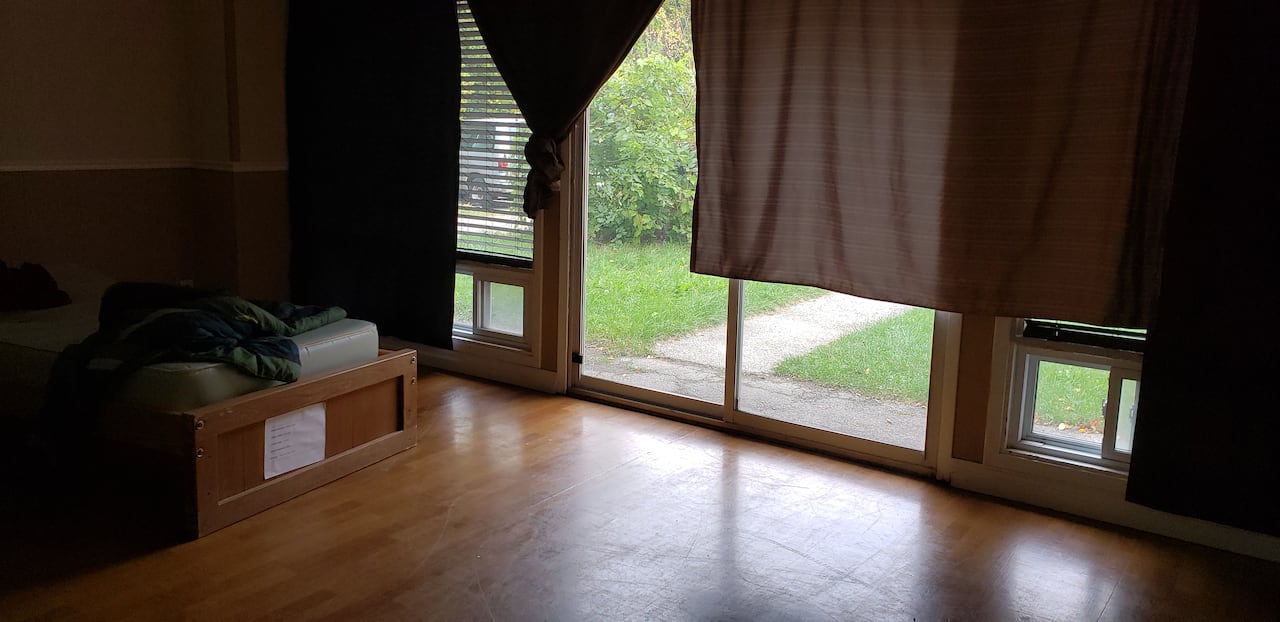 Mary Leigh said her son Donald was moved to this room in the charity’s Oakville headquarters even though she said windows in his room should be partially boarded up for his safety. (Submitted by Mary Leigh)
Both Juga and Leigh say they fear further disruption if Local 249 strikes or is locked out, but that they want the workers to get a fair deal.
“We all know what the economy has done in the last three years,” Juga said. “I don’t want to see these support workers lowballed and I get the impression that this may be what’s going to happen. I don’t want to see a strike forced.”
And if there’s not a strike, Juga said she wants her daughter and everyone else moved back as quickly as possible.
“We recognize the incredible stress this situation has created for the families whose loved ones were uprooted without their consent and thrust into chaotic living conditions,” Local 249 said, adding members “applaud the families for their work to fight for their loved ones and the staff members who support them.”
In her statement, Kyle said CWSDS is supporting residents with the transition.
“While this temporary service change has understandably raised concerns for some,” she said, “CWSDS has also received positive feedback from several family members who expressed appreciation and gratitude for the careful planning that went into orchestrating the move and ensuring the continuation of our 24/7 supportive living services.”