
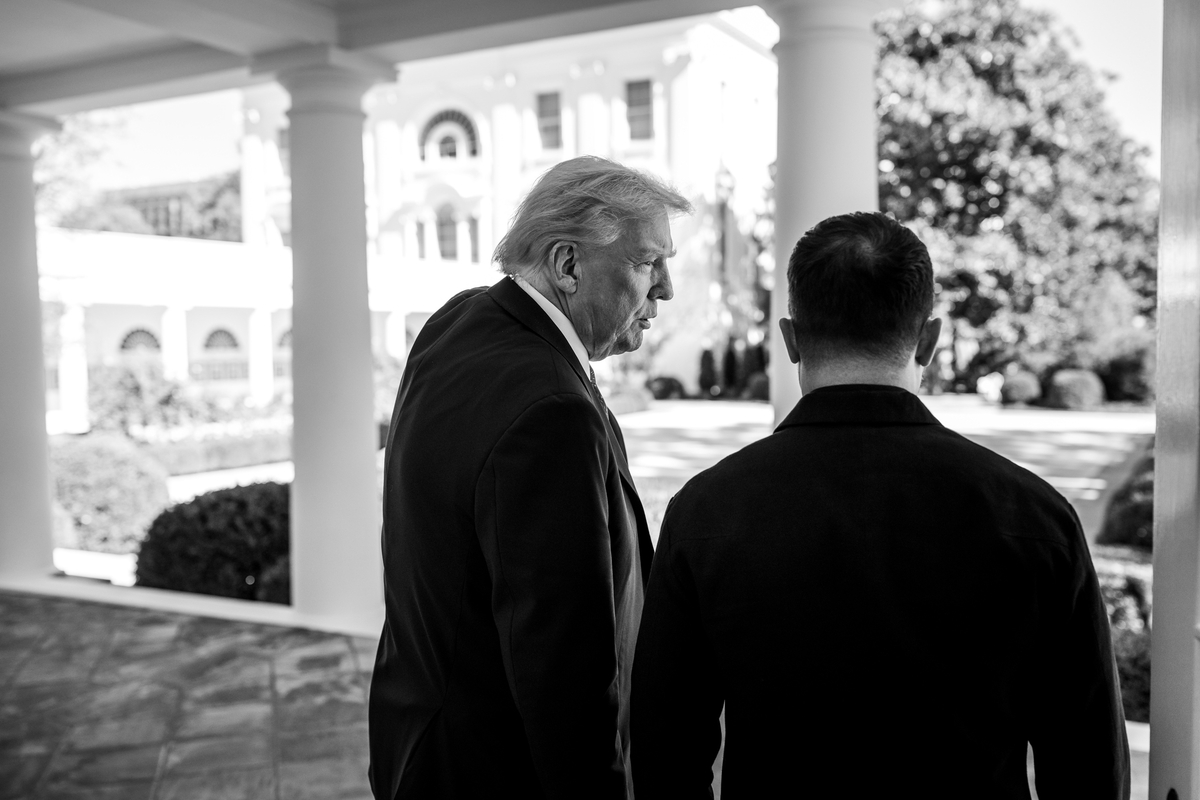
WASHINGTON, DC – President Volodymyr Zelensky departed Washington on Friday without the public assurance of long-range Tomahawk missiles he had sought, following a highly anticipated meeting with US President Donald Trump.
The encounter, framed by Trump’s singular focus on an immediate peace deal, has exposed deep fractures in the US-Ukraine relationship and provoked fury among congressional Democrats.
JOIN US ON TELEGRAM
Follow our coverage of the war on the @Kyivpost_official.
Instead of a promise of advanced weaponry, Zelensky received a demand: an emphatic call to negotiate peace.
Following the meeting, Trump declared on his Truth Social platform that he had urged the Ukrainian president – and separately, Vladimir Putin – that “it is time to stop the killing, and make a DEAL!”
Leverage and the limits of the “deal”
The US President’s hardline stance on diplomacy was precisely what military analysts predicted.
Jennifer Kavanagh, a senior fellow and director of military analysis at the Washington-based Defense Priorities think tank, told Kyiv Post in an interview Friday evening that Trump remains “very focused on ending the war and has preferred negotiation and diplomacy to continued fighting.”
Kavanagh’s assessment highlighted the transactional nature of the Trump administration, suggesting the administration views military aid as a bargaining chip, not a strategic imperative.
She was unsurprised by the silence on Tomahawks, citing their “escalation risks” and the lack of readily available launchers or sufficient US stockpiles.
Other Topics of Interest
Trump Budapest Meeting: Putin’s Last Chance? | Bohdan Nahaylo
As Trump gains momentum abroad, questions are mounting at home and in Russia: is Putin, facing battlefield failures and mounting domestic strain, beginning to lose control?
Crucially, Kavanagh highlighted a specific kind of dealmaking pitch from Zelensky: a “drones for Tomahawks” swap, or more realistically, a trade of Ukraine’s drone expertise for other critical materiel. She strongly suggested that air defense capabilities would be a more sensible return on investment than Tomahawks.
However, the debate over military aid quickly pivoted to the question of diplomatic power, particularly the leverage the US President held over Russia.
On the question of US leverage over Russia, Kavanagh pointed to Moscow’s core demands. She argued that only Trump can deliver on addressing some of those demands, particularly issues concerning NATO expansion and the European security architecture.
This gives Trump a significant “card they can play” – not by capitulating to Putin, but by keeping him engaged in the diplomatic process. Offering sanctions relief, she added, is another potent economic tool.
As for Ukraine, she noted that Trump did not publicly demand “territorial concessions” or other forms of surrender, suggesting he is still “supportive of Ukraine” and is not willing to force a collapse.
Diplomatic black hole
While some analysts saw a potential diplomatic path forward, others offered a more pessimistic view of the visit’s overall outcome, seeing a severe setback for Kyiv.
Offering a far more critical assessment of the visit’s overall outcome, Yuriy Boyechko, CEO of the US-based non-profit Hope for Ukraine, told Kyiv Post that the failure to secure military aid signaled a major negative step for Kyiv.
Boyechko argued that the most important outcome of the visit was the negative one: the failure to secure a firm commitment for long-range Tomahawk missiles.
He suggested that the prior threat of providing these missiles was merely a diplomatic ploy intended to bring Moscow to the negotiating table, a strategy underscored by President Trump’s abrupt about-face after his call with President Putin.
Where Trump had previously used the Tomahawks as an “ultimatum,” he now cited the need to preserve US stockpiles, effectively shelving the very weapon Ukraine needed for military leverage.
This public reversal meant Kyiv was leaving the White House without the game-changing military support it had hoped would help force a swift end to the war.
Boyechko concluded that the meeting effectively locked Ukraine into a “diplomatic black hole” and a drawn-out, low-yield negotiating process.
With the Trump-Putin summit now positioned as the central goal, and without concrete guarantees, the conflict’s resolution was shifting from the battlefield to high-level talks that prioritize the optics of peace over decisive action.
This sets the stage for months of grinding conflict, likely to claim many civilian lives and bring immense suffering to Ukraine this winter.
Democratic fury over ‘appeasement’
The diplomatic ambiguity was immediately seized upon by Democrats in the US Congress, who slammed the White House for undermining Ukraine and offering an implicit gift to the Kremlin.
Representative Gregory Meeks (D-NY), the ranking member of the House Foreign Affairs Committee, issued a blistering statement, accusing Trump of “appeasement over strength.”
Meeks argued that Trump “failed to deliver today on providing any support for Ukraine” and was instead playing into Putin’s hands, calling his negotiating tactics “as toothless as Trump’s supposed support for Ukraine.”
The sentiment was echoed in the Senate by Jeanne Shaheen (D-NH), who insisted in a statement that words alone would not suffice as Russia escalates its attacks.
She demanded that Trump “immediately impose tougher sanctions on Russia” and provide the long-range missiles Kyiv needs, asserting, “President Zelensky cannot leave Washington empty-handed as Putin escalates brutal attacks.”
Zelensky’s defense: avoiding escalation
Under intense scrutiny, President Zelensky attempted to defend the decision to withhold the Tomahawk issue from public discussion, stating it was necessary because the US “doesn’t want escalation.”
Despite defending the lack of a public agreement, Zelensky simultaneously affirmed the strategic power of the weapon, noting with palpable satisfaction: “I think that Russia is afraid about Tomahawks, really afraid, because it’s a strong weapon.”
In lieu of long-range missiles, the Ukrainian leader confirmed that air defense was the “main focus” of discussions, noting plans to accelerate deliveries and expand domestic production with US backing.
He also offered a glimpse into his negotiating position on territory, stating: “First, we need a ceasefire, to sit and speak and understand where we are,” and that the immediate goal is to “stop where we are… holding the current line while talks advance.”
The tense choreography of the White House meeting highlights the delicate position of the Ukrainian President, forced to navigate between the urgent requirement for military aid and the US political opposition’s insistence on a swift, if imperfect, peace.