

Standing in front of an adoring crowd at the Knesset last week, US President Trump told Israel’s leaders that “you’ve won” in Gaza.
“What a victory it’s been,” he said in a speech that was maundering even for the famously loquacious president.
Speaking before Trump — hours after the 20 remaining living hostages were released by Hamas — Prime Minister Benjamin Netanyahu was only slightly less triumphant, boasting that Trump’s plan “ends the war by achieving all our objectives.”
“All of the prime minister’s objectives have now been achieved,” said his spokeswoman, as the ceasefire came into effect.
There is one problem, however.
Get The Times of Israel’s Daily Edition
by email and never miss our top stories
By signing up, you agree to the terms
No one seems to have informed Hamas that they have been defeated.
Trump’s 20-point plan, if fully implemented, would indeed spell an unmitigated victory for Israel and likely a fatal blow to any Hamas plans to rule Gaza in the foreseeable future.
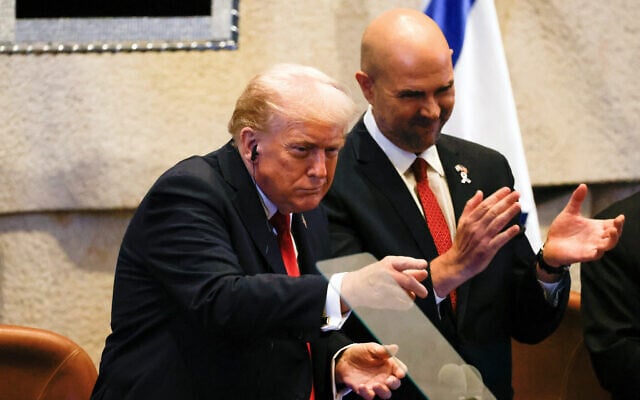
US President Donald Trump addresses Israeli lawmakers at the Knesset, as Speaker Amir Ohana applauds, October 13, 2025, in Jerusalem. (Jalaa Marey/Pool Photo via AP)
But it is nowhere near being fully implemented. Only two of the 20 clauses have been carried out, both of them concessions by Israel. It released thousands of Palestinian prisoners and gave up any potential plan to push Gazans to emigrate.
Hamas, on the other hand, seems determined to show that it controls events on the ground.
It has slow-rolled the release of the 28 slain hostages. By Sunday, it had handed over only 12, six days after the end of the 72-hour window to give up all 28 bodies.

Family and friends of slain hostage Eitan Levy attend his funeral at the Holon-Bat Yam Cemetery, October 16, 2025. (Avshalom Sassoni/Flash90)
Senior Israeli officials mince no words in their rejection of Hamas — and White House — excuses that the terror group is struggling to find or access the remaining bodies. “We know, as a matter of fact, they can easily bring back a significant number of dead hostages and give them back according to the agreement,” said Foreign Minister Gideon Sa’ar. Defense Minister Israel Katz instructed the IDF to prepare plans to return to war if Hamas continues to avoid fulfilling its obligations.
Not about to step down
Hamas does not seem especially bothered by such threats, whether they come from Jerusalem or Washington.
Hamas politburo member Mohammed Nazzal told Reuters that Hamas would not commit to disarming, a central component of Trump’s plan. This despite Trump’s threat that the terror group could be dealt with “violently” if it refuses to give up its weapons.
Hamas is not trying to hide its weapons or its determination to violently eliminate any opposition in Gaza. It has carried out public executions, and its operatives have put uniforms back on, riding around Gaza in pickup trucks brandishing rifles.

This image grab from a handout video released by the Hamas-run al-Aqsa TV’s Telegram channel on October 13, 2025, shows Hamas gunmen executing blindfolded, bound, and kneeling men as a crowd surrounds them in a street in Gaza City. (Al-Aqsa TV / AFP)
This is not the behavior of a whipped organization that is about to hand over power and give up violence.
Sunday’s attack in Rafah was the logical next step for Hamas. It had been testing how serious the Trump administration was about the terms of the ceasefire, and how determined he was to keep Israel from enforcing them by fire.
Hearing the White House make excuses for it, and seeing the IDF watching from behind the new “yellow line” in Gaza, no one should be surprised that Hamas continued to test the boundaries of the ceasefire.
Trump’s repeated declaration that “the war is over” has made that reality less likely to emerge. He has signaled to Hamas that the threat of a renewed IDF push into Gaza City is off the table, and that they have plenty of space to maneuver before they risk paying a significant price.

IDF troops of the 36th Division operate in Gaza City in a handout photo issued on October 8, 2025. (Israel Defense Forces)
Leaving a coherent Hamas organization inside of Gaza all but guarantees more conflict in the Strip, and keeps Trump’s vision of an age in which “peace and respect can flourish among the nations of the broader Middle East” a distant dream.
Hamas has shown time and again that it can suffer immense damage and return stronger than it was before. It did so after Operation Cast Lead in 2008, Operation Protective Edge in 2014, and the repeated smaller operations in Gaza since the Israeli pullout in 2005.
True, it has never taken anything like the punishment Israel inflicted since its October 7, 2023 invasion, but it remains armed, motivated, and the strongest force in Gaza besides the IDF.
There is a pathway to defeating Hamas through the US-backed agreement, but it is a narrow one. It will only work if Hamas understands that it has no wiggle room, and that any violation will be met by military force.
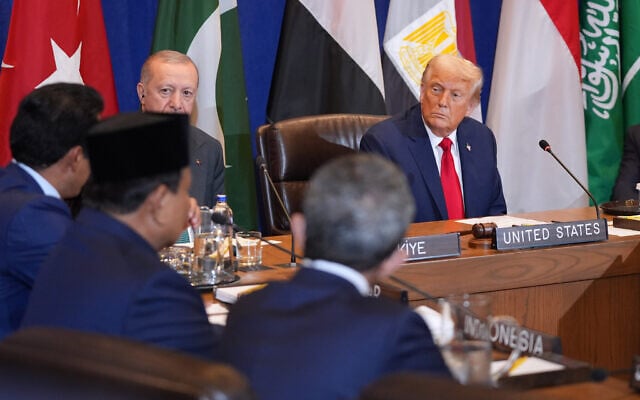
US President Donald Trump listens during a multilateral meeting with leaders of Qatar, Jordan, Turkey, Pakistan, Indonesia, Egypt, United Arab of Emirates, and Saudi Arabia, during the United Nations General Assembly, September 23, 2025, in New York. (AP Photo/Evan Vucci)
The White House is clearly determined to maintain the ceasefire, and has taken the position until now that keeping Israel from responding in force will make it more likely for Hamas to be disarmed and toppled by other means. But that fundamentally misreads what Hamas is and what it responds to.
If there is not a vigorous Israeli response, and a clear message from Trump that the IDF is free to respond to further violations, Hamas will continue pushing the bounds of the deal until it falls apart.
“Peace through strength,” Trump likes to say.
There is no better time to prove that adage.
Is The Times of Israel important to you?
If so, we have a request.
Every day, even during war, our journalists keep you abreast of the most important developments that merit your attention. Millions of people rely on ToI for fast, fair and free coverage of Israel and the Jewish world.
We care about Israel – and we know you do too. So today, we have an ask: show your appreciation for our work by joining The Times of Israel Community, an exclusive group for readers like you who appreciate and financially support our work.
Already a member? Sign in to stop seeing this
You appreciate our journalism

You clearly find our careful reporting valuable, in a time when facts are often distorted and news coverage often lacks context.
Your support is essential to continue our work. We want to continue delivering the professional journalism you value, even as the demands on our newsroom have grown dramatically since October 7.
So today, please consider joining our reader support group, The Times of Israel Community. For as little as $6 a month you’ll become our partners while enjoying The Times of Israel AD-FREE, as well as accessing exclusive content available only to Times of Israel Community members.
Thank you,
David Horovitz, Founding Editor of The Times of Israel