
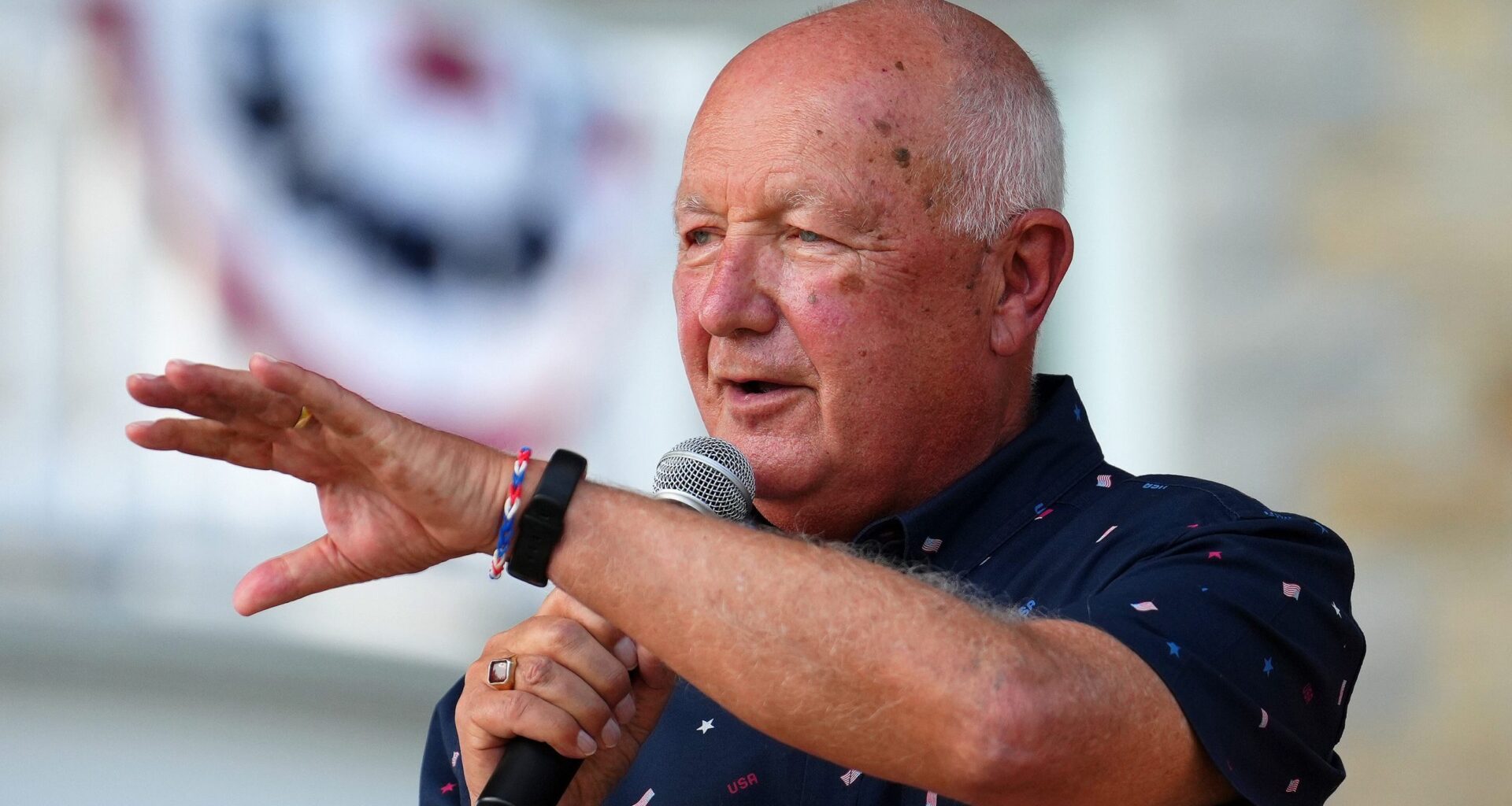
Canadians need to take the tariff dispute with the United States less personally, and stop viewing their relationship with their American neighbours as akin to being part of some sort of family, says the U.S. ambassador to Canada.
Ambassador Pete Hoekstra told CHEK News the two countries can find a way to make a deal over tariffs, but they need to focus on business and not emotion when addressing the position of President Donald Trump.
“Someone asked me today, they said, we’re a family — no, we’re not a family, we’re two independent sovereign nations who are very tightly knitted together, but we’re not a family,” Hoekstra said in an interview in Vancouver on Thursday.
“We have our national interest. You have your national interest. Sometimes those align perfectly. Sometimes there’s a little tension, and sometimes we maybe disagree.
“As we go through this discussion on tariffs, if we stretch it and pull it in different ways, that happens all the time. If people actually start doing things which start cutting it apart, that’s harder to repair.”
Cutting it apart includes “making it personal,” said Hoekstra.
“This is a business discussion,” he said. “The president has said we’re not focusing tariffs on Canada, the president said we’re going to do business differently as a country, we’re going to require every country who wants access to the American market to pay a tariff.”
Trump has set a deadline of Aug. 1 to boost tariffs on some Canadian exports to 35 per cent. Canadian officials were in Washington, D.C. on Thursday to hold talks with American officials, while reiterating Prime Minister Mark Carney’s position that Canada will not agree to a deal at any cost just to hit the deadline.
Hoekstra brushed off criticism from B.C. Premier David Eby over saying that Trump thinks Canadians are “nasty” to deal with because of their boycott of American travel and liquor.
“I’m glad he’s paying attention,” Hoekstra said of Eby.
“If he wants to disagree with the president, take umbrage with it, he can talk to the president.”
Hoekstra relayed how Trump felt during an address to the Pacific NorthWest Economic Region Foundation summit in Bellevue, Wash., earlier this week.
“Canadians staying home, that’s their business, you know. I don’t like it, but if that’s what they want to do, it’s fine. They want to ban American alcohol. That’s fine,” Hoekstra told the audience.
“There are reasons why the president and some of his team referred to Canada as being mean and nasty to deal with, OK, because of some of those steps.”
Eby’s office distributed Hoekstra’s comments to media, and then the premier repeatedly blasted Hoekstra and Trump for the characterization while attending a meeting of other premiers and the prime minister this week.
“Do they think Canadians are not going to respond when the president says, ‘I want to turn you into the 51st state and beggar you economically unless you bow to the U.S.’?” Eby told CBC News.
“Obviously, Canadians are outraged.”
Hoekstra was appointed U.S. Ambassador to Canada in April by Trump. A former U.S. congressman from Michigan, he also served as ambassador to the Netherlands in Trump’s first term, and as chair of the Republican Party in Michigan during the November U.S. election in which Trump won his second term.
During Hoekstra’s recent swing through British Columbia, he toured BC Place, met with Vancouver organizers of the FIFA 2026 World Cup, had tea with Lt.-Gov. Wendy Cocchia, held a roundtable with the Mining Association of BC, met with the University of British Columbia’s president and spoke to a roundtable at the Greater Vancouver Board of Trade. He did not visit Vancouver Island.
He said his goal is to listen to Canadians, report back to the Trump administration on what they are saying and advance the president’s agenda.
“We’ve got potential investments on the books, on both the north and the south side of the border,” said Hoekstra. “Let’s get through this so we have the framework.”
Hoekstra said he fields questions from Canadians on how best to deal with Trump, but that his goal is to listen and pass on advice back to the president, and not the other way around.
“It’s not my job to advise the Canadians,” he said.
“The Canadians have made it very, very clear that they don’t appreciate advice from Americans — not specifically on that question, but it’s kind of like: no we’re Canada, we will set our own direction and what’s best for Canada.
“My position is to advise the president of the United States of America how best to achieve his objectives, not for me to advise the Canadians on how best to achieve their objectives.”
Eby and others have said the Trump tariff dispute has irrevocably harmed the relationship between the two countries. Asked whether Canada and the U.S. have a path to return to normal, Hoekstra said:
“It depends on how people behave over the next period of time.”