
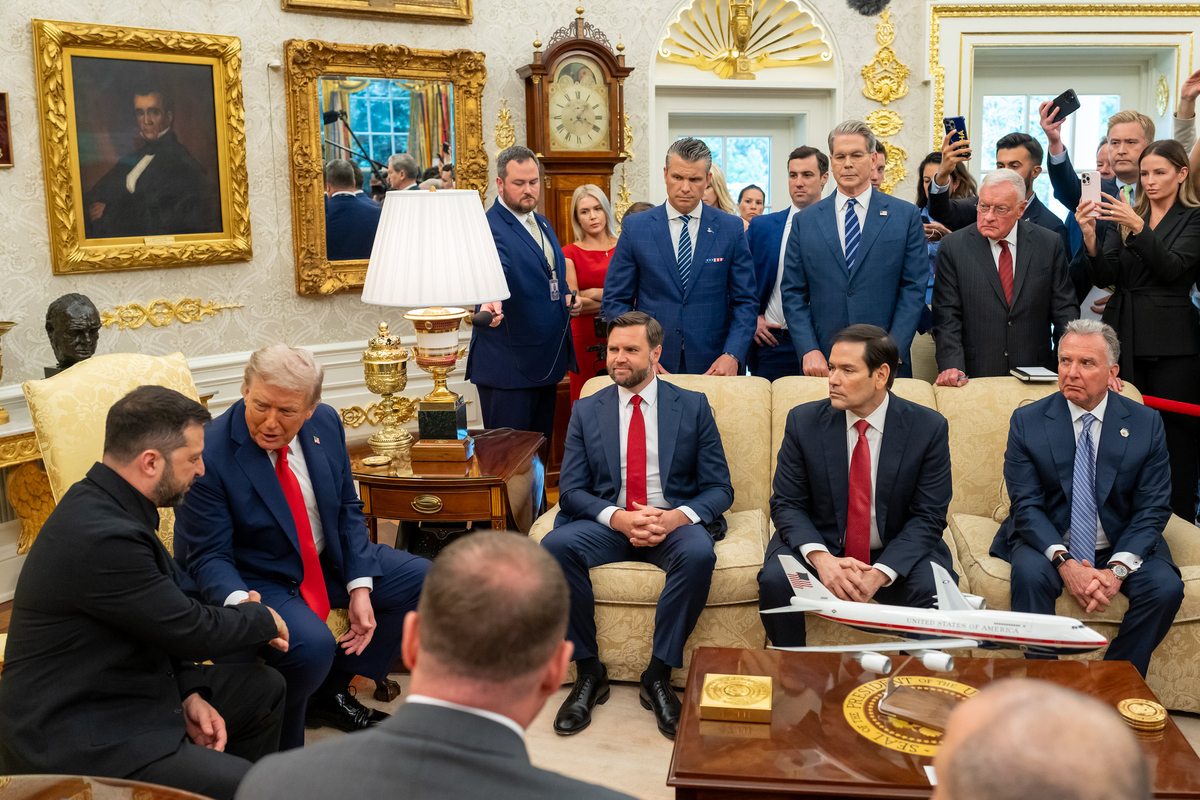
WASHINGTON, DC – US President Donald Trump on Sunday reiterated his call for an immediate ceasefire between Russia and Ukraine along current front lines, demanding that Kyiv effectively cede Russian-occupied territory, including most of the Donbas region, to end the conflict.
Speaking to reporters late Sunday aboard Air Force One, Trump insisted that the topic of the Donbas was not even discussed during his recent conversations with Russian President Vladimir Putin, reiterating his focus on freezing the conflict.
JOIN US ON TELEGRAM
Follow our coverage of the war on the @Kyivpost_official.
“No, we never discussed it,” Trump said when asked, citing earlier media reports, if he had talked to Putin about the illegally occupied eastern region.
Trump stated his current solution for an immediate halt to the fighting based on the existing front lines. He insisted the two sides “should just stop at the lines where they are – the battle lines,” adding that negotiating the rest is “very tough.”
When pressed for clarity on the fate of the Donbas, a region whose territories have been a central point of Russia’s war, the US President’s answer was blunt, endorsing a de facto partition as an initial step.
Asked what should happen with the Donbas region, Trump replied: “Let it be cut the way it is. It’s cut up right now. I think 78% of the land is already taken by Russia. You leave it the way it is right now. They can negotiate something later on down the line.”
Other Topics of Interest
Russia Hits Trains and Power Grid, Leaving Thousands Without Electricity
Preview: Russian attacks hit railway lines in Sumy and power facilities in Chernihiv, leaving tens of thousands without electricity and disrupting train services nationwide.
Trump concluded with his core message: “But I said cut and stop at the battle. Go home. Stop fighting, stop killing people.”
Vance claims Tomahawk decision still pending
Trump’s comments came as his administration is still weighing whether to approve a crucial weapons request from Kyiv.
Earlier on Sunday, Vice President J.D. Vance addressed reporters at Joint Base Andrews, attempting to balance an optimistic outlook on a resolution with cautiousness about the specific increase in US military aid.
When questioned about his optimism for a resolution to the Russia-Ukraine war, Vance pointed to the administration’s sustained diplomatic efforts. He stated the entire team “has been working at this for eight months” and will “keep on walking down the pathway of peace.”
He expressed optimism but conceded the “timeline is anybody’s guess.” On the critical question of whether the US would sell long-range Tomahawk missiles to Kyiv, a move Ukraine has lobbied for aggressively, Vance confirmed the request was under active consideration, but that no final decision had been made.
“The [US] president right now is certainly hearing that request from the Ukrainians,” Vance stated. He confirmed that the decision is ultimately Trump’s, but added, “he has not yet made the decision to give Tomahawks to Ukraine.”
Vance said that any decision would be filtered through an “America First” lens, prioritizing the domestic military stockpile. He said that this means “we need to have the critical weapon systems for our own military, for our own troops.”
He said that Trump is “trying to bring peace because he thinks that’s what’s in America’s best interest,” and that if he thinks it is in America’s best interest to sell additional weapons, “he will do that.”
Analyst: Tomahawks are “leverage” to force Putin’s hand
The apparent contradiction between the push for a fixed peace line and the potential for a major arms sale to Ukraine was interpreted by one analyst as a strategic exercise in coercive diplomacy.
Glen Howard, president of the US-based Saratoga Foundation think tank, told Kyiv Post on Sunday that Trump’s policy is fundamentally about generating a negotiating advantage.
“With Trump, it’s all about leverage,” Howard said bluntly. He suggested the wavering on the missile sale is tactical: “He wants to use the weapons as leverage against Putin and thinks he can lure Putin back to Budapest” for a deal.
Howard pointed to an internal White House struggle between a “Witkoff camp,” which favors immediate territorial concessions, and a “Kellogg/Rubio faction,” which is more aligned with traditional support for Kyiv. The two divisions refer to Steve Witkoff, Trump’s special envoy to Putin and a former Florida real estate broker, and Lt. Gen. (Ret.) Keith Kellogg, Trump’s envoy to Kyiv, and Mark Rubio, the Secretary of State.
The analyst suggested the re-emergence of a partition proposal was a worrying sign of the former’s influence, noting the “disheartening” fact that “Trump revived the Donetsk deal.”
He noted, however, that the key diplomatic route is currently being steered by Rubio, which he viewed as a positive sign for Kyiv’s interests.
Howard noted that “Rubio is meeting with the Russians and there remain some preliminary negotiations between the US and Moscow.” He added that he expects Rubio to “demand clarity from the Russians.”
The Tomahawk threat, Howard argued, remains the strongest card in Washington’s hand to ensure good faith from Moscow.
He concluded by noting the contradiction between Trump’s conciliatory public rhetoric and the military realities of US support. “The fact is that the Trump administration… continues to help Ukraine target Russian oil refineries by passing on intelligence,” Howard said.
The analyst said that both intelligence sharing and Tomahawk sales are “related to leverage,” concluding that Trump “is doing it to both leaders in an attempt to play the role of a neutral arbiter. This may work in New York real estate, but it does not work well when it comes to dealing with the Kremlin.”