
Unlock the Editor’s Digest for free
Roula Khalaf, Editor of the FT, selects her favourite stories in this weekly newsletter.
Scores of Volodymyr Zelenskyy’s MPs are potentially refusing to vote to restore the independence of Ukraine’s anti-corruption agencies, fearing the regained powers will be used by prosecutors to take revenge against them.
According to three people close to Ukraine’s leader, as many as 70 MPs from the ruling Servant of the People party have signalled their unease with the measure, which rolls back a bill hastily pushed through parliament on Tuesday.
The holdouts may put in jeopardy Zelenskyy’s efforts to undo a bill, widely criticised by Ukraine’s allies and civil society, that subordinated the country’s main anti-corruption agencies under a prosecutor-general chosen by the president.
“People are scared to be unjustly prosecuted as a revenge,” said one of the top managers of Zelenskyy’s parliamentary faction.
Parliament Speaker Ruslan Stefanchuk said on Friday that the new bill would be considered during a session on July 31. But given the doubts over MPs backing the legislation, it may be delayed, or tabled at a time when there are too few MPs present to pass it.
The faction leader and the senior official said that fear of retribution arose after the publication of an interview with the head of the Specialised Anti-Corruption Prosecutor’s Office (Sapo), one of the agencies whose independence was removed by the lawmakers’ votes and Zelenskyy’s signature on the law on Tuesday.
Speaking to the Ukrainian public broadcaster Suspilne on Thursday, head of Sapo, Oleksandr Klymenko, said his organisation was “collecting all the information” about how the original bill came about and vote unfolded.
“We will analyse all the situations, events, statements, all the accusations, claims against us. Down to the molecules,” he said. “We will recreate the chronology of events second by second and give an analysis of all this.”
 Oleksandr Klymenko, head of the Specialised Anti-Corruption Prosecutor’s Office, insisted ‘We have never engaged in political persecution’ © Global Images Ukraine via Getty Images
In a statement to the Financial Times on Friday, Klymenko said “Only people involved in corrupt schemes have reason to fear Nabu and Sapo. We have never engaged in political persecution,” he added. “All investigations by Nabu and Sapo are based totally on facts and evidence, not on political positions or the votes of members of parliament.”
“The independence of anti-corruption institutions is not a threat, but one of the key guarantees of justice, the rule of law and the continued democratic development of Ukraine,’’ he said.
The original bill passed on Tuesday with 263 votes; 226 votes are needed for legislation to be adopted in the the Verkhovna Rada, Ukraine’s parliament.
Recommended

The MP from Zelenskyy’s party confirmed there was concern among many members, but said they believed it still had a good chance to pass.
The senior official said that many people feared Sapo and its partner agency the National Anti-Corruption Bureau (Nabu) would open criminal probes into them. A law enforcement official familiar with Nabu’s work said that there were investigations open that involved sitting MPs.
The senior official said that several MPs from Zelenskyy’s party were considering giving up their mandates rather than voting on the new bill.
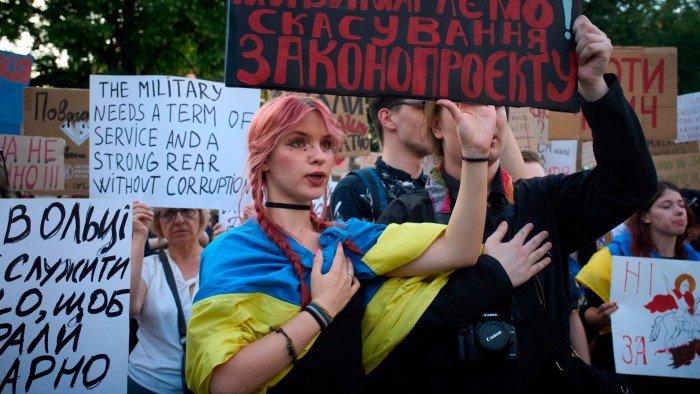
The law signed by Zelenskyy on Tuesday that subordinated Nabu and Sapo to the executive sparked one of the biggest political crises of his presidency and the largest anti-government protests since the start of the war.
He softened his stance on the issue after taking advice from UK prime minister Sir Keir Starmer and speaking to western partners, including French President Emmanuel Macron and European Council president António Costa, who urged him to repeal the law immediately.
Zelenskyy said on Thursday that he had submitted a new draft law to the Ukrainian parliament that would restore full independence to the agencies while putting measures in place to ensure there would be no Russian influence within them or any other law enforcement body.
Zelenskyy’s justification for pushing the original bill through was the alleged infiltration of Russian spies within Nabu.
Nabu and Sapo said late on Thursday that they supported the president’s new bill.
Zelenskyy said the revised bill included “new provisions aimed at protecting against influence” by Russia’s spy agencies, “primarily in response to cases involving certain representatives of Nabu”.
It calls for employees of all law enforcement agencies, including Nabu, who have relatives originating from or residing in Russia to undergo polygraph tests every two years.