
Unlock the White House Watch newsletter for free
Your guide to what Trump’s second term means for Washington, business and the world
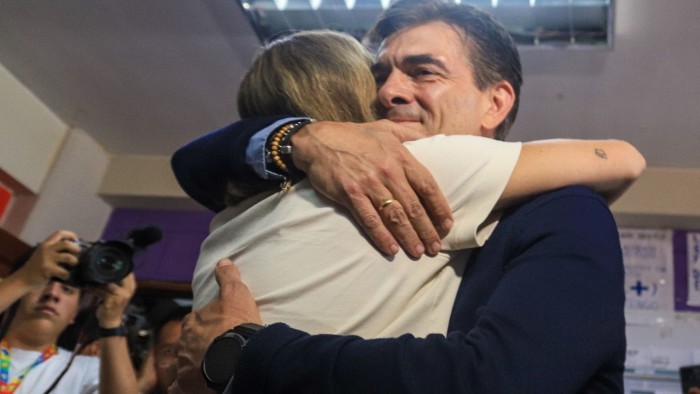
Centrist senator Rodrigo Paz has won Bolivia’s presidential election as the South American country swung to the right during an economic crisis.
Paz secured 54.5 per cent of the vote in Sunday’s run-off, well ahead of Jorge Quiroga, his conservative rival, on 45.5 per cent, according to preliminary results.
Oscar Hassenteufel, president of the Supreme Electoral Tribunal, said the trend in the results was “irreversible”. Paz will take power on November 8.
The election ends a long period in power for the Movimiento al Socialismo (MAS), which governed for all but one of the past 20 years, first under the charismatic leftist Evo Morales then under Luis Arce.
Strained by economic mismanagement and infighting, the MAS won just over 3 per cent of the vote in the first round in August. The next congress will be dominated by centrist and rightwing parties.
Paz, the 58-year-old son of former president Jaime Paz Zamora, won voters over with his promise of “capitalism for all”, carving a path between the MAS and its traditional opposition and promising to maintain social programmes while promoting private-sector growth.
Paz also pledged to rebuild relations with the US, which have been chilly since Morales expelled the US ambassador in 2008 after accusing him of conspiracy.
US secretary of state Marco Rubio this week described Bolivia’s election as “a transformative opportunity”.
Paz will need to take rapid measures to tackle the country’s economic crisis. Bolivia has one of the highest inflation rates in Latin America, with prices in September up more than 23 per cent year-on-year.
Recommended

Foreign exchange reserves all but ran out in March 2023, forcing the government to sell gold reserves to pay for fuel imports and service debt.
On the campaign trail, Paz rejected the need for a loan from the IMF but met officials from the fund on a recent trip to Washington.
Paz has said his government will start to bring the fiscal deficit down from more than 10 per cent of GDP by gradually lifting the fuel subsidy that cost the government $2bn, or 4 per cent of GDP, in 2024.
At some point, the new government will have to loosen the fixed exchange rate, which has been set at roughly $b7 to the dollar since 2011. In practice, few dollars are available at this rate and the US currency sells for almost twice that amount on the black market.
Paz has also raised the possibility of reforms to mining and hydrocarbon laws, which could entice foreign direct investment and reactivate the sectors.
But Paz’s Christian Democratic party will lack a majority in the next congress and will have to strike deals to advance its agenda.
One possible coalition partner is the Unidad party of Samuel Doria Medina, another centrist who came third in the presidential election’s first round before lending his support to Paz.