
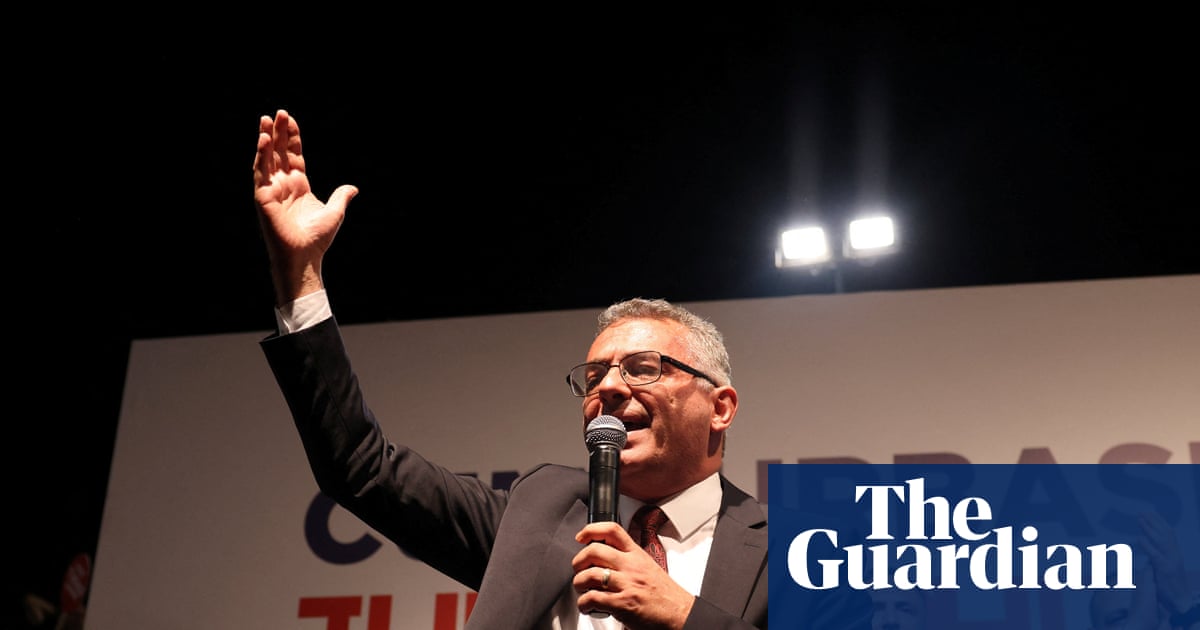
Turkish Cypriots have handed the pro-European leftwing leader Tufan Erhürman a resounding victory in a presidential poll likely to inject renewed vigour into the deadlocked peace process on Cyprus.
Erhürman, 55, who campaigned on reviving stalled UN-brokered talks to reunify the island, defeated the incumbent nationalist, Ersin Tatar, by nearly 27 percentage points – a landslide win that surprised even his most ardent supporters.
Tatar, whose five-year tenure had been dominated by the rallying cry of “a two-state solution” to the Cyprus problem, picked up 35.8% of the vote against 62.8% for his opponent. In contrast to the moderate Erhürman, the hard-right nationalist had been openly backed by Ankara.
News of the result was met with scenes of euphoria in the Turkish-occupied north. Analysts described the electoral win as a potential gamechanger on an island that has been ethnically split for more than 50 years between Greeks in the internationally recognised south and Turks in the north.
“His win offers hope for peace on Cyprus,” the former MEP Niyazi Kızılyürek said on Sunday. “Supporters say they expect real change in everyday life, starting with confidence-building measures, and everyone expects that he will want to resume negotiations based on UN resolutions very soon.”
Erhürman’s supporters celebrate his resounding win. Photograph: Yiannis Kourtoglou/Reuters
The outcome, he told the Guardian, would be “a test” for Greek Cypriots. “Its easy when the opposite side doesn’t want to talk, which was the case with Tatar. Now they will be forced to respond to a charismatic Turkish Cypriot leader who wants to sit down and negotiate.”
UN-brokered negotiations to reunite Cyprus have been on pause since they spectacularly broke down in the Swiss mountain town of Crans-Montana eight years ago – the longest hiatus in the peace process ever.
Polls had indicated a neck-and-neck race between the election’s two main contenders.
The scale of Erhürman’s victory showed that the decidedly secular Turkish Cypriots were tired of isolationist policies that had seen the territory become increasingly aligned with the Islamist leadership of the ruling AKP party in Ankara, as well as wanting a shift towards Europe. The community has long complained of its identity being eroded under the influence of Turkey, the only country to acknowledge the breakaway republic.
“Supporters of Erhürman see themselves as an autonomous ethno-political community, not as Turks of Cyprus, and they want to keep it that way,” said Kızılyürek, adding that the children of Turkish settlers born in the north had been especially appalled by what they perceived as the “anti-democratic turn” of Turkey in recent years.
“They voted for Erhürman in a big way because they want their future to be in the European Union,” he said.
Ersin Tatar speaks to the media after casting his ballot. Photograph: Birol Bebek/AFP/Getty Images
Cyprus has been divided since 1974 when a coup aimed at union with Greece – engineered by the military junta then in power in Athens – prompted Turkey to invade and seize the island’s northern third. Ever since, as many as 45,000 mainland Turkish troops have been stationed in the north.
skip past newsletter promotion
Sign up to Headlines Europe
A digest of the morning’s main headlines from the Europe edition emailed direct to you every week day
Privacy Notice: Newsletters may contain information about charities, online ads, and content funded by outside parties. If you do not have an account, we will create a guest account for you on theguardian.com to send you this newsletter. You can complete full registration at any time. For more information about how we use your data see our Privacy Policy. We use Google reCaptcha to protect our website and the Google Privacy Policy and Terms of Service apply.
after newsletter promotion
In 1983 the territory unilaterally declared independence, but in the absence of a settlement decades of international isolation have ensued.
Although Cyprus, the EU’s most easterly state, joined the bloc in 2004, the benefits of membership are only applied in the south and will not extend across the whole island until it is reunified.
Erhürman, a professor of law, has pledged to explore a federal solution, which has been long supported by the international community, under which Greek and Turkish Cypriots would live in a bi-communal, bi-zonal federation.
On hearing the outcome of Sunday’s vote he instantly issued a message of unity, telling his compatriots he would embrace them regardless of their party affiliation.
Sami Özuslu in Nicosia’s UN-patrolled buffer zone. Photograph: Helena Smith/The Guardian
Sami Özuslu, an MP in Erhürman’s main opposition Republican Turkish party, said reunification talks would be back at the top of the agenda.
“We don’t have another five years to waste,” he said standing in the UN-patrolled buffer zone that bifurcates Nicosia, the island’s capital. “Mr Tatar was the worst president the Turkish Cypriots ever had. Not once did he sit down at the negotiating table, and look where that got us. We need hope and only Mr Erhürman can offer that.”