
Property owners in an area of Richmond have been warned that the recent B.C. Supreme Court decision recognizing Aboriginal title within city limits could cast immense uncertainty over their property ownership and land titles.
In a new notice letter issued by Richmond Mayor Malcolm Brodie, property owners — including homeowners in the impacted area — were advised that the court’s August 2025 ruling siding with the Cowichan Tribes may affect the legal status of certain properties within the city.
Despite the land having been granted in fee simple by the Crown more than a century ago, the court found that members of the Cowichan Tribes hold Aboriginal title to approximately 732 acres in southeast Richmond — a waterfront area immediately adjacent to the Fraser River, with residential, commercial, industrial, and agricultural uses.
“If you look at the draft map attached to the briefing, your property is located within the Claim Area outlined in green. For those whose property is in the area outlined in black, the Court has declared Aboriginal title to your property which may compromise the status and validity of your ownership — this was mandated without any prior notice to the landowners. The entire area outlined in green is claimed on appeal by the Cowichan First Nations,” wrote Brodie in the notice distributed to impacted property owners.
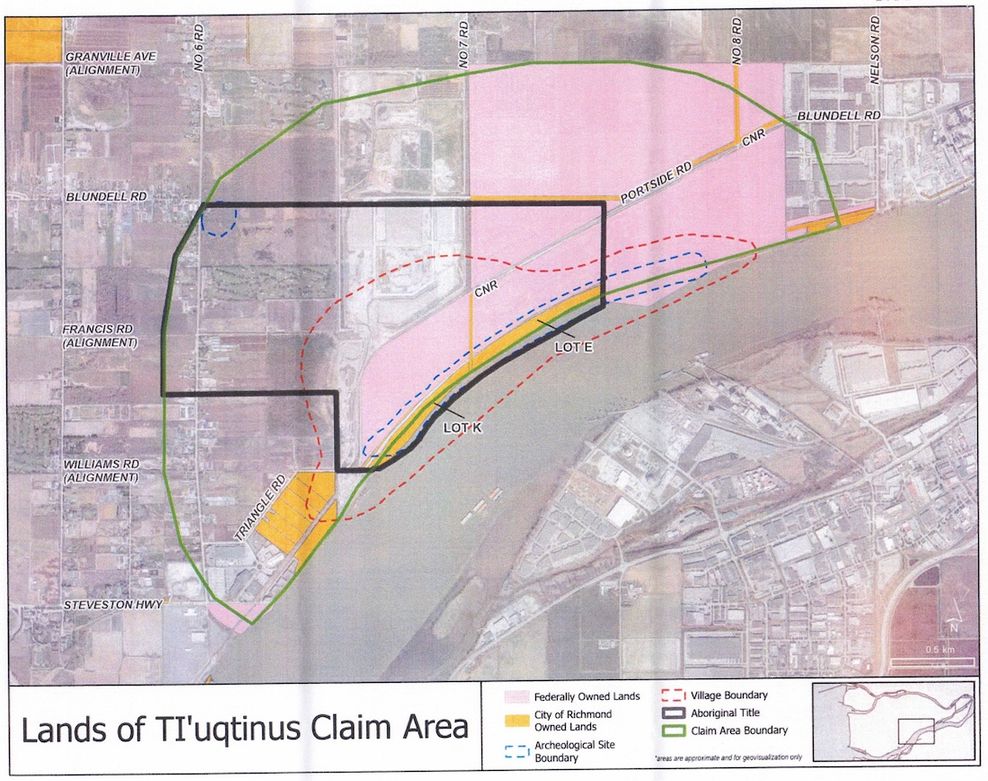
Aboriginal title to the Cowichan Tribes granted by the August 2025 court decision (black) and the larger area pursued by the First Nations (green). (City of Richmond)
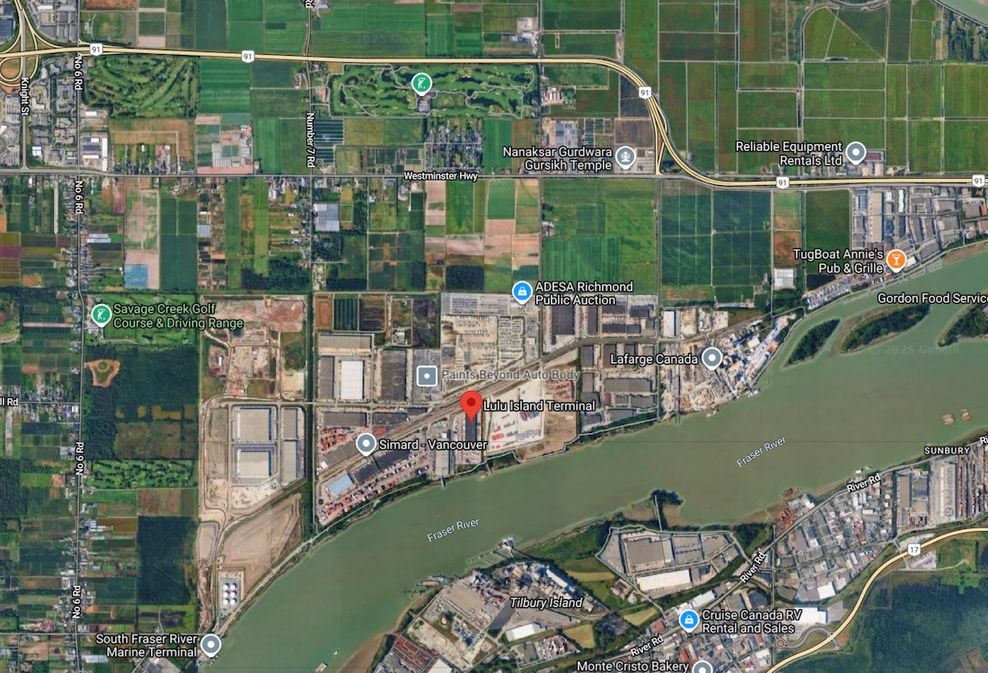
Cowichan First Nation’s claimed area in southeast Richmond. (Google Maps)
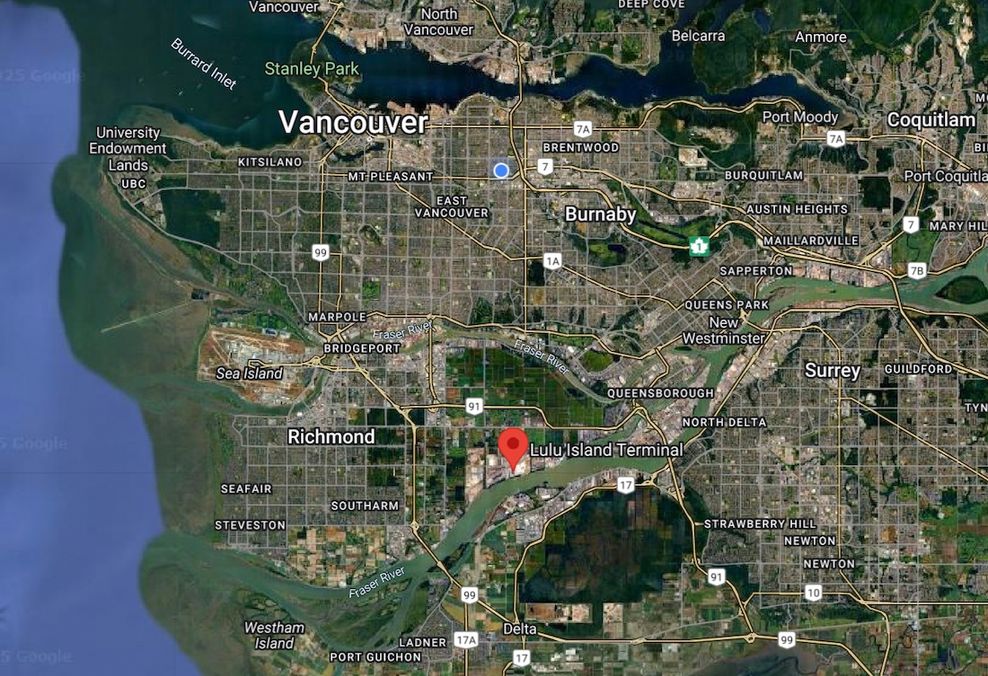
Cowichan First Nation’s claimed area in southeast Richmond. (Google Maps)
Cowichan Tribes to appeal for even more land than granted by court ruling
The Cowichan Tribes are a collective of First Nations based on Vancouver Island, arguing during the court trial that they historically had a summertime village within the area in question.
The municipal, provincial, and federal governments and the Musqueam Indian Band are appealing to have this ruling overturned. During the trial, the Musqueam and Tsawwassen First Nations went as far to dispute the existence and legitimacy of the Cowichan Tribes.
From the outset, the Cowichan Tribes sought an area of 1,846 acres to be designated under their Aboriginal title. Although trial judge Justice Young deemed about 40 per cent of this area to be under Aboriginal title, the Cowichan Tribes are launching their own appeal process to expand the declared Aboriginal title area that covers the entire green area in the map — all 1,846 acres, an area equivalent to nearly twice the size of Vancouver’s Stanley Park, instead of 732 acres.
The City is hosting an information session on the evening of Tuesday, October 28, 2025 at Richmond City Hall to help property owners understand the implications.
The August 7 decision by Justice Young marks a historic first: recognition of Aboriginal title over urban lands that were long ago subdivided, sold, and registered under B.C.’s Torrens system.
During the trial, the municipal government was the only party to argue that historical Crown grants should have extinguished Aboriginal title.
Federal and provincial lawyers, the City’s briefing notes suggest, were constrained by internal political directives from government leaders that limited their arguments in court — a fact that has drawn public criticism and speculation that the federal and provincial governments “pulled their punches” and did not defend the interests of the public and private property owners.
“Enormous uncertainty into the security of any title in British Columbia”
The City’ briefing attached to the notice letter warns that the ruling “introduces enormous uncertainty into the security of any title in British Columbia,” given that the lands in question were fully alienated and registered under provincial law about 150 years ago. No private landowners were formally notified of the previous litigation, despite the possibility that their properties could be affected by the outcome.
“Richmond is the only non-Crown landowner affected by the declarations who is party to the appeal proceedings. It will be making legal arguments that Aboriginal title and fee simple title cannot co-exist over the same lands. It will also be arguing that in rem remedies are not available to Indigenous claimant groups in circumstances where innocent landowners have acquired land in fee simple,” reads the briefing by the City.
As the appeal moves forward, lawyers and property owners alike are watching closely — aware that the Cowichan decision could reshape the landscape of land ownership and Aboriginal title law across B.C. and elsewhere in Canada.
For property owners within the disputed area in Richmond, there are questions over how the attached Aboriginal title could impact land values, mortgages, and the ability to sell the properties.
The court’s Cowichan Tribes decision, coupled with the more recent decision granting the Haida First Nation with Aboriginal title across the Haida Gwaii archipelago, have ignited fierce criticism of the BC NDP-led government’s approach toward reconciliation, with ramifications that could severely negatively impact the economy, investment climate, and social stability.
Conservative Party of B.C. leader John Rustad has formally requested Premier David Eby to pause all negotiations between the provincial government and First Nations, until the Supreme Court of Canada can determine whether Aboriginal title and private property can co-exist over the same land.