
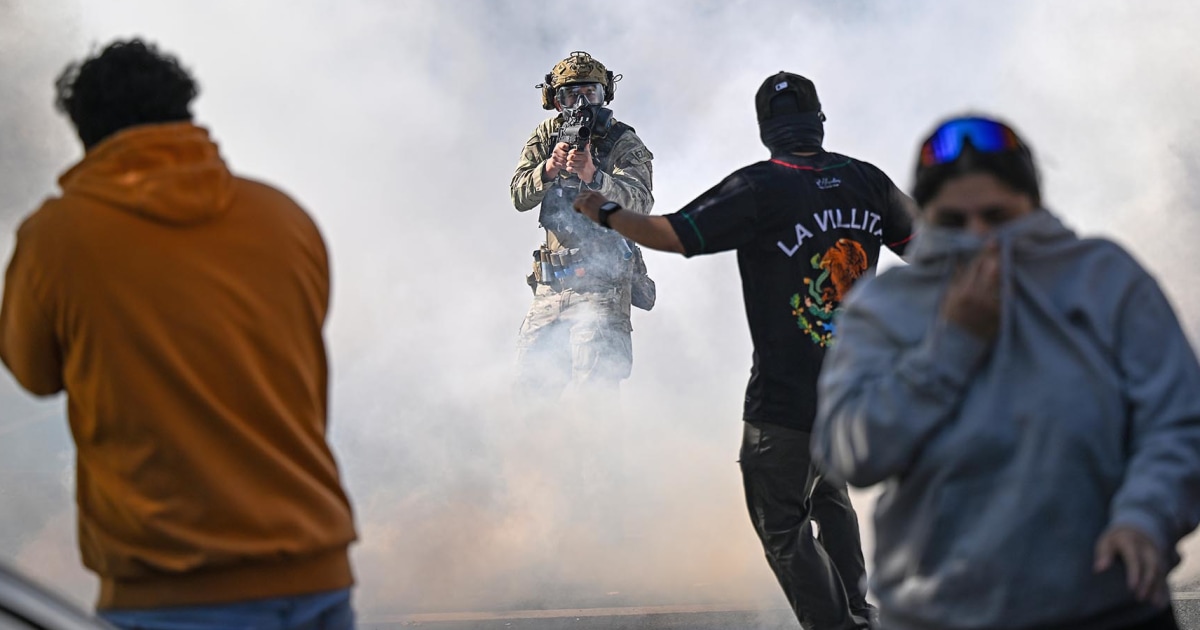
A federal judge in Chicago is set to question federal immigration authorities on Monday about whether they violated a court order with their continued use of tear gas and violent tactics against protesters and journalists in the area.
U.S. District Judge Sara Ellis for the Northern District of Illinois previously ruled that immigration agents can’t use tear gas on journalists and protesters who pose no threat — yet the incidents have continued, drawing rebuke from Ellis. She has also ordered that federal agents wear and use their body cameras.
The court hearing Monday morning comes as immigration enforcement has surged in the area as part of Operation Midway Blitz, which the Department of Homeland Security said last week has led to more than 1,500 arrested around Illinois. DHS did not immediately respond to request for comment about the hearing.
Scenes of federal agents detaining people around the city, sometimes while using physical force, have led to an increase in demonstrations against President Donald Trump in Chicago. Community members have formed groups to monitor activity from Immigration and Customs Enforcement and Customs and Border Protection in what they say is an attempt to protect their city from government overreach.
The confrontations between protesters and federal immigration agents have escalated, with instances of federal agents using tear gas in Chicago neighborhoods.
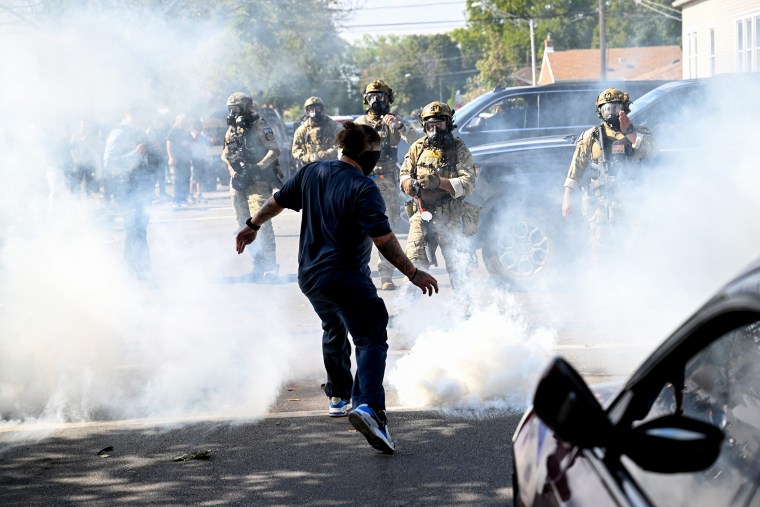 A resident of Chicago’s East Side kicks a tear gas cannister back towards officers on Oct. 14.Joshua Lott / The Washington Post via Getty Images
Days after Ellis’ Oct. 9 order restricting the use of chemical agents on protesters and journalists, federal agents used “crowd control measures” to disperse a crowd in Chicago’s Southeast Side, according to a statement from a CPB spokesperson. NBC Chicago reported that tear gas was used on crowds that had gathered after a collision between a Border Patrol vehicle and another car that was being pursued by the agents. CBP said the crowd turned “hostile.”
“This type of escalation is going to cause harm — it’s not the people of Chicago. It is the federal agents,” said Beatriz Ponce De Leon, Chicago’s Deputy Mayor of Immigration and Refugee Rights, according to NBC Chicago.
The lawsuit first came in response to multiple confrontations around an ICE processing facility in suburban Broadview, Illinois, in late September and October where federal agents fired pepper balls and tear gas and used physical force, including slamming people to the ground, as protesters tried to block vehicles from entering and leaving the facility.
The lawsuit was filed on Oct. 6 by journalists and protesters looking to restrain the ability of federal agents to use excessive force and retaliatory tactics. The plaintiffs claimed the actions illegally restricted the constitutional right granted by the First Amendment to peacefully assemble and gather news.
Last week, DHS said on social media that its enforcement surge in the area, known as Operation Midway Blitz, “is making Illinois SAFE again” and that they had arrested over 1,500 people across Illinois, including criminals and gang members. The agency has also said their officers are being targeted.
Ellis said last week she had been a “little startled” after seeing images of clashes between agents and the public in the Chicago area.
DHS is also asking for modifications and exceptions to the judge’s order on body-worn cameras.
Ellis had ordered the interim head of the Chicago regional ICE field office, Russell Hott, to appear in court for the 10:30 a.m. hearing. He then abruptly returned to Washington on Friday.
DHS Assistant Secretary Tricia McLaughlin said in a statement to NBC News Monday that Hott had been the interim field office director in Chicago but had now returned to Washington as planned for his permanent post as field office director of the nation’s capital. Samuel Olson will now be the interim field office director of Chicago, she said.
DHS asked Friday to send the CBP Deputy Incident Commander Kyle C. Harvick to appear instead because, according to the Department Of Justice, Border Patrol officers — not ICE agents — are “mostly, if not entirely” responsible for the recent tear gas incidents, according to WTTW.
“We’re not on the border. We are in an urban, densely populated area where crowds are going to converge when there’s a commotion, where appropriate crowd control is important,” Ellis said at an emergency hearing Thursday, WTTW reported. “Trying to apprehend and detain people is very, very different when you’re in an urban setting than when you’re out on the border.”
Ellis also responded to the government’s request to send a different official to Monday’s hearing. “If the witness says ‘I don’t know’ or can’t answer my questions, we will come in Tuesday with a different person to answer questions,” she said, adding that she wasn’t trying to “micromanage” that decision, according to WMAQ.
Last week, U.S. Justice Department attorney Sean Skedzielewski said “one-sided and selectively edited media reports” were to blame for the images of the violent clashes.

The Associated Press contributed.