
Donald Trump has strongly endorsed the Aukus pact and praised prime minister Anthony Albanese as a “great” leader, but the president’s navy secretary says the US may seek to “clarify some ambiguities” in the nuclear submarine deal.
Trump and Albanese also signed a multi-billion dollar agreement for Australia to supply the United States with critical minerals, amid a deepening trade war as China threatens to cut its supply of rare earth elements. But the president also downplayed any prospect of cutting tariffs on Australian goods.
“We do actually have a lot of submarines. We have the best submarines in the world, and we’re building a few more currently under construction, and now we’re starting we have it all set with Anthony [Albanese],” Trump said.
“We’ve worked on this long and hard, and we’re starting that process right now. I think it’s really moving along very rapidly, very well… we have them moving very quickly.”
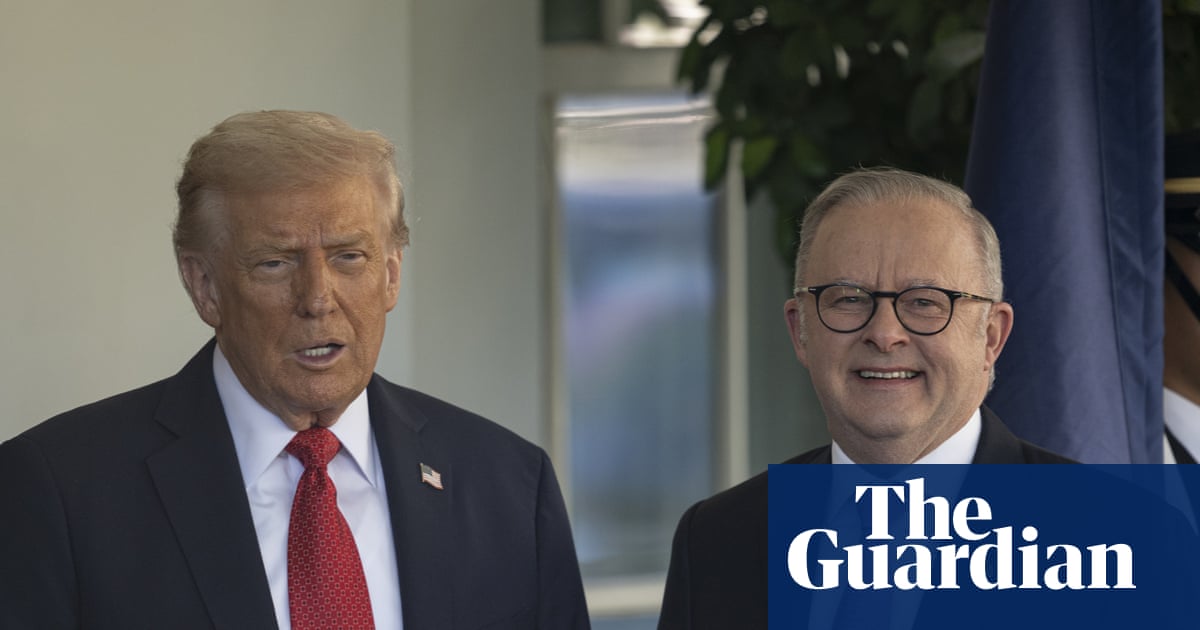
Anthony Albanese and Donald Trump after signing a $8.5bn rare earth minerals agreement at the White House. Photograph: Anna Moneymaker/Getty Images
In a wide-ranging 35-minute press conference at the White House, before his first formal meeting between the pair, Trump assured the future of Aukus and said America had no better friend than Australia, but told ambassador Kevin Rudd “I don’t like you” after his former comments about the president were brought up.
Rudd later apologised to Trump.
Sign up: AU Breaking News email
In comments nearly entirely positive about Australia and his relationship with the prime minister, Trump did not repeat previous demands for Albanese’s government to raise defence spending, and Albanese suggested Trump visit Australia for the President’s Cup golf tournament to be held in Melbourne in 2028.
Albanese met Trump for a long-awaited first bilateral sitdown on Monday morning local time (early hours of Tuesday morning Aedt) in the cabinet room of the White House. Nine months after Trump’s inauguration, and following several phone conversations between the pair, Albanese sat between the president and vice-president, JD Vance, at the cabinet room table in a meeting which also included war secretary Pete Hegseth, secretary of state Marco Rubio, Rudd, and Australian ministers Tim Ayres and Madeleine King.
Trump hosted Albanese for a working lunch following their meeting.
Australia had sought an explicit endorsement of the Aukus pact and the $368bn plan for Australia to acquire nuclear-powered submarines from the US, as well as relief from Trump’s trade tariffs. The signing of the critical minerals deal, by which Australia and the United States will each offer at least USD$1bn to projects in both countries, was seen as a major strategic win by Australia; Trump and Albanese signed the agreement in Trump’s cabinet room.
A framework agreement circulated by the Australian government said it would see the two countries work together on “coordinated investment to accelerate development of diversified, liquid, fair markets for critical minerals and rare earths”. The agreement says they will work together on mining and processing, including mobilising government and private sector support through guarantees, loans, or equity, and offtake arrangements. The agreement will set price mechanisms including price floors, and also includes a commitment to boosting mechanisms to “review and deter” asset sales “on national security grounds.”
Albanese called the deal “a really significant day” to take the Australia-US relationship “to the next level”.
“This is $8.5bn pipeline that we have ready to go. We’re just getting started,” Albanese said.
Trump added: “in about a year from now, we’ll have so much critical mineral and rare earths, that you won’t know what to do with them.”
skip past newsletter promotion
Sign up to Breaking News Australia
Get the most important news as it breaks
Privacy Notice: Newsletters may contain information about charities, online ads, and content funded by outside parties. If you do not have an account, we will create a guest account for you on theguardian.com to send you this newsletter. You can complete full registration at any time. For more information about how we use your data see our Privacy Policy. We use Google reCaptcha to protect our website and the Google Privacy Policy and Terms of Service apply.
after newsletter promotion
Albanese’s office later announced the first projects would include the Alcoa-Sojitz gallium project at Wagerup, Western Australia, said to produce 10% of the world’s supply of that mineral, with a right of offtake for both Australia and the US. The Arafura Nolans in the Northern Territory – projected to produce 5% of global rare earths – will also get US$100 million from the Australian government in equity investment.
Arafura is backed by Gina Rinehart’s Hancock Prospecting, and has already received hundreds of millions in government commitments.
Trump asked John Phelan, secretary of the navy, to speak about Aukus at the beginning of the meeting. Phelan called Australia “a very important ally of ours in the Indo-Pacific” and appeared to allude to the Henderson naval base in Fremantle, calling it “very important to our ability to project power with our allies.”
“I think what we’re really trying to do take this framework and improve it for all three parties, clarify some of the ambiguity that was in the prior agreement. So it should be a win-win for everybody,” he said.
Phelan provided no further detail. Asked for clarification later by Guardian Australia, Trump claimed they would be “minor details” and there “shouldn’t be any more clarifications… we’re just full steam ahead building.”
Asked about comments from his administration – including Hegseth – calling for a major boost to Australian defence spending, Trump instead praised Australia’s record in building “magnificent holding pads for the submarines”.
“I’d always like more, but they [Australia] have to do what they have to do. You can only do so much. I think they’ve been great,” he said.
“They’re building tremendous docking because they have a lot of ships and a lot of things happening. And I think their military has been very strong.”
Asked if Australia would get relief from trade tariffs, however, Trump indicated that would not be up for review, noting: “Australia pays among the lowest tariffs.”