
Your support helps us to tell the story
From reproductive rights to climate change to Big Tech, The Independent is on the ground when the story is developing. Whether it’s investigating the financials of Elon Musk’s pro-Trump PAC or producing our latest documentary, ‘The A Word’, which shines a light on the American women fighting for reproductive rights, we know how important it is to parse out the facts from the messaging.
At such a critical moment in US history, we need reporters on the ground. Your donation allows us to keep sending journalists to speak to both sides of the story.
The Independent is trusted by Americans across the entire political spectrum. And unlike many other quality news outlets, we choose not to lock Americans out of our reporting and analysis with paywalls. We believe quality journalism should be available to everyone, paid for by those who can afford it.
Your support makes all the difference.Read more
Japan’s stock market hit a record high on Tuesday as the country elected Sanae Takaichi as its first female prime minister.
Ms Takaichi won 237 votes in the 465-seat lower house, securing her position as Japan’s 104th prime minister after a coalition deal between her ruling Liberal Democratic Party (LDP) and the right-wing Japan Innovation Party (Ishin). She was later approved by the upper house and sworn in on Tuesday afternoon.
Her victory marks a major breakthrough in a country where men still dominate politics, but it also signals a sharper turn to the right on issues such as immigration and social policy. Economically, investors expect her to double down on stimulus measures – a stance that has fuelled what traders have dubbed the “Takaichi trade.”
Ms Takaichi, a heavy metal drummer and admirer of the former British prime minister Margaret Thatcher, comes from the same hardline LDP faction as the late Shinzo Abe, and is expected to pursue the same mix of high government spending and easy monetary policy that once fuelled his “Abenomics” agenda.
The Nikkei 225 index responded by inching close to the never-broken 50,000 mark before lunch on Tuesday after a second straight day of record gains, while the broader Topix index reached its highest level in 34 years. The yen weakened to about ¥151 per US dollar, boosting exporters such as Toyota and Sony.
Ms Takaichi replaces Shigeru Ishiba, ending a three-month political vacuum and wrangling since the Liberal Democratic Party’s disastrous election loss in July.
“Political stability is essential right now,” Ms Takaichi said earlier on Monday at the signing of a coalition agreement with Ishin leader and Osaka governor Hirofumi Yoshimura, with the policies agreed to by the pair underscoring Ms Takaichi’s hawkish and nationalistic views. “Without stability, we cannot push measures for a strong economy or diplomacy,” she added.
open image in gallery
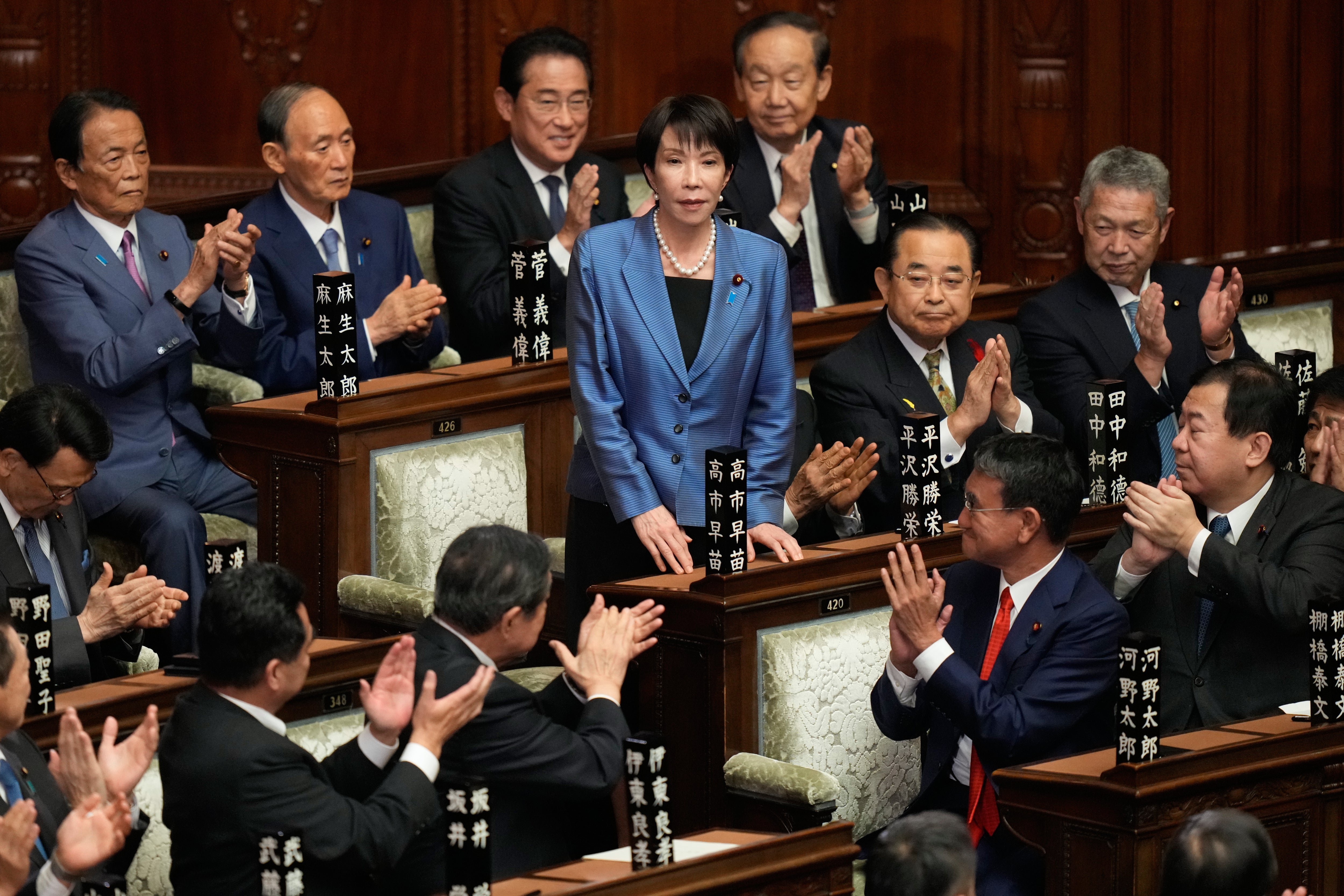
Lawmakers applaud as Sanae Takaichi, center, is elected as Japan’s new prime minister during the extraordinary session of the lower house, in Tokyo, Japan (AP)
The July election left the LDP without the numbers to govern alone – an unprecedented blow for a party that has dominated Japanese politics for nearly seven decades. Public frustration over inflation, falling wages and a series of political funding scandals forced the resignation of several senior ministers, including the finance and defence chiefs, weakening Mr Ishiba’s government and eroding investor confidence.
Multiple rounds of coalition talks failed before the LDP struck a last-minute deal this week with the Japan Innovation Party (JIP), a nationalist, Osaka-based bloc that shares Ms Takaichi’s hawkish views on defence and constitutional reform.
The coalition agreement emphasises Ms Takaichi’s signature priorities: fiscal stimulus, economic security, and a stronger military posture amid rising tensions with China and North Korea.
She has said earlier that the focus of her economic policy will be on dealing with rising consumer prices and increasing wages. One of her popular promises is continued easy credits as she opposes raising interest rates, but that could hinder efforts to curb inflation and to strengthen the Japanese yen.
Ms Takaichi’s government is now expected to unveil an economic relief package by December to ease the impact of inflation and a weak currency. She also faces pressure to repair ties with traditional partners after Komeito Party’s departure, which exposed rifts between the LDP’s nationalist and centrist factions.
Japan’s falling birthrate will also continue to be a challenge for the new government as the country’s population is shrinking at a record pace. Ms Takaichi is Japan’s first woman to lead a government, but she has long opposed policies aimed at boosting gender equality. She supports the imperial family’s male-only succession and opposes same-sex marriage and separate surnames for married couples.
However, she aid she favours giving tax incentives to companies that provide childcare facilities to their employees and possible tax breaks for family spending on childcare.
Japan ranks 118th out of 148 countries in the 2025 Global Gender Gap Index, the lowest among G7 nations. Women hold only about 16 per cent of seats in the lower house and 26 per cent in the upper house, making Japan one of the lowest-ranked developed countries for female political representation.
Tuesday was generally a strong day for Asian markets, with gains across the region amid signs of easing US-China trade tensions. On Monday, US president Donald Trump downplayed the risk of a clash with China over the issue of Taiwan and expressed his hope of reaching a “very strong trade deal”.
Chinese equities joined the advance, with the Shanghai Composite up 1.2 per cent. South Korea’s Kospi hovered at record highs, led by semiconductor firms.
India’s Nifty 50 also hit a fresh 52-week peak, lifted by increased foreign inflows during the Diwali festival season. Hong Kong and Australian shares also made gains.