
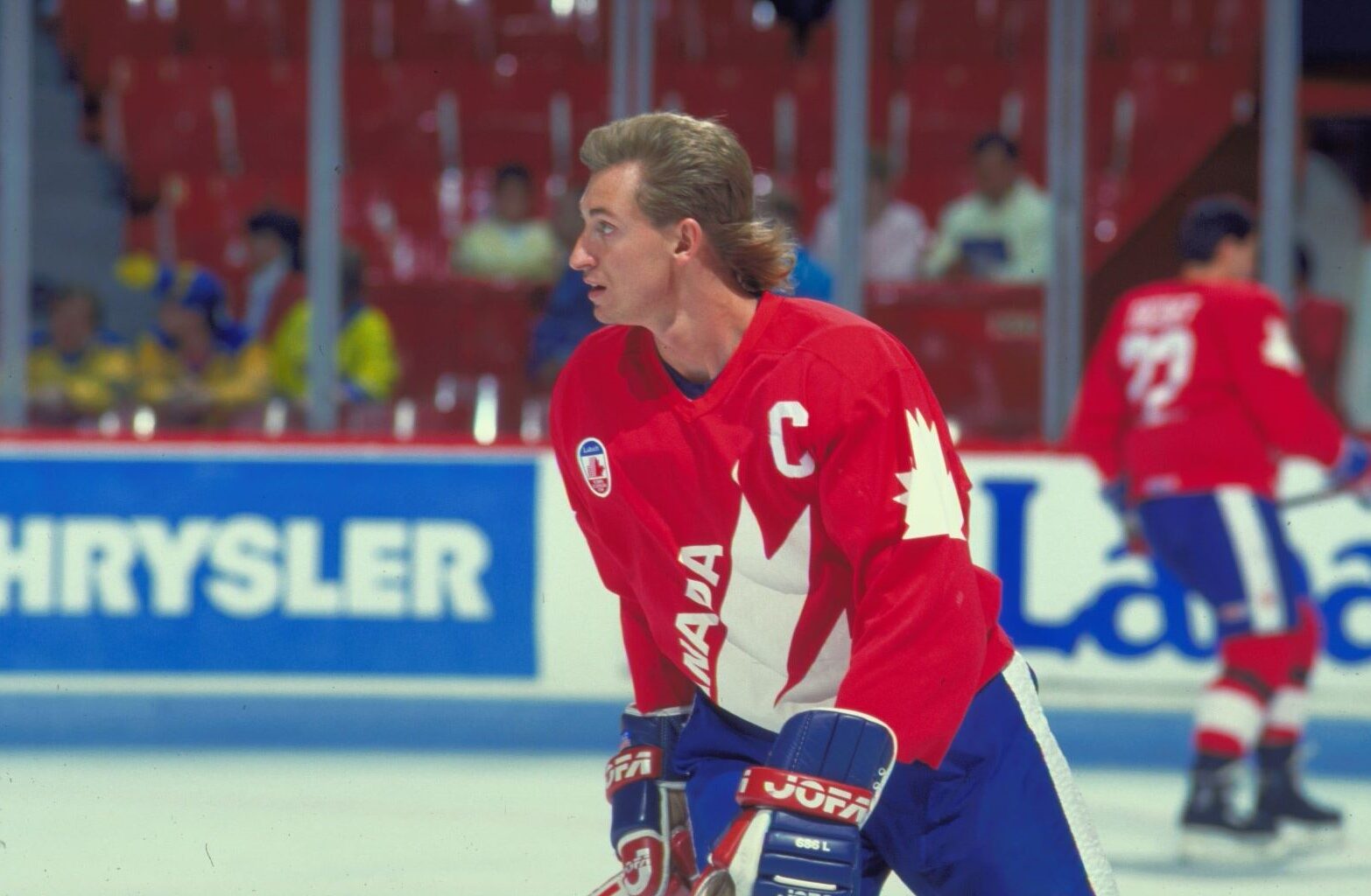
Canada’s Wayne Gretzky #99 skating during warm-up.
photo: © Paul Bereswill / Hockey Hall Of Fame
WJC #1—1977
After pre-IIHF events in the Soviet Union, Canada, and Finland, it was the Czechoslovaks who applied to host the first official event over Christmas and New Year’s of the 1976-77 hockey season. All games were played in Banska Bystrica and Zvolen. Eight teams played a simple round robin. Apart from several Canadian and Soviet players, there were not a lot of big names at the event. The Swedes had Bengt-Ake Gustafsson, the Finns had Reijo Ruotsalainen, and the Czechoslovaks had Frantisek Cerny. But Canada had Dale McCourt, Rob Ramage, and John Anderson, while the Soviets led with Slava Fetisov, Sergei Makarov, and Sergei Mylnikov. The Czechoslovaks surprised Canada on Christmas Day, building a 4-2 lead early in the third before Canada rallied for a 4-4 tie. The Soviets were unbeaten, leading to a clash on the final day for gold between Canada and CCCP—Canada needed a win; the Soviets could take top spot with a win or tie. The game was a crazy one. The Soviets jumped into a 6-0 lead after the first period, and after a goalless second Canada tried to engineer a rally for the ages. They scored four, but couldn’t get closer. The 6-4 result gave the Soviets gold.
WJC #2—1978
The second incarnation of the World Juniors adopted a much different format. Eight teams were divided into two groups, the top two from each advancing to a medal round robin. The top two from that group then played a gold-medal game. Montreal and environs were the hosts this time, and to say attendance was sparse is an understatement. Only 41,681 fans attended the 25 games, an average of fewer than 2,000 a game. Canada’s star factor was off the charts, starting with 16-year-old Wayne Gretzky who led the tournament in scoring with 17 points in six games. Bobby Smith, Rick Vaive, and Rob Ramage were three other big names for the hosts. But in the medal round Canada lost to the Soviets, 3-2, on a Vyacheslav Ryanov goal midway through the third and to the Swedes, 6-5, sending the hosts to third place. In the gold-medal game at the Forum, the Soviets beat the Swedes, 5-2, to claim their second gold in a row.
WJC #3—1979
Karlstad and Karlskoga co-hosted the 3rd World Juniors in Sweden, and the IIHF used the same format as the previous year except the stand alone, gold-medal game was eliminated. Round-robin results from the medal round of play would determine gold, silver, and bronze. Norway played for the first time but went winless and were relegated, and the Soviets again finished on top. Their only blemish was a 2-2 tie with the Czechoslovaks in the final round. The star power was on the rise, though. Jari Kurri (FIN), Anton Stastny (TCH), Pelle Lindbergh (SWE), Igor Larionov (URS), and Brian Propp (CAN) were just some of the players who would go on to have long and successful pro careers.
WJC #4—1980
The Soviets won for a fourth consecutive year with a perfect 5-0 record and a goals differential of 24-9. They were led by Larionov and Vladimir Krutov while Finland recorded their most important result in the nation’s history to date—a silver medal. This was their first ever medal in IIHF competition. They started with a shocking 2-1 win over Canada thanks to two goals by Reijo Ruotsalainen, the second with only 3:19 left in the game. Suomi then beat Sweden and the Czechoslovaks in the medal round. Sweden took the bronze while the Swiss, who first played in 1978 and were relegated, earned promotion for this year only to be demoted again.
WJC #5—1981
The Swedes became the first team other than the Soviets to win gold, and they did so in dramatic fashion. The tournament was played in Germany for the first time, the 20 games spread over six cities. The Swedes beat Finland, 2-1, in the round robin on the strength of two goals from Jan Ingman, and this result carried over to the playoff round and proved decisive. In the medal round, the Swedes tied the Czechoslovaks, 3-3, and then defeated the Soviets, 3-2, thanks to a goal and an assist from Patrik Sundstrom. The Finns also beat the Soviets in the final round, 6-3. The medals went to Sweden, Finland, and the Soviets, while Canada finished a disappointing 7th, a result that ended up seeing Canada revamp its entire junior program.