

Prime Minister Benjamin Netanyahu on Tuesday replaced his National Security Adviser Tzachi Hanegbi, effective immediately, after reported disagreements over policies during the war in Gaza.
A longtime senior Likud party member and minister since the 1990s, Hanegbi reportedly opposed Netanyahu’s plan to invade Gaza City over the summer, as well as last month’s unsuccessful strike on Hamas leaders in Qatar.
Gil Reich, who was Hanegbi’s deputy, will immediately become acting head of the National Security Council and national security adviser. Before taking up the deputy role in 2022, Reich served as deputy director of Israel’s Atomic Energy Commission.
Netanyahu released a statement thanking Hanegbi for his service and wishing him “much success in his future endeavors and good health.”
In his own statement, Hanegbi acknowledged disagreements with his former boss.
Get The Times of Israel’s Daily Edition
by email and never miss our top stories
By signing up, you agree to the terms
“I thanked the prime minister for the privilege of being a partner in shaping Israel’s foreign and security policy during challenging years — for the opportunity to express an independent position in sensitive discussions, and for the professional dialogue we maintained, even in times of disagreement,” he said.
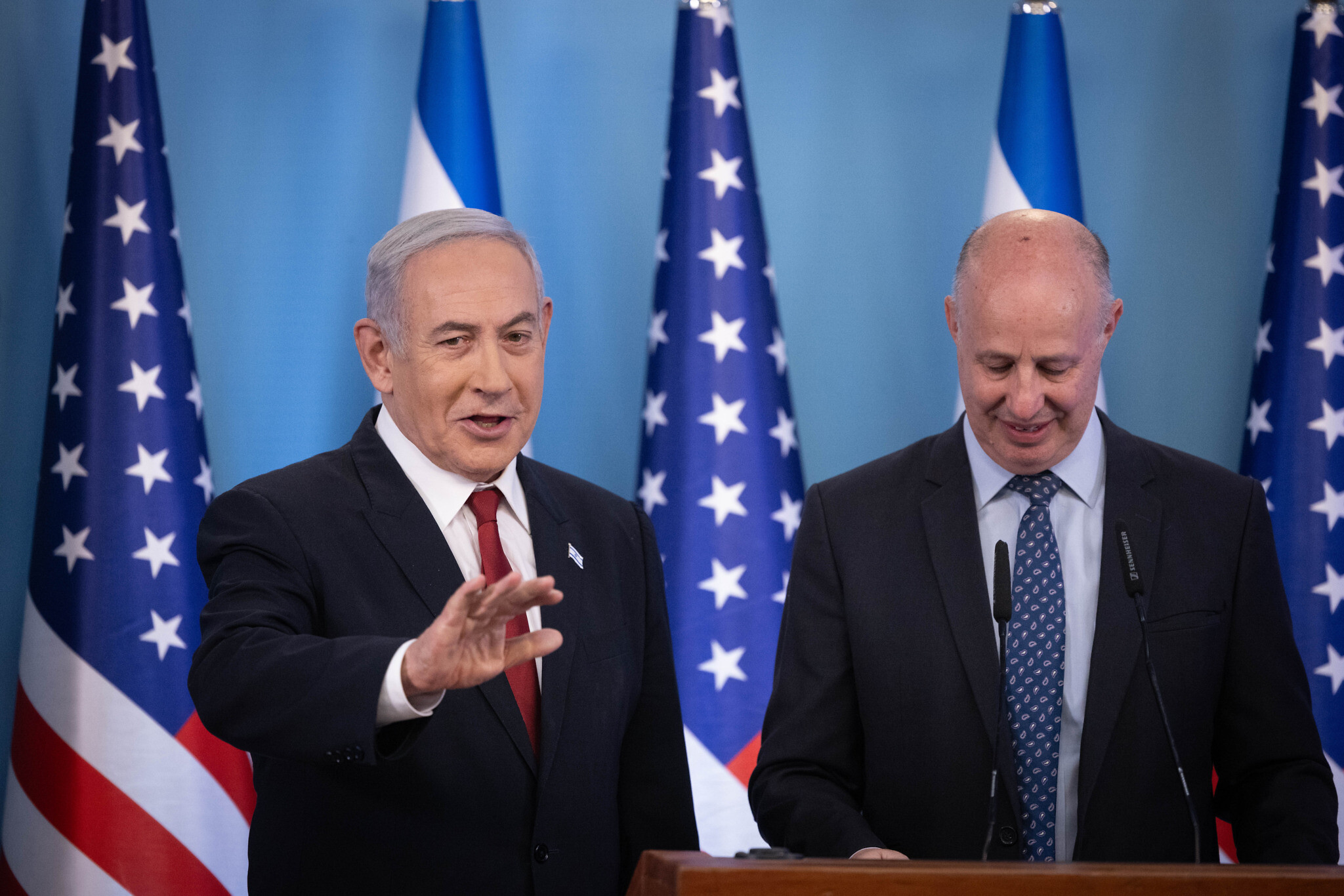
Prime Minister Benjamin Netanyahu with National Security Adviser Tzachi Hanegbi at a press conference after the US allowed Israel into its visa-waiver program, at the Prime Minister’s Office in Jerusalem, on September 28, 2023. (Chaim Goldberg/Flash90)
He warned that the war that started on October 7, 2023, in which a ceasefire recently took effect, “has not yet ended.”
“Our fighters remain on guard on many fronts,” he said, “and the mission to bring all our hostages home has not yet been completed. Nor has the obligation yet been fulfilled — by diplomatic or military means — to ensure that the terrorist organizations in the Gaza Strip are removed from power, disarmed, and that Gaza will no longer pose a threat to Israel.”
Netanyahu defined his goals in the war as returning the hostages, defeating Hamas, and ensuring that Gaza does not pose a threat to Israel.
Hanegbi admitted his own responsibility for the “terrible failure of October 7,” and — in an apparent message to the prime minister, who has long opposed a state commission of inquiry on the matter — said it “must be thoroughly investigated to ensure that the necessary lessons are learned and to help restore the public trust that has been shaken.”
“We must all remain committed and attentive to the needs of those who have borne the dearest price of all — the bereaved families and the wounded, in body and soul,” Hanegbi said.
He called for unity within Israeli society, casting it as “essential to ensuring the eternity of Israel.”
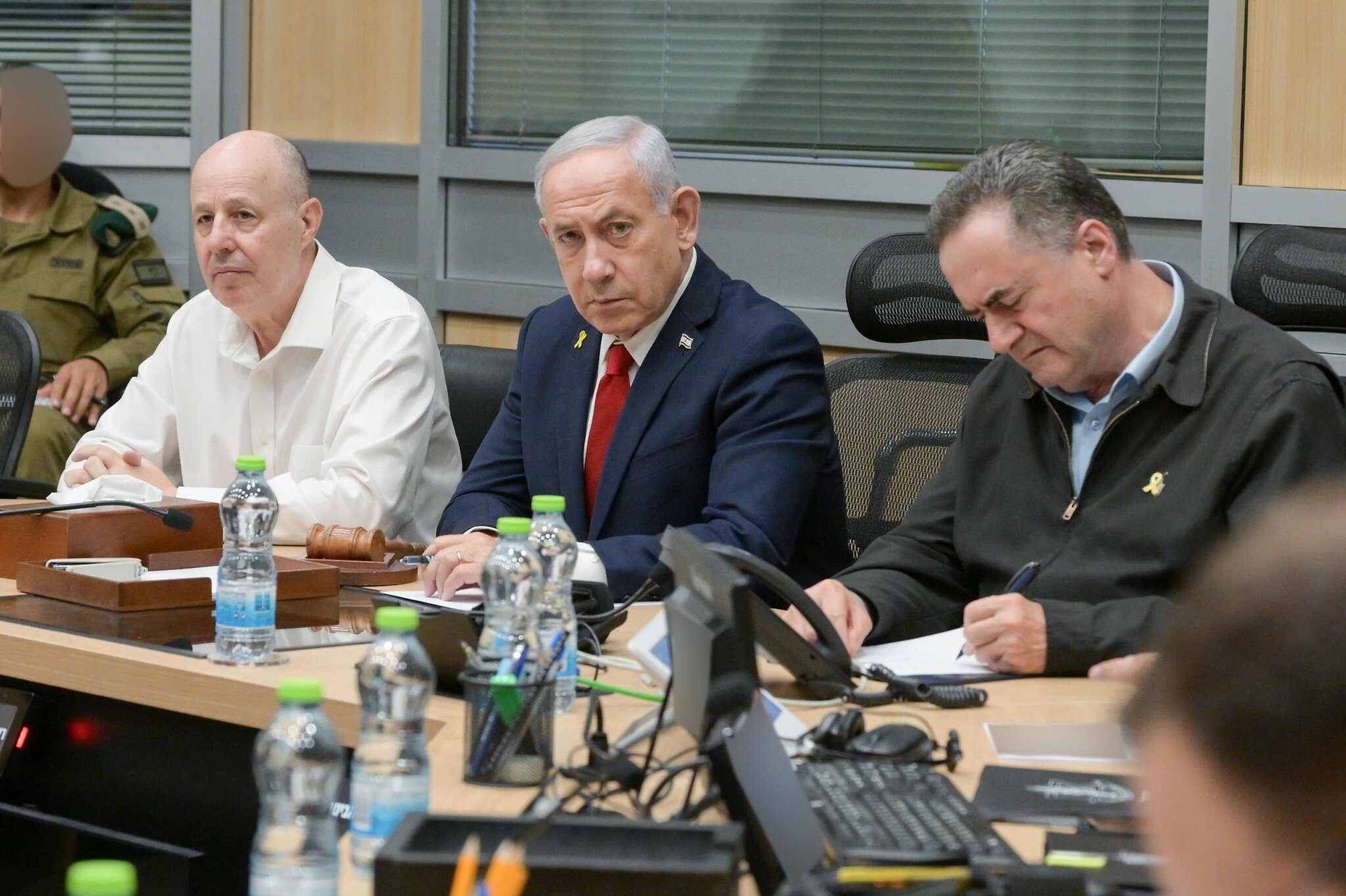
From left, National Security Advisor Tzahi Hanegbi, Prime Minister Benjamin Netanyahu and Defense Minister Israel Katz at the IDF command bunker at the Kirya in Tel Aviv on September 16, 2025 (Maayan Toaf/GPO)
According to the Kan public broadcaster, Netanyahu told Hanegbi days ahead of his ousting that he would remain in the role, despite reports that the premier was unhappy with him.
Associates of Netanyahu told Kan that Hanegbi was leaking information to the press and was undermining the premier. They also suggested that Sara Netanyahu, the prime minister’s wife, long rumored to be intimately involved in high-level appointments, was unhappy with Hanegbi’s work.
Netanyahu has lost other key members of his inner circle as well. Chief of Staff Tzachi Braverman is heading to the Court of St. James to serve as Israel’s ambassador in London, and Strategic Affairs Minister Ron Dermer is expected to step away from public service in the coming months.
The prime minister fired then-defense minister Yoav Gallant last November, IDF chief of staff Herzi Halevi retired earlier this year, and several other senior military commanders and officials have stepped down in the wake of the October 7 failings.
However, Netanyahu has dismissed the idea of stepping down and has avoided taking responsibility for the massacre, repeatedly asserting that the security establishment — not political leaders — failed to prevent the deadliest attack in Israel’s history.
Mossad chief David Barnea is one of the only top security officials who was serving in his role on the day of the massacre and remains in his position.
Is The Times of Israel important to you?
If so, we have a request.
Every day, even during war, our journalists keep you abreast of the most important developments that merit your attention. Millions of people rely on ToI for fast, fair and free coverage of Israel and the Jewish world.
We care about Israel – and we know you do too. So today, we have an ask: show your appreciation for our work by joining The Times of Israel Community, an exclusive group for readers like you who appreciate and financially support our work.
Already a member? Sign in to stop seeing this
You appreciate our journalism

You clearly find our careful reporting valuable, in a time when facts are often distorted and news coverage often lacks context.
Your support is essential to continue our work. We want to continue delivering the professional journalism you value, even as the demands on our newsroom have grown dramatically since October 7.
So today, please consider joining our reader support group, The Times of Israel Community. For as little as $6 a month you’ll become our partners while enjoying The Times of Israel AD-FREE, as well as accessing exclusive content available only to Times of Israel Community members.
Thank you,
David Horovitz, Founding Editor of The Times of Israel