
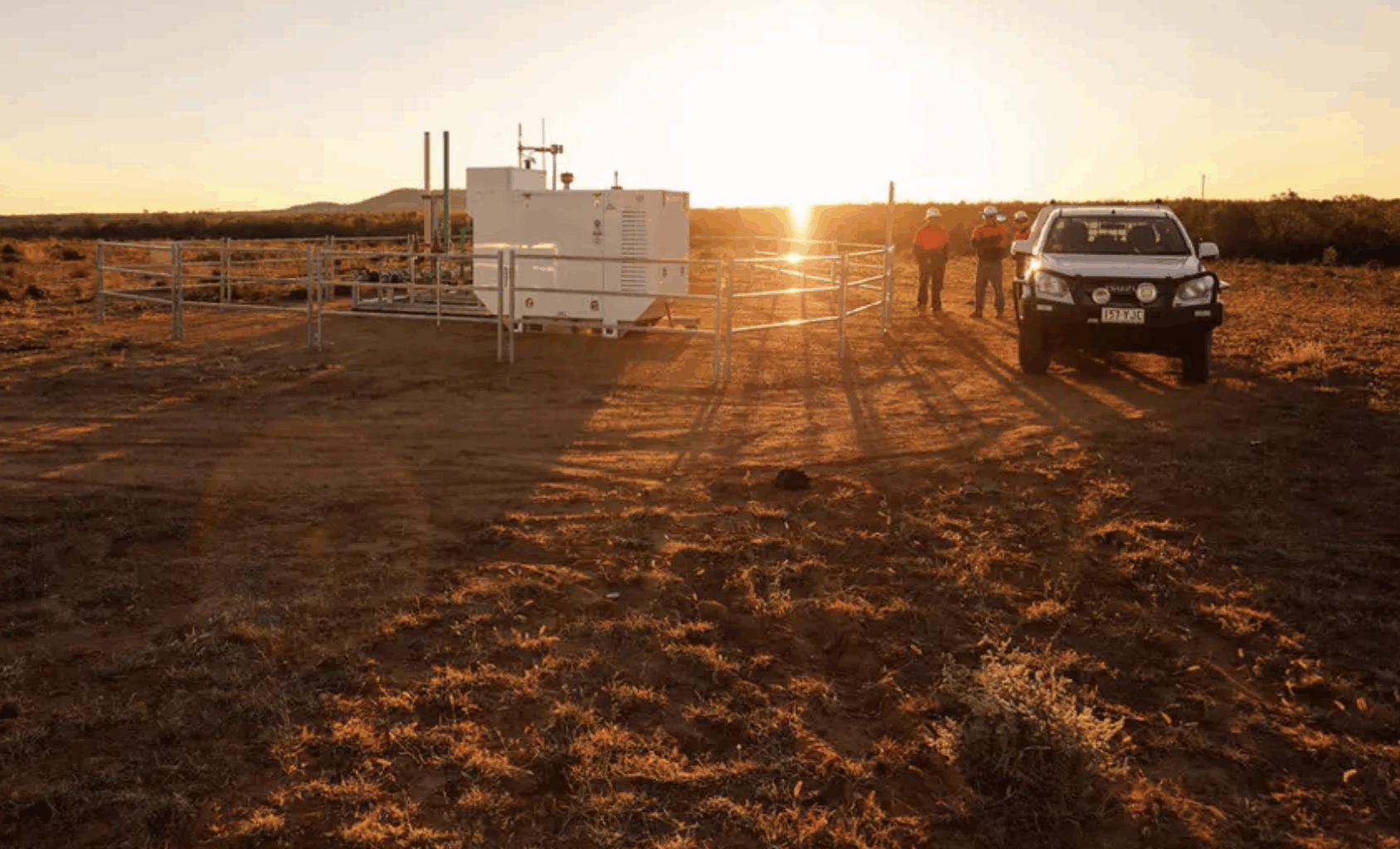
The Queensland LNP government has announced a supply deal for a new gas generator with a company controlled by Australia’s richest person, Gina Rinehart, just over a week after announcing its “energy roadmap” that effectively kills off new wind and solar projects.
The supply deal for the 400 megawatt (MW) Brigalow gas fired power station was announced by the state-government owned generator CS Energy, which will build the facility next to its Kogan Creek coal fired power generator. It will be supplied by the expansion of Senex’ Atlas coal seam gas fields.
Treasurer and energy minister David Janetzki says it will be the first new gas generator in more than a decade in Queensland, and said gas powered generation forms a key part of the new Energy Roadmap to deliver affordable, reliable and sustainable power.
“This is part of our plan to improve the energy assets we have while we build what we need for the future,” Janetzki said in a statement announcing the deal.
“The Roadmap includes extended coal generation, more low-cost energy production in wind and solar and more dispatchable supply including gas turbines, pumped hydro and batteries for firming and storage.”
However, the roadmap’s modelling assumes no new large scale wind and solar capacity being built in Queensland, apart from those already under construction, contracted by Rio Tinto (the state’s biggest energy consumer), or already underwritten by the federal government’s Capacity Investment Scheme.
Senex Energy CEO Darren Stevenson said his company is proud to be investing more than $1 billion in the Western Downs to deliver reliable energy supply for households and businesses.
“With energy shortfalls forecast for the east coast in coming years, this agreement will add critical new supply to the domestic market when it’s needed most,” Senex CEO Darren Stevenson said in a statement.
Just for the record, the Australian Energy Market Operator forecasts no reliability gaps in Queensland, or breaches of the reliability standard over the next 10 years, despite the announced early closure of the state’s biggest coal generator at Gladstone by Rio Tinto.
Rio Tinto has made it clear that its giant smelter and refineries in Gladstone have no future if they continue to rely on fossil fuel generation, and it has signed up to a series of wind, solar and solar hybrid off-take agreements, each the biggest of their kind in Australia.
AEMO has also made it clear that the biggest risk to energy reliability in Australia is the sudden failure of ageing coal fired power stations, such as the explosions that have rocked CS Energy’s Callide coal facility in Queensland in recent years.
Rinehart has been a fierce critic of renewables and net zero targets, describing net zero as a “magic pudding”, although one of her portfolio companies, the listed lithium miner Liontown Resources, has achieved 81 per cent average renewables share from wind, solar and battery storage at its remote, off-grid Kathleen Valley mine.
Rinehart’s Hancock Energy and Korean industrial giant Posco took control of Senex in 2022, with the intention of tripling its gas production. It was described by Rinehart at the time as her company’s first “significant direct investment” in the energy business.

Giles Parkinson is founder and editor-in-chief of Renew Economy, and founder and editor of its EV-focused sister site The Driven. He is the co-host of the weekly Energy Insiders Podcast. Giles has been a journalist for more than 40 years and is a former deputy editor of the Australian Financial Review. You can find him on LinkedIn and on Twitter.