
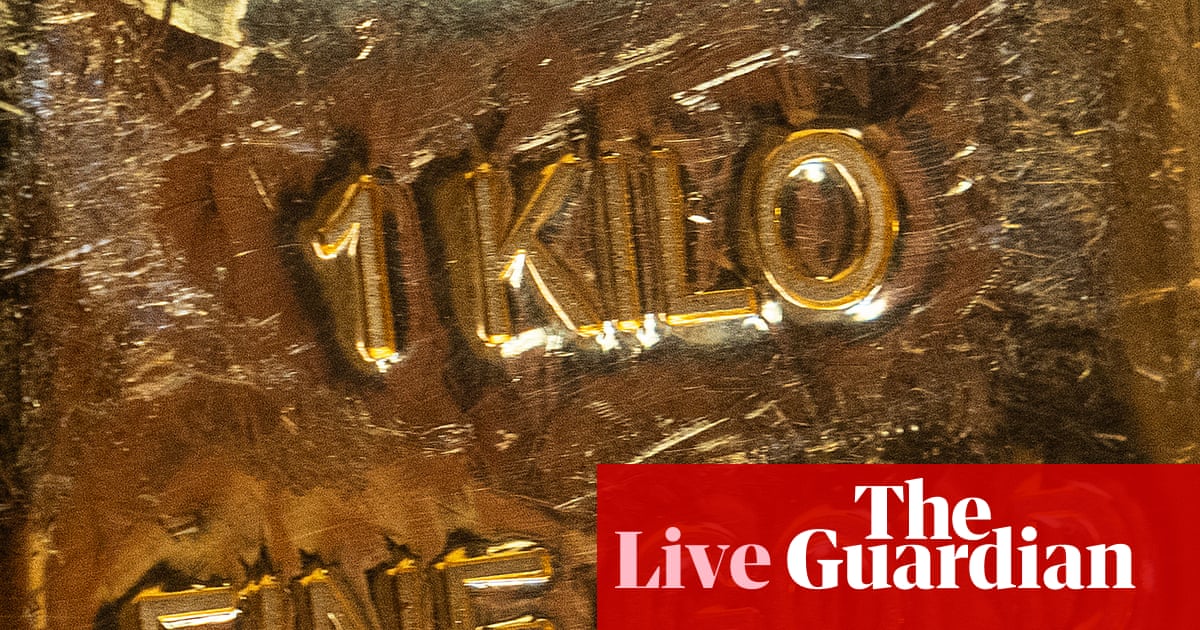
Gold on track for biggest fall since 2020
Back in the precious metals market, gold is on track for its biggest one-day fall in over a year.
Bullion has dropped by over 4% so far today to $4,175 per ounce, as a blistering rally that reached a series of fresh record highs fades.
That would be its biggest one-day fall since 9 November 2020, the day when Pfizer and BioNTech announced that their Covid-19 vaccine was 90% effective in trials, triggering a surge into shares.
Gold has been a traditional safe-haven away from risky assets, and has also benefited from the ‘debasement trade’ where investors move out of fiat currencies and into harder assets.
Daniela Sabin Hathorn, senior market analyst at capital.com, reckons easing trade war tensions have hit gold.
The upside in gold and silver seems to have run out of steam at the start of the week…. The trade had become quite overcrowded and was running a little hot considering the levels both markets were at, so a reversal is not entirely out of the blue.
The catalyst for the pullback has been the perception of easing tensions between China and the US after Trump said that he expects to make a trade deal after meeting with President Xi Jinping at a Pacific Rim summit in South Korea later this month.
Shares in precious metal miners have fallen sharply too, with Fresnillo slumping 14% and Endeavour Mining losing 9%.
But despite today’s drop, gold is still up 60% so far this year, on track for its best year since 1979….
Updated at 10.02 EDT
Key events
Show key events only
Please turn on JavaScript to use this feature
Closing post
Time to recap….
The governor of the Bank of England, Andrew Bailey, has warned recent events in US private credit markets have worrying echoes of the sub-prime mortgage crisis that kicked off the global financial crash of 2008.
Appearing before a House of Lords committee, the governor said it was important to have the “drains up” and analyse the collapse of two leveraged US firms, First Brands and Tricolor, in case they were not isolated events but “the canary in the coalmine”.
Bailey warned:
“Are they telling us something more fundamental about the private finance, private asset, private credit, private equity sector, or are they telling us that in any of these worlds there will be idiosyncratic cases that go wrong?”
“I think that is still a very open question; it’s an open question in the US.”
He added:
“I don’t want to sound too foreboding, but the added reason this question is important is if you go back to before the financial crisis when we were having this debate about sub-prime mortgages in the US, people were telling us: ‘No it’s too small to be systemic; it’s idiosyncratic.’
That was the wrong call.”
Gold prices have tumbled by more than 5% today, set for their biggest daily drop for more than five years. Analysts blamed profit-taking, and the easing of US-China trade tensions, for the sell-off.
UK government borrowing was the highest for five years in September after rising debt interest costs and higher welfare payments pushed the public finances deeper into the red.
Rachel Reeves has blamed a heavier than anticipated blow from Brexit and austerity for forcing her to take action to balance the books at next month’s autumn budget.
And in other news:
On gold, David Morrison, senior market analyst at Trade Nation, says:
It has been a long time coming, but it looks as if gold is finally having a bit of a downside correction following its record-breaking upside run.
Gold had several attempts to push above $4,400, starting last Thursday. But on each occasion, it ran into resistance around $4,380. That is pretty much what happened this morning. The big question for investors and traders alike is if this the start of a much-needed correction?
The gold price over the last five years Photograph: LSEG
But, after its recent parabolic surge, could the top be in for gold?
Morrison says it’s very difficult to know, adding:
Analyst speculation will centre around the shape and extent of this sell-off, as well as giving some consideration as to how long this rally has been going. If you trace it back to the lows hit this time in 2023, then the rally is relatively young. But if you go back to the lows of 2015 as your starting point, it all looks a bit different. The first major test to the downside comes in around $4,000.
But it’s also quite possible that this is all we get from the dip, and that buyers come back in around $4,200. It’s really a question of having some patience to see how the situation progresses from here.
Updated at 11.27 EDT
Crumbs, gold’s fall is gathering pace – it’s now down 5.2% at $4,126 per ounce.
There doesn’t seem to be a single trigger for the selloff, though.
Nitesh Shah, commodities strategist at WisdomTree, has suggested:
“Gold prices are still yet to go much higher, but the speed is being a bit aggressive and as a result of that, we will get pullbacks each time we hit those fresh highs.”
By my maths, this is now the biggest one-day drop since 11 August 2020.
Updated at 11.14 EDT
Gold on track for biggest fall since 2020
Back in the precious metals market, gold is on track for its biggest one-day fall in over a year.
Bullion has dropped by over 4% so far today to $4,175 per ounce, as a blistering rally that reached a series of fresh record highs fades.
That would be its biggest one-day fall since 9 November 2020, the day when Pfizer and BioNTech announced that their Covid-19 vaccine was 90% effective in trials, triggering a surge into shares.
Gold has been a traditional safe-haven away from risky assets, and has also benefited from the ‘debasement trade’ where investors move out of fiat currencies and into harder assets.
Daniela Sabin Hathorn, senior market analyst at capital.com, reckons easing trade war tensions have hit gold.
The upside in gold and silver seems to have run out of steam at the start of the week…. The trade had become quite overcrowded and was running a little hot considering the levels both markets were at, so a reversal is not entirely out of the blue.
The catalyst for the pullback has been the perception of easing tensions between China and the US after Trump said that he expects to make a trade deal after meeting with President Xi Jinping at a Pacific Rim summit in South Korea later this month.
Shares in precious metal miners have fallen sharply too, with Fresnillo slumping 14% and Endeavour Mining losing 9%.
But despite today’s drop, gold is still up 60% so far this year, on track for its best year since 1979….
Updated at 10.02 EDT
UK hands anti-money laundering powers to the FCA
The UK is overhauling how anti-money laundering rules in the private sector are policed, handing responsibility to the City watchdog.
Powers to regulate against money laundering by lawyers, accountants and company formation agents is being handed to the Financial Conduct Authority (FCA), and taken off the Solicitors Regulation Authority.
Steve Goodrich, head of research and investigations at Transparency International UK, has welcomed the change, saying reforms to “the UK’s broken system for tackling illicit finance” are long overdue.
Goodrich explains:
“For too long, fragmented and ineffective oversight of lawyers, accountants and company formation agents have enabled kleptocrats, oligarchs and criminals to launder and stash their dirty money in there UK – contributing to Britain’s £100 billion-a-year money laundering problem. Rationalising the current patchwork of regulators into one properly resourced organisation has the potential to provide a step-change in the UK’s efforts to tackle dirty money.
“For this reform to succeed, the FCA must be equipped with the funding and expertise necessary to oversee a broad range of professions. A smooth transition, with intelligence and investigative leads from existing supervisors passed on to the FCA, will also be vital.”
Susan Hawley, executive director of Spotlight on Corruption, hopes the FCA can bring a stronger approach to preventing money laundering:
“This bold decision to make the FCA a super-regulator for money laundering is long-awaited and really welcome. The FCA’s relatively strong capacity, expertise and appetite to take enforcement action has the potential to shake up the legal and accountancy sectors who are used to seeing their supervisors go softly on them.
However, this will only work if it is sustainably funded, with reinvestment of money laundering fines back into supervisory capacity, and draws in existing sector-specific expertise.
Updated at 09.54 EDT
PlayTech shares plunge after “smear campaign” claims
Shares in gambling technology company PlayTech have plunged by a quarter, after being accused of commissioning a report that damaged the reputation of Swedish rival Evolution.
Evolution claimed this morning that one of PlayTech’s subsidiaries, Playtech Software Limited (PTS), commissioned a report alleging regulatory misconduct, as part of a “defamatory smear campaign”.
The report, created by private intelligence company BlackCube, apparently claimed that Evolution’s live casino products were being accessed from countries where online gambling is restricted or banned, such as Iran, Syria and Sudan – which could be a potential breach of gaming laws and anti-money laundering rules.
Last month a New Jersey court ordered BlackCube to reveal who had commissioned the report.
Playtech has today rejected Evolution’s allegations, stating that the suggestion that PTS had engaged in a smear campaign was “wholly untrue and is designed to distract from serious questions about Evolution’s business practices.”
Playtech told the City that it had commissioned “an independent business intelligence firm” to investigate concerns about Evolution’s activities.
Shares in Playtech have tumbled 26%, making it the biggest faller on the FTSE 250 index of medium-sized companies listed in London.
Over on Wall Street, Coca-Cola has beaten analyst forecasts after raising its prices.
Coca-Cola reported a 6% rise in revenues, helping to lift earnings per share to 82 cents, up from 78 cents expected.
Today’s results also show that Coca-Cola’s price/mix (which measures how prices changed, and whether more expensive products were sold) grew 6%, “primarily driven by pricing actions in the marketplace and favorable mix”.
Over in Bagsværd, Denmark, there’s news of a surprise shake-up at pharmaceuticals group Novo Nordisk.
Novo Nordisk’s chair Helge Lund, vice chair Henrik Poulsen, and five independent board members are all standing down, following a row over the leadership of the company.
Lund explains that its board could not reach agreement with its largest shareholder, Novo Nordisk Foundation:
“Following dialogue with the Novo Nordisk Foundation regarding the future composition of the Board of Directors, it has not been possible to reach a common understanding.
The Board proposed a renewal focusing on addition of select, new competencies while also maintaining continuity, whereas the Board of the Foundation wanted a more extensive reconfiguration.
This is Lund’s second corporate exit this year – in April, he agreed to step down as chair as BP amid shareholder opposition to its green energy plans pithy Oscar Wilde quote here>.
Updated at 09.58 EDT
Bailey: I’m keen to improve private credit, not necessarily regulate it
Q: If the Bank did conclude there was a systemic risk arising from private credit, would you would want the government to bring it within your regulatory remit?
It would entirely depend on what the nature of the issue was, BoE governor Andrew Bailey replies, adding that the Bank would look at the existing tools at its disposal too.
We have to have a system which encourages risk to be taken and investments to be made.
My first reaction is – how can we improve that? I wouldn’t go to regulation as the first answer to that.
He adds that the Bank can’t ‘sweep problems under the carpet’ if it finds them during its stress test of the sector.
Q: You’re obviously ahead of other countries and central banks in the actions you’re taking [looking at private finance]…
“Well, we’ll see”, Bailey jokes.
Q: ….to what extent must this be dealt with on an international scale?
Bailey says the issue could be taken up to the FSB (which he chairs) for international collaboration.
Updated at 08.24 EDT
The current governor of the Bank of England then reveals he disagrees with his predecessor-but-one over financial regulation.
Mervyn, now Lord, King recently criticised the use of risk weights when assessing various kinds of lending.
He told the House of Lords Financial Services Regulation Committee in September that “I am not a fan of risk weights,” saying they make the regulatory system so complicated that borrowers move outside the formal banking sector for certain kinds of lending (ie, into the private credit market).
Lord King also argued that regulators can’t assess the riskiness of different kinds of lending, as they don’t know what kind of crisis they will face.
Today, Andrew Bailey tells the same committee that “I honestly don’t agree with him on this”, for two reasons.
First, it is “a very dangerous slope to go down” not to look at risk in the system.
Second, the alternative of a “risk free leverage ratio” would mean banks would have to hold a lot of capital in reserve, which would prompt a “very fierce” response from the industry, Bailey predicts.
ShareBoE’s Bailey on impact of Brexit
Q: To what extent is Brexit culpible for the sluggish performance of the economy?
BoE governor Andrew Bailey says he doesn’t take a position on Brexit, a public official.
But, he suggests, there have been some negative economic consequences, telling the House of Lords Financial Services Regulation Committee:
In so far as Brexit has made the economy less open to trade, that will have a negative effect for a period.
Over time, trade adjusts…. but in the initial phase that would have an effect on productivity by reducing the openness of the economy, the ability to exploit the division of labour….
Bailey also points out that uncertainty delays investment decisions.
He’s then challenged by former Conservative MP Lord Lilley, who points to growth in services exports to the EU since Brexit.
Bailey replies that policymakers have managed to “offset” many of the more pessimistic predictions after the 2016 referendum about the impact on financial services.
Q: Is there a risk of a liquidity crunch, if a private equity firm finds themselves with a lot of hard-to-sell assets?…
BoE deputy governor Sarah Breeden says an important aspect about private equity is that its funding is long-term – it doesn’t hold “runable liabilities” like banks.
Deputy bank governor Sarah Breeden, appearing alongside Bailey, said the Bank would be carrying out a war game exercise in these markets, to test the linkages between private credit and other sectors.
It will “shine a light on what is opaque”, she explains.
The voluntary exercise will involve banks, insurers, private equity companies, and pension fund investors.
Andrew Bailey says the Bank will act as the ‘hub’, and tell participants to work out how they would react to a particular stress, then the Bank can identify stress points in the system.
Updated at 07.42 EDT
Q: When you were in Washington last week, did other countries share the same anxieties about private finance?
Yes, BoE governor Andrew Bailey replies.
Q: Was there any output from that meeting?
Bailey jokes that he has enough work to do already, before reminding the Lords that he now chairs the Global Financial Stability Board – private finance will now be an “even more important part” of their workplan.
Andrew Bailey then argues that the Bank of England must use the collapse of First Brands and Tricolour as “another reason to have more drains up, frankly”.
He tells the Lords Financial Services Regulation Committee we need inspection of how the private credit market is structured, and what the connections to the banking world are.
Bailey then reveals he met with “people from the private equity and private credit world” some months ago, who told him that everything was fine in their world apart from the role of the ratings agencies
He adds:
“I said, we’re not playing that movie again, are we?”
Good movie, though….
Bank of England governor Andrew Bailey then warns that we are beginning to see the “slicing and dicing and tranching of loan structures” in the financial markets.
“Alarm bells start going off at that point” if you were involved in regulating the sector before the 2008 financial crisis, he points out.
ShareBank of England warns collapse of First Brands and Tricolor may show systemic problems
Top Bank of England policymakers have warned that the collapse of two US firms, First Brands and Tricolor, last month has highlighted the risks in the private credit market.
Governor Andrew Bailey compared the failures of sub-prime auto lender Tricolor and the car parts supplier First Brands, which have left US banks nursing losses, to the sub-prime mortgage crisis that predated the financial crisis of 2008.
Testifying to the House of Lords Financial Services Regulation Committee this morning, Bailey explains that the big, and open, question today is whether the two failures are idiosyncratic or “the canary in the coalmine”.
Bailey explains:
Are they telling us something more fundamental about the private finance, private asset, private credit, private equity sector, or are they telling us that in any of these worlds there will be idiosyncratic cases that go wrong?
I think that is still a very open question, it’s an open question in the US.
[Reminder: Last week, the boss of JP Morgan, Jamie Dimon, has warned over further losses linked to the private credit sector, saying more “cockroaches” could emerge’…]
Bailey then explains that the Bank has to take this question very seriously, and incorporate it into its existing work on private finance.
He then warns:
I don’t want to sound too foreboding, but the added reason this question is important is if you go back to before the financial crisis when we were having this debate about sub-prime mortgages in the US, people were telling us, no it’s too small to be systemic, it’s idiosyncratic in that sense.
That was the wrong call.
I’m not saying the call should be the same this time, but it underlines why the question is aposite.
There’s a lot we dont know about First Brands and Tricolor at this time.
BoE deputy governor Sarah Breeden weight in too, saying the First Brands and Tricolor collapses illustrate some of the risks the Bank has been talking about in this market for some time.
Breeden says:
It’s about high leverage, it’s about opacity, it’s about complexity and it’s about weak underwriting standards. Those are things that we were talking about in the abstract as a source of vulnerability in this bit of the financial system, and those appear to have been at play in the context of these two defaults.
Updated at 08.33 EDT