
Key events
Show key events only
Please turn on JavaScript to use this feature
Russia vows “painful response” if EU confiscate assets
Any action by the EU to confiscate Russian assets in Euroclear accounts will result in a “painful response” from Russia, Foreign Ministry spokesperson Maria Zakharova said on Thursday.
“The EU has no legal means to seize Russian assets, so their confiscation would be ‘theft,’” Zakharova said.
A proposal by the European Commission to use Russian assets frozen in Europe to provide a €140bn (£122bn) “reparation loan” to Ukraine will be discussed on Thursday.
Under the plan, the EU would use cash balances from frozen Russian central bank securities to give Kyiv support that would cover much of its funding needs for 2026 and 2027.
But what do countries within the 27-member bloc think?
Belgium’s prime minister Bart De Wever, center, speaks with Netherland’s prime minister Dick Schoof, center, and Croatia’s prime minister Andrej Plenkovic, right, during a round table meeting at an EU Summit in Brussels, Thursday, Oct. 23, 2025. Photograph: Geert Vanden Wijngaert/AP
The Belgian prime minister, Bart De Wever, has said he would oppose the measure until he secured guarantees on the use of Russian immobilised assets.
De Wever, whose country is home to chief asset holder Euroclear, said he did not see the legal basis for such a decision yet, adding that immobilised assets had not even been touched in the second world war.
German chancellor Friedrich Merz said on Thursday: “I share the Belgian prime minister’s concerns but am confident we will take a step forward.”
Finland’s prime minister Petteri Orpo said: “We have a solution on the table which is legally sustainable and takes Belgium’s concerns into account.”
Sweden’s prime minister, Ulf Kristersson, said: “I won’t declare victory on this until we’re done but I see a very broad support for using frozen Russian assets.”
ShareRussia: EU sanctions “simply don’t work”
The Russian foreign ministry said on Thursday that EU sanctions against Russia worked primarily against the bloc itself, adding that the EU elites simply could not accept that their sanctions were not working.
EU countries on Thursday formally adopted a 19th package of sanctions against Russia for its war against Ukraine that includes a ban on Russian liquefied natural gas imports.
Updated at 05.10 EDT
China “opposes” US sanctions on Russia
China said Thursday it opposes recent sanctions slapped by the US on the two largest Russian oil companies over Moscow’s war in Ukraine, saying they had “no basis in international law”.
China, a major Russian trading partner, has said it takes a neutral stance on the war and has refrained from condemning Moscow’s 2022 full-scale invasion of Ukraine.
Asked about the new US sanctions at a daily press conference in Beijing, the foreign ministry spokesperson Guo Jiakun said “China consistently opposes unilateral sanctions that have no basis in international law and are not authorised by the UN security council”.
In response to another question about Trump’s statement that the Chinese president, Xi Jinping, could have a “big influence” on Putin in efforts to end the war, Guo said that “dialogue and negotiations are the only feasible way out of the Ukraine crisis”.
At the same press conference, Guo criticised sanctions on Russia agreed Wednesday by the EU whose targets included Chinese companies, saying Beijing was “strongly dissatisfied”.
“China is neither the creator of the Ukraine crisis nor a party to it,” he said. “The European side is in no position to make irresponsible remarks about the normal exchanges and cooperation between Chinese and Russian enterprises.”
Guo urged Brussels to “stop making an issue out of China”, vowing that Beijing “will take all necessary measures to safeguard its legitimate rights and interests”.
Updated at 04.47 EDT
Russia: US sanctions “extremely counterproductive”
Russia’s foreign ministry said on Thursday that US energy sanctions were extremely counterproductive to finding peace in Ukraine.
Russian goals in Ukraine remain unchanged, and the root causes of the conflict need to be resolved, the Russian foreign ministry spokesperson Maria Zakharova told reporters in Moscow.
The US has sanctioned Rosneft and Lukoil, Russia’s two largest oil companies, as the Trump administration increased pressure on the Kremlin to negotiate an end to its war against Ukraine.
The former Russian president Dmitry Medvedev also said on Thursday that decisions by the Trump administration to cancel a summit in Budapest and impose sanctions on Russian oil companies showed that Washington was “on the warpath” with Moscow.
“The US is our enemy, and their talkative ‘peacemaker’ has now fully embarked on the warpath with Russia,” Medvedev wrote on Telegram, referring to US president Donald Trump.
“The decisions taken are an act of war against Russia. And now Trump has fully aligned himself with loony Europe.”
Updated at 04.32 EDT
Opening summary
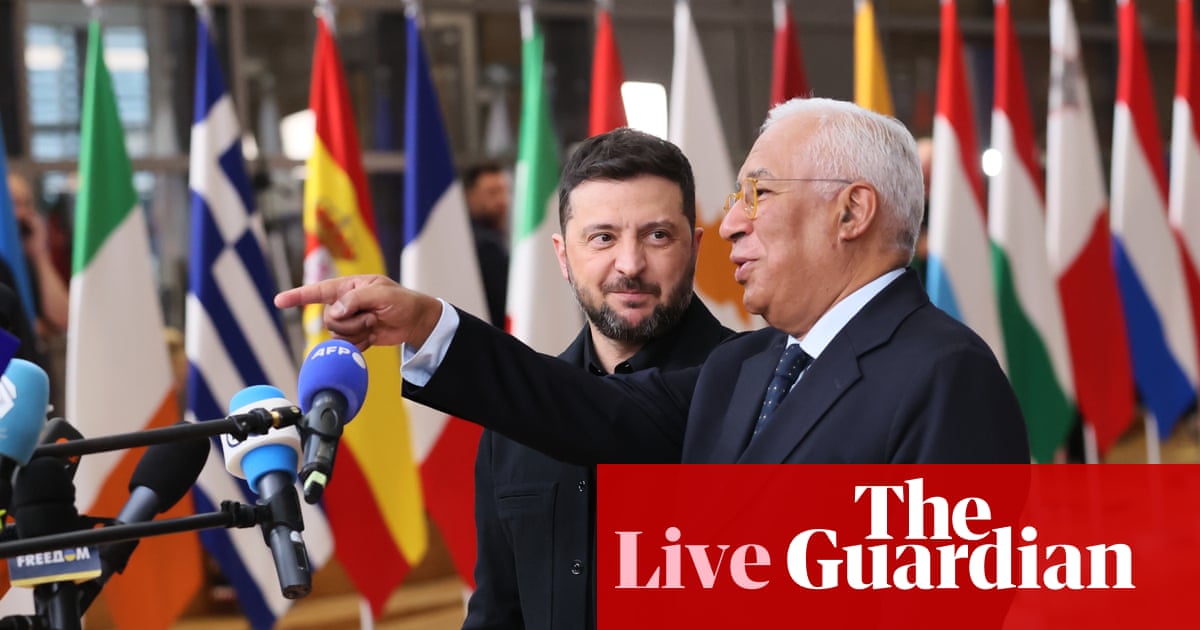
European leaders are meeting on Thursday with the Ukrainian president, Volodymyr Zelenskyy, in Brussels to reaffirm support for Kyiv. The president of the European Council, António Costa, welcomed Zelenskyy, addressing him as “future member of the European Union”. The meeting comes as the 27 member bloc formally adopted a 19th package of sanctions against Russia for its war against Ukraine that includes a ban on Russian liquefied natural gas imports. The Danish rotating presidency of the EU said:
It’s a significant package that targets main Russian revenue streams through new energy, financial, and trade measures.
Zelenskyy and Costa arrive for the European Council leaders’ summit in Brussels. Photograph: Yves Herman/Reuters
In a major policy shift, Donald Trump on Wednesday imposed sanctions on Russia’s two biggest oil firms. New restrictions have been unveiled against Rosneft and Lukoil – as well as dozens of subsidiaries – because of “Russia’s lack of serious commitment to a peace process to end the war in Ukraine”.
Trump said to reporters that he has a “very good relationship” with his Russian counterpart, but felt he had to cancel their planned meeting in Budapest as “it didn’t feel right to me”. In a sign of growing frustration, he told reporters:
It didn’t feel like we were going to get to the place we have to get. So I cancelled it. But we’ll do it in the future … I have good conversations. And then, they don’t go anywhere. They just don’t go anywhere.
He also hinted that the sanctions could be lifted if the Russian president was prepared to cooperate in peace talks.
Volodymyr Zelenskyy thanked the United States and the European Union on Thursday for agreeing on new energy sanctions against Russia, saying they were “very important”. He also told reporters in Brussels that a ceasefire was possible in Russia’s war on Ukraine but that yet more pressure would be needed on Moscow to make it happen. He ruled out making any territorial concessions to Russia.
A proposal by the European Commission to use Russian assets frozen in Europe to provide a €140bn (£122bn) “reparation loan” to Ukraine will be discussed on Thursday. Under the plan, the EU would use cash balances from frozen Russian central bank securities to give Kyiv support that would cover much of its funding needs for 2026 and 2027. “I won’t declare victory on this until we’re done but I see a very broad support for using frozen Russian assets,” the Swedish prime minister, Ulf Kristersson, said at a meeting of EU leaders in Brussels.
However, the Belgian prime minister, Bart De Wever, laid out three demands on the use of Russian immobilised assets to provide a loan to Ukraine, adding he would oppose that measure until he secured guarantees. De Wever, whose country is home to chief asset holder Euroclear, said he did not see the legal basis for such a decision yet, adding that immobilised assets had not even been touched in the second world war. He said: “We are the only ones, Euroclear is the only financial institution that offers the windfall profits to Ukraine. We know that there are vast amounts of Russian money in other countries who have always been silent about this.
“If these three demands, which I think are quite reasonable, are met then we can go forward. If not, I will do everything in my power at the European level, also at the national level, politically and legally to stop this decision.”
EU countries will on Thursday agree on filling the financial needs of Ukraine in 2026 and 2027, the European Council president, António Costa, said. ““The technicality of the solutions, we continue to work on with the European Commission, but the most important is the political decision,” Costa said before a summit of EU leaders in Brussels.
Tens of thousands of people in Hungary are expected to turn out for rival rallies by Viktor Orbán’s ruling party and his main opponent as they kick off campaigning for elections next year in a highly polarised political climate.
Engineers have repaired a damaged high-voltage line and restored external power to the Zaporizhzhia nuclear power station in Ukraine, its Russian-installed management said on Thursday. The plant – Europe’s largest, with six reactors – was seized by Russian troops in the first weeks of Moscow’s 2022 invasion of Ukraine. It currently produces no electricity, but needs external power to ensure that fuel in the reactors remains cool and no meltdown occurs. Until Thursday, the plant had been without power for 30 days, relying on backup diesel generators.
The Netherlands will hold a general election on 29 October after the previous government collapsed. Geert Wilders’ far-right PVV leads the polls, though some support has shifted to Christian Democrats.
Updated at 04.57 EDT