
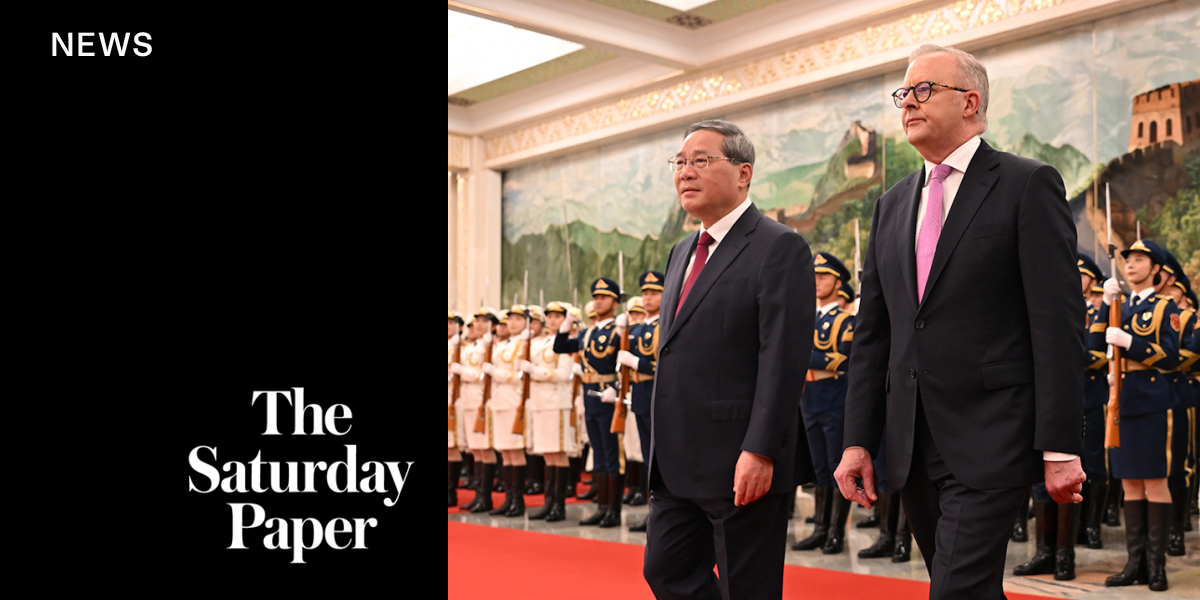
From Don Farrell’s perspective, the trip was a huge success. The trade minister expects increased opportunities with China and the prime minister has been able to assert new stability in the relationship.
The six-day visit followed weeks of meticulous planning. Those involved say the highlights were a “very personal” lunch between Anthony Albanese and Chinese President Xi Jinping and a Whitlam-esque walk along the Great Wall.
“I wouldn’t call it a reset as much as a continuation of the policy that we adopted when we first came to government,” Farrell tells The Saturday Paper. “We said we wanted to stabilise the relationship. We said we wanted to restore that $20 billion worth of trade that had been lost and we managed to do that over the last two-and-a-half years.
“The final product to get back into the Chinese markets was lobster, just before Christmas, but we are interested in trade diversification.
“That doesn’t mean selling less product into China. In fact, we want to sell more. What it does mean is finding new markets in the rest of the world to ensure that we balance out the trade that we do with China with other countries. We never want to find ourselves in a situation where we’re so reliant on one country.”
Former foreign affairs minister Bob Carr characterised the trip as an investment in the relationship with China. He also sees it in the context of maintaining electoral advantage with Chinese Australians.
“It’s showing the Australian electorate and showing the Chinese that we are taking the relationship seriously. It’s not just a short, busy, transactional visit. There’s some warmth in it,” he says.
“But all this is going into Chinese social media circulating in Australia and it all translates into votes, consolidating Labor’s competitive advantage as the party preferred by up to a million Chinese-background people on the Australian electoral roll.”
This last point is important but has received less attention than the trade and strategic elements of the visit. The trip received glowing and extensive coverage from Chinese mainland media and in the Chinese–Australian press.
It is a long way from the Scott Morrison-era diplomatic freeze, after the Coalition pushed for an inquiry into the origins of the Covid-19 pandemic.
Addressing a United States congressional committee this week, the former prime minister continued to position his side of politics as wary of China. He took aim at the Chinese government’s “assertive and aggressive” behaviour while he was in power, saying the Chinese government maintains the same aims now but is trying different tactics with the Albanese government.
“This included abandoning their economic and diplomatic bullying and coercion for more inductive engagement, laced with charm and flattery,” Morrison told the committee before raising the surprise live-fire drills by the Chinese navy in international waters this year.
“That said, the PRC [People’s Republic of China] still continues to engage in intimidatory behaviour by their military against Australia when it suits them, without remorse.”
Morrison made the case to the US committee that the AUKUS agreement he helped broker should not be abandoned by the Trump administration.
“Strengthening and deepening the networks of US’s alliances and partners is critical to resilience and deterrence,” Morrison said.
“This is as true in the economic sphere as it is in the security sphere in this new era of post-globthe alisation and strategic rivalry. It is critical these tracks of national policy are aligned and integrated.”
Albanese’s trip came as Australia continues to balance its relationship with China against an increasingly erratic relationship with the US. On Thursday, his government announced that Australia will lift its de facto ban on American beef imports – a key issue in Donald Trump’s tariff negotiations.
The opposition, with Nationals leader David Littleproud leading the call, is demanding to see the science behind the move, but Farrell says it is not “suspicious” and nor is there any biosecurity risk.
“The US has set a very ambitious target of renegotiating heaps and heaps of trade agreements,” Farrell tells The Saturday Paper. “We are in the fortunate position that the level of tariffs that the Americans have decided to impose on us is 10 per cent, so it’s at the very bottom of the list of tariffs.
“The Americans are our strategic allies. Nothing is going to change under this government about that. And, you know, we’ll continue to engage. I think things are in a good place with America.”
Labor figures say the Albanese government has a maturing relationship with China as its largest trading partner, while at the same time maintaining the US as Australia’s greatest strategic ally.
“We’re trying very hard to continue the deep relationship we have with the US,” a senior Labor source tells The Saturday Paper.
“I feel like there’s a lot of reporting going on at the moment, which is probably unhelpful, but I think our relationship with the US is still very strong despite what things might be happening with Trump.
“But even with China, I think the trip overall was good, but I don’t think we got really a lot out of it. But I don’t know that we needed to. I think just being over there and relationship-building is always the key.
“We’re a soft middle-power country. We don’t have the military kit like the US,” the source says. “I think we’ve got to be careful how we position ourselves but still be assertive about our views of the world. And it’s just that balance that the government’s just trying to weigh up.”
Senior government sources say neither Australia nor Albanese have been snubbed by the US president, despite the fact Trump has not met with Albanese and no meeting is currently scheduled. The sources say Australians “don’t particularly like” Trump and regard him as a “weirdo”.
Yet the opposition spent much of the final parliamentary Question Time of the week trying to needle the prime minister over his lack of face time with the US president.
“It’s the Chinese that have the largest influence over the largest number of marginal seats. It’s just the way it is. And so Labor not only get that and understand it, but all of them get it, so they’re all disciplined about it.”
“People are not sitting around talking about an Albanese meeting with Trump,” a government source tells The Saturday Paper.
It is understood Albanese expected to be criticised for his trip to China, anticipating it would be portrayed as favouring the relationship over the strategic alliance with the US.
The opposition, led by shadow foreign affairs minister Michaelia Cash and trade spokesman Kevin Hogan, dismissed the China trip, which also included a panda viewing and a public game of tennis, as “indulgent”, “extended” and a “working holiday”. They also questioned whether there were any “tangible outcomes” from the six days abroad.
“They should have gone out of the way to add another Asian country, whether it was Japan, South Korea, Philippines, Vietnam. I think that would have sent a good message that he wasn’t just heading there to reinforce a propaganda victory,” a Liberal source tells The Saturday Paper.
“I know he didn’t intend it that way, but that’s what it has been used as. And I think it would have been clever if he had gone there and then to Japan, that would have been a smart move.”
During the trip Albanese raised concerns with Xi over the live-fire drills that caused commercial airlines crossing the Tasman Sea to reroute mid flight.
When asked by the Coalition’s new defence spokesman, Angus Taylor, about what assurances the prime minister got from the president, Albanese said Australia has “strategic competition in the region that we have to deal with” and that “we comply with international law, and we expect international law to be complied with as well”.
It was an opportunity for Albanese to criticise Taylor for deviating from the accepted Australian position of “strategic ambiguity” on Taiwan and seemingly committing the Coalition to war against China.
“What I’m saying we should commit to is a joint commitment to the security of Taiwan,” Taylor told 7.30 in the middle of Albanese’s trip.
The comment came following pressure from the US over support for Taiwan in a potential military conflict with China, in particular from Under Secretary of Defense for Policy Elbridge Colby, who is leading the review of the AUKUS pact.
“Peace through deterrence and strength is incredibly important. That does mean you’re prepared to act under certain circumstances,” Taylor said.
“That means working together very closely in the Taiwan Strait to the security of Taiwan, and that commitment should underpin what we are doing in AUKUS.”
It appeared to be a deviation from the position of successive Australian prime ministers.
“What we saw from the shadow defence minister in his first outing, in uttering comments in an area that requires responsibility, requires a national interest, requires the support of our sovereignty when it comes to our decision-making processes – what we saw is a breach,” Albanese told parliament.
“Those comments by the shadow minister for defence were entirely irresponsible.”
A day after the 7.30 interview, Taylor had sought to clarify his assessment of the stance on Taiwan in a Sky News interview.
“My comment is about joint commitments to the status quo,” he said. “That’s not the same as committing to join in a conflict in every scenario.”
Bob Carr, a former director of the Australia–China Relations Institute, is surprised the doctrine of strategic ambiguity is seen as flexible.
“We acknowledge the Chinese claim that Taiwan is a province of China. We acknowledge that, but we want any settlement, any move to reunification, to be settled peacefully, without force. That’s been an Australian position,” he explains.
“It’s breakouts like his and Jane Hume’s about Chinese spies that just makes Chinese background voters think the Coalition is hostile to them, and it’s going to hurt Australia’s interests by being antagonistic towards China.”
Within the Liberal Party still smarting from the election loss, there’s concern that too many Liberals see cultural diversity as “niche” rather than a “top tier” pathway to government.
“It just undermines the effort when one or two say silly things or aren’t disciplined. Like Angus freelancing on a new position on Taiwan. Jane Hume, Chinese spies,” a Liberal insider says.
“One person can undermine years of good work. So, until the Coalition has that unified recognition that there’s 15 seats in play on this diaspora, the pathway to government just gets harder.”
Asked if the Liberal Party’s issue in culturally diverse seats is as significant as their issue in teal seats, the source argued it was “bigger at scale”, as it involved three categories of large groups: Indian, Chinese and Muslim.
“It’s clear politically. When you look at the 30 seats that we’ve lost in two elections, I think about half of them – so 15 – would have a significant diaspora. So the domestic implications are larger than any other diaspora,” the source said.
“It’s the Chinese that have the largest influence over the largest number of marginal seats. It’s just the way it is. And so Labor not only get that and understand it, but all of them get it, so they’re all disciplined about it.
“Whereas in the Liberal Party, I think some get it and then others don’t.”
The source stressed they regarded Opposition Leader Sussan Ley as “getting it”, as well as a “lot of the team”, but “if we go to the next election and you just have one person freelancing, then the wheels come off”.
Labor’s Jerome Laxale, who won the northern Sydney seat of Bennelong from the Liberals in 2022, represents one of the nation’s largest Chinese–Australian communities. He argues that the Coalition doesn’t understand how important this constituency is.
“I do a lot of things in not just English. I have things translated in simplified Chinese, or things translated in Korean. We have a Mandarin and Cantonese speaker that works for us. For a moment there we had a Korean speaker that worked for us. Where we don’t provide interpreters, we send multi-language-targeted communication as well,” he tells The Saturday Paper.
“We communicate on WeChat and RedNote and, for a bit there, KakaoTalk, which is the Korean version of that. We hold events that have interpreters. We do all that stuff because dealing with government in English is hard enough; imagine having to do that if English is your second language. So, we try really hard to break down those barriers so that people can engage with government as much as they can.
“We go make sure we attend important cultural events and hold them ourselves, right?”
The decision has clearly paid off.
“Look at the diversity within our caucus and maybe that’s why we get it,” Laxale says, laughing. “Fifty-seven per cent women, diverse backgrounds, diverse professions. Our caucus reflects why we understand communities like this and why we have the honour of representing them.
“The Liberals don’t get it, and their public commentary reflects how far they are away from truly understanding modern Australia.”
At least some in the Coalition are aware of this and of the complexity it adds to politics when taking on Albanese.
“How do you hold him to account without him laughing all the way to the ballot box saying, ‘I’ll keep winning these seats, thank you,’ ” the Liberal source says.
“Because I think when Labor looks around and says, ‘look at the seats we hold now compared to when we were in opposition’, there is no other community that has given them more than the Chinese community. Like, they are thanking their lucky stars.
“So that is widely recognised in the Labor Party machine and it’s affecting how they act on foreign policy.”
This article was first published in the print edition of The Saturday Paper on
July 26, 2025 as “‘Thanking their lucky stars’: How the Chinese vote shaped Albanese’s trip”.
For almost a decade, The Saturday Paper has published Australia’s leading writers and thinkers.
We have pursued stories that are ignored elsewhere, covering them with sensitivity and depth.
We have done this on refugee policy, on government integrity, on robo-debt, on aged care,
on climate change, on the pandemic.
All our journalism is fiercely independent. It relies on the support of readers.
By subscribing to The Saturday Paper, you are ensuring that we can continue to produce essential,
issue-defining coverage, to dig out stories that take time, to doggedly hold to account
politicians and the political class.
There are very few titles that have the freedom and the space to produce journalism like this.
In a country with a concentration of media ownership unlike anything else in the world,
it is vitally important. Your subscription helps make it possible.
Send this article to a friend for free.
Share this subscriber exclusive article with a friend or family member using share credits.

Used 1 of … credits
use share credits to share this article with friend or family.
You’ve shared all of your credits for this month. They will refresh on August 1. If you would like to share more, you can buy a gift subscription for a friend.
SHARE WITH A FRIEND
? CREDITS REMAIN
SHARE WITH A SUBSCRIBER
UNLIMITED
Loading…
News
‘World upon his shoulders’: Farrell on the trade challenge facing the US
Karen Barlow
EXCLUSIVE: The trade minister tells The Saturday Paper about Australia’s edge in negotiations with the US over tariffs.