
Brady Martin has been re-assigned to the OHL, according to Alex Daugherty. He only got a few games in for Nashville and had been a healthy scratch recently, so this makes sense. He gets a chance to really hone his game playing junior and then either get back in the lineup for a couple games at the end of the season, or be back in the mix for training camp next September.
*
Staying with Nashville, Jonathan Marchessault was back at practice on Wednesday:
Jonathan Marchessault is on the ice for Preds practice after missing the previous two games with an injury.
Michael McCarron is also on the ice for practice with some stitches above his eye after his fight with Ross Johnston last night @1025TheGame
— Max Herz (@MaxHerzTalks) October 22, 2025
All indications are that he’ll be ready to go for the Predators’ home game on Thursday night when they host the Vancouver Canucks.
*
Pierre Engvall looks to be done for the season with an ankle surgery, per Stefen Rosner. He had a hip surgery and then has recently had his ankle done as well, so it seems as if the idea is to have him back healthy for 2026-27. This is kind of important for Max Shabanov because that keeps another regular winger out of the lineup for the Islanders, and helps secures Shabanov’s position on the team. He has played well so far this season, but it should keep him in the lineup for the entire campaign.
*
Marco Rossi was back in the lineup for the Minnesota Wild on Wednesday night after missing a game. He was skating on the second line, so not full-time back with Kirill Kaprizov just yet, but that’s probably coming soon, especially with the Wild taking another loss, this time 4-1 in New Jersey. They have now lost four of their last five games, all in regulation, and have tallied a total of eight goals in that span.
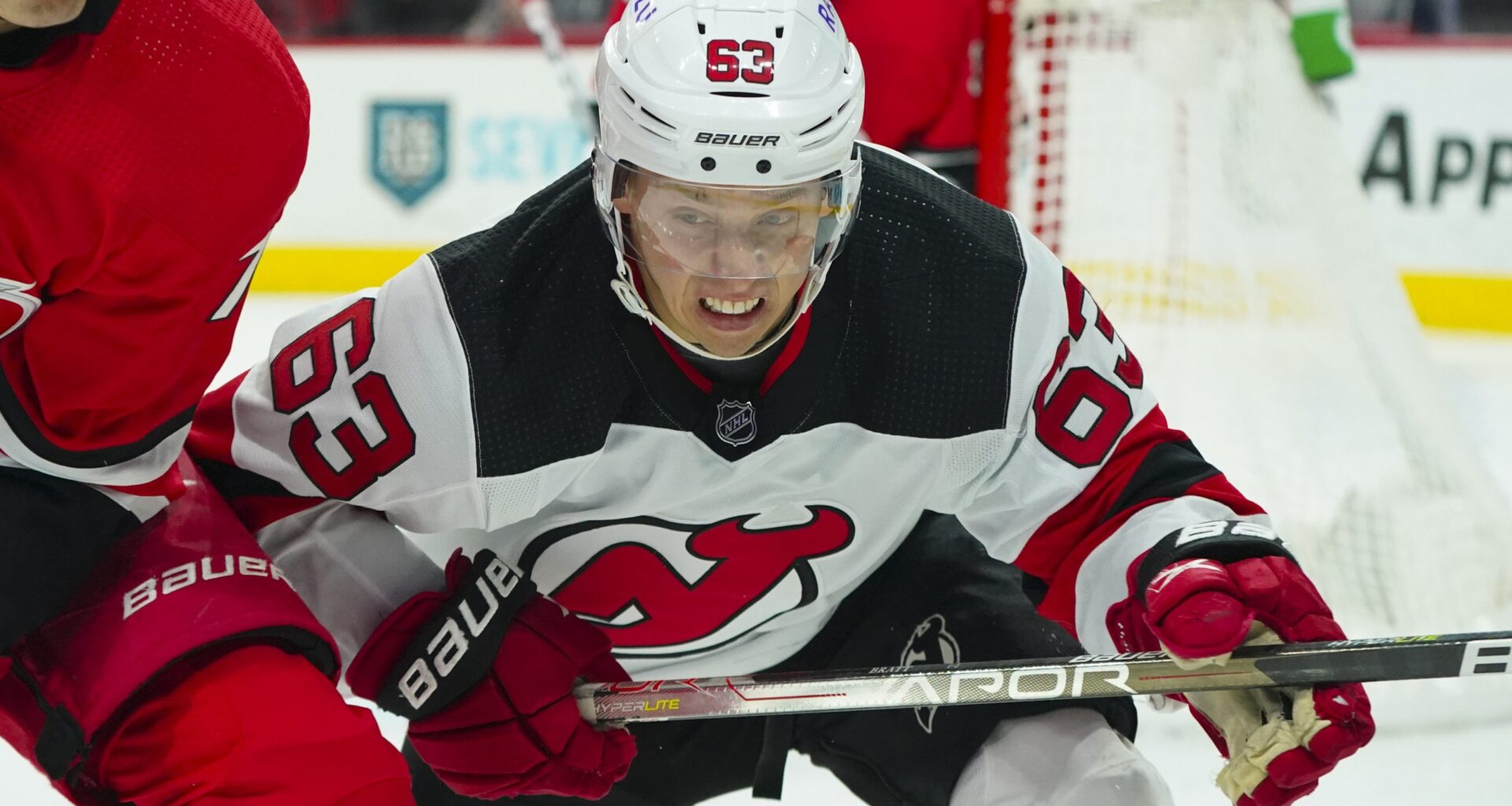
The Devils got goals from Paul Cotter, Jesper Bratt, and Brenden Dillon, and the goal from Bratt gives him four goals and seven assists in seven games to start the season. He is also on a seven-game point streak to start the year.
Arseniy Gritsyuk also got into the goal column, registering his first of his NHL career.
Nico Daws was very good in goal for the Devils, stopping 29 of 30 shots he faced.
Matt Boldy scored the lone goal for the Wild, finishing the game with six shots and a block. He has five goals, six assists, and 33 shots in eight games.
Filip Gustavsson allowed three goals on 35 shots for the loss.
Stefan Noesen was in the lineup for the first time this season for New Jersey, slotting on the fourth line and second power-play unit.
*
Goals from Jason Zucker, Tyson Kozak, Jack Quinn (PP), and Josh Doan led the Buffalo Sabres to a 4-2 win at home to the Detroit Red Wings. After starting the season 0-3, the Sabres are now 3-1 in their last four games, outscoring the opposition 17-10. That includes wins over Florida, Ottawa, and a Detroit team that had started the year 5-1.
Doan had a goal on two shots while adding a hit in nearly 19 minutes of ice time. He is up to three goals and six points in seven games, totaling 22 shots and nine hits in that span. It has been a superb start to his Buffalo career.
Colten Ellis got his first career NHL start, and held the fort for the Sabres, stopping 29 of 31 shots.
Emmitt Finnie and JT Compher replied for the Red Wings. Moritz Seider had five shots, a block, two PIMs, and a hit in a solid multi-cat night.
John Gibson allowed four goals on 31 shots for the loss.
*
For the third time in eight games, the Montreal Canadiens found themselves in overtime, and for the third time in those overtime games, they managed the win to gain the extra point. This time, it was a 2-1 win in Calgary thanks to an overtime winner from Mike Matheson off a great (and patient) play from Ivan Demidov.
Zachary Bolduc (PP) had the other goal for the Habs. That goal was assisted by Lane Hutson, who now had six points in his last six games after going pointless in his first two.
Jakub Dobes was in net again for Montreal, and he was great in net once again for Montreal by stopping 36 of 37 shots for his fourth win. His save percentage is now up to .950 on the season and given how well he’s played, and how shaky Sam Montembeault has looked, Dobes certainly looks like he may be the starting goalie now.
Adam Klapka scored the lone Calgary goal and Dustin Wolf allowed two goals on 28 shots for the loss.
MacKenzie Weegar was held pointless once again but he had five shots, three blocks, and a pair of hits in a very good peripheral night.
*
We are two weeks into the 2025-26 regular season and while we need some more games before we start panicking (or celebrating, depending on how things are going), it is worth looking at how those first two weeks compare to the start of last season. Let’s look at the individual team games that have taken place so far compared to the same point from the 2024-25 season, and how they are similar (or different).
Data is current as of the morning of Wednesday, October 22nd and is from Natural Stat Trick.
Goal Scoring Is Down (Again)
The 2024-25 season saw teams score 2.98 goals per 60 minutes (GF/60) over the whole campaign, the lowest mark since the COVID bubble season. Looking at just the first couple of weeks, here is where things stand this season compared to last year:

To date, that is a decline of about 4.5% in goals per 60 minutes compared to last year. If that percentage holds, we are looking at over 350 fewer goals this season compared to the 2024-25 campaign. If you’re thinking to yourself that we haven’t been seeing as many high-scoring games as October 2024, then you’re on the right track.
The curious part about that is that penalties are up slightly compared to this time last year. Using data from NHL.com, the first 214 individual team games of 2024-25 saw teams average 3.23 power-play opportunities per game. To this point in 2025-26, that number is about 3.27. It isn’t a huge difference, but the scoring decline is not because of fewer power plays, as was the case last year.
Non-Power Play Scoring is a Problem
When looking at all the game states other than the power play (5v5, 4v4, 3v3, PK), we see why goal scoring has declined. Comparing again to this point last year, here are the rates of shots and goals at any strength other than the power play, as well as the accompanying shooting percentages:

That table shows that non-power play goal rates are down about 0.16 per 60 minutes compared to the early portion of 2024-25, which is the entire drop in goal scoring overall from last year (and then some). A huge part of that is that shots on goal are down 1.5 per 60 minutes outside of the power play.
After a 2024-25 season that saw the lowest rate of power-play opportunities per game since they started recording them in 1963-64, they have increased slightly compared to a year ago (about 0.05 per team per game). It is a good thing, too, because with the non-power play goal-scoring decline, we don’t need fewer power plays.
Shots Are Down Again
Back in May, I wrote about how shots on goal per shot attempt have been declining in recent seasons and were considerably lower in 2024-25 than just 3-4 years ago. Whatever the reason – changes in how the NHL counts a shot, increases in shot blocking, better defensive positioning, or some combination of those things – the league saw its lowest shot-per-game total in over 20 years.
Shots on goal are down once again, and it’s worth looking at why. Once again comparing the early portions of the last two seasons, here are the rates of non-power play shots on goal per shot attempt (CF):

That is 0.015 fewer shots on goal per shot attempt outside of the power play, which is 166 fewer shots on goal than if they had the same shot-per-attempt rate as last year, or over fewer 2000 shots over the course of a full season. The table in the previous section shows us a decline in shots on goal per 60 minutes, and part of that is teams are attempting fewer shots outside of the power play in general, but they are also converting fewer of the attempts into shots on goal.
What Does This Tell Us?
The thing to watch is the power play opportunities. Again, back in May I wrote about how declining power-play opportunities affected both forwards and defencemen because goal distribution at even strength was shifting more towards depth players. If the power play opportunities start drying up to the level they were last year, it would be very bad news for the top producers in the league, and thus the top fantasy hockey options. This is something to check back on a month from now.