
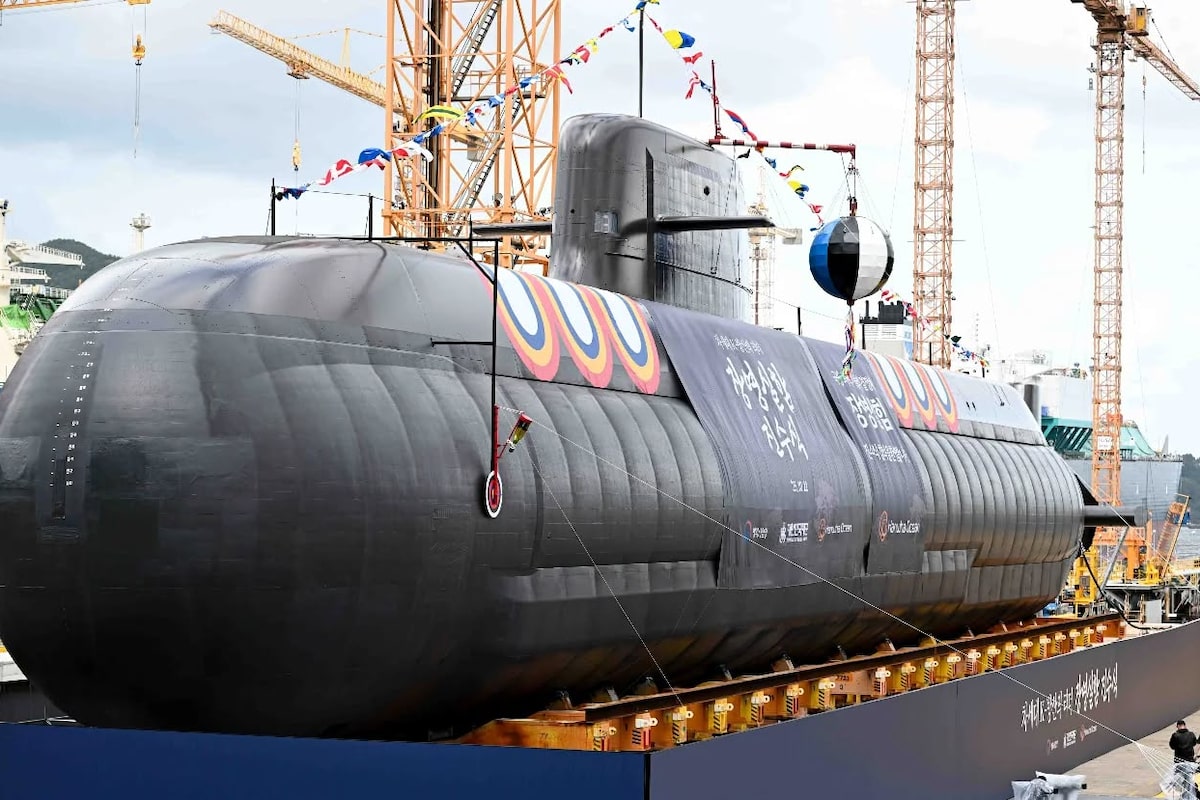
A KSS-III Batch-II submarine at Hanwha Ocean’s facility in Geoje, South Korea. Hanwha is one of two companies shortlisted by Ottawa to compete on a multibillion-dollar contract to build up to 12 new submarines.Supplied
The huge South Korean shipyard that will welcome Prime Minister Mark Carney next week as he shops for new submarines resembles a giant’s workshop: roughly 40 colossal vessels in various stages of assembly that utterly dwarf the small army of people building them.
More than 30,000 employees work at Hanwha Ocean’s facility, which sprawls across five square kilometres, an area larger than Vancouver’s Stanley Park.
Towering over them are four Goliath cranes that can each lift 900 tonnes, immense assembly halls as tall as cathedrals and entire portions of ships as big as multi-storey buildings waiting to be welded together.
South Korea, a global powerhouse in ship construction, is now on the short list of two bidders competing to supply Canada with 12 submarines. The other is a joint proposal by Germany and Norway.
Mr. Carney has promised to tour the Hanwha yard in Geoje, South Korea, which lies about 330 kilometres southeast of Seoul, next week during his first Asian trip as Prime Minister.
Germany, Norway make submarine pitch ahead of Carney’s review of rival South Korean bid
He’s also attending the Association of Southeast Asian Nations summit in Kuala Lumpur, visiting Singapore and participating in the Asia-Pacific Economic Cooperation Forum in Gyeongju, South Korea, where it’s possible he may meet with Chinese President Xi Jinping.
Mr. Carney’s Oct. 25 to Nov. 1 trip to Asia is part of a broader effort by the Prime Minister to diversify trade away from an increasingly protectionist and unreliable United States under President Donald Trump. He’s set a 10-year goal of doubling exports to countries other than the U.S., which he has calculated would add $300-billion in annual new business.
A decision about the submarines is as much about foreign policy as defence, now that Mr. Carney is looking to greater trade and ties with Europe and Asia as a way to reduce reliance on the U.S., which has launched a damaging trade war on Canada.
The Prime Minister’s visit to Asia comes just after Germany and Norway dispatched their defence ministers to Ottawa to pitch Canada on their offering.
Bolstering defence
The 12-submarine purchase is part of Mr. Carney’s plan to add tens of billions of dollars in annual defence spending over the next decade, some details of which are likely to be announced in the Nov. 4 budget.
If Ottawa ultimately awards the submarine contract to Seoul-based Hanwha, it would be the first time the Canadian government has purchased a major weapons platform from a non-Western supplier.
Unlike Germany and Norway, South Korea isn’t part of the Western NATO military alliance to which Canada belongs.
On the other hand, South Korea is winning customers among European NATO members including Poland and Norway. Poland accounted for more than 45 per cent of South Korean arms exports between 2020 and 2024, the Stockholm International Peace Research Institute (SIPRI) says.
The diesel-electric KSS-III Batch-II submarine is Hanwha’s offer to Canada. The company says it could deliver the first boat by 2032 and four subs by 2035.Supplied
In recent years, Poland has struck deals to buy more than 360 Black Panther K2 tanks, close to 50 FA-50 light attack aircraft, as well as hundreds of self-propelled K9 howitzers and multiple Chunmoo rocket launchers from South Korea.
Mr. Carney, overseeing Canada’s biggest military spending increase in more than 70 years, faces a difficult foreign policy decision on the submarines: Europe or South Korea? Either option leads to a deep international partnership with the winning bidder – a de facto alliance – that will last more than 50 years on a contract worth upwards of $100-billion, including acquisition, maintenance and upkeep.
South Korea’s push
Seoul is putting on a full-court press to win what would be a milestone military contract for the Asian country, which has set itself the economic objective of building the fourth-largest defence industry in the world. It ranked among the top 10 defence exporters between 2020 to 2024, according to SIPRI.
Hanwha’s offer to Canada is the KSS-III Batch-II submarine, while TKMS, as part of a joint German-Norwegian project, is offering the 212 CD. Both are diesel-electric submarines because Canada has ruled out purchasing nuclear-powered boats.
There’s a lot riding on this bid for South Korea, according to Dae Young Kim, a defence expert with the Korea Research Institute for National Strategy. The country’s military contractors are winning new customers, but their penetration of advanced Western markets such as Canada, Germany, France and the United Kingdom remains comparatively limited, he said.
The Korean campaign for the Canadian sub contract is like “a national team stepping onto the Olympic stage,” Mr. Kim said.
Winning the Canadian submarine contract would be a strategic turning point for Seoul’s efforts to become a major player in the arms market, the analyst said. It would represent a significant shift “from a rising exporter to a top-tier global defense power,” Mr. Kim said.
Sub purchase reflects new defensive approach
Canada’s planned submarine purchase will be transformative for this country’s military might, making it the first time in history the Royal Canadian Navy will have more than a token presence underwater. Canada hasn’t purchased unused submarines since the 1960s, during the Cold War, and has never ordered anywhere near 12 at once. Canada currently has four second-hand subs, but only one is operational.
“We’ve never truly bought submarines in Canada to use them as submarines,” Vice-Admiral Angus Topshee, Commander of the Royal Canadian Navy, said in an interview. “They’ve almost always been bought purely to practice our own anti-submarine warfare, to teach our surface and air forces to hunt submarines.”
Opinion: Canada’s new warships could be obsolete by delivery time
Times have changed. The move from a symbolic deterrent role to a fully capable undersea fleet reflects new threats from Russia and other countries.
“With great power competition intensifying in both the Arctic and Indo-Pacific, submarines are now critical for deterrence, surveillance, and allied interoperability,” said Fen Hampson, professor of international affairs at Carleton University.
The Canadian military has said it needs 12 subs to properly defend the country, based on the assumption that for high readiness only one of every four vessels would be fit to deploy, with others under maintenance or used for training.
The understated name of Ottawa’s acquisition program – Canadian Patrol Submarine Project – obscures what’s really happening. Canada is buying vessels with a serious offensive capability to launch missile strikes and both options being considered are attack submarines. The South Korean model, the KSS III, can fire ballistic missiles, for instance.
“What a submarine offers is the ability to surveil your waters without anyone knowing that you’re there, and offer a lethality that no other platform can provide,” Vice-Adm. Topshee said. “I would argue also that submarines are a very un-Canadian type of approach. It’s the sneak attack from below and all the rest. But fundamentally, if we’re going to fight a war, why should we fight fair?”
Both submarine options being considered by Ottawa – Hanwha’s KSS-III Batch-II and TKMS’s 212 CD – are considered attack subs.Supplied
When he visits the Hanwha shipyard next week, Mr. Carney will tour the exact submarine South Korea is pitching to Canada. He visited TKMS’s shipyard in Kiel, Germany, this past August when Ottawa announced the hunt for a new sub had narrowed to two companies.
Vice-Adm. Topshee, who toured the South Korean shipyards last year, said the scale of shipbuilding is what caught his attention. “If they run behind on a program, they’ve got over 20,000 workers: they can shift effort, and they can maintain schedule,” he said. “They have the capacity to do different things that we simply don’t have.”
Workers at Hanwha’s Geoje facility.Supplied
Spin-off benefits
Both Hanwha and TKMS are trying to make their proposals more attractive by increasing their commitments to benefit Canada, including local jobs and manufacturing and supply contracts.
Hanwha says if under contract by 2026, it could deliver the first boat by 2032 and four subs by 2035. TKMS has said the company “is positioned to deliver the first submarine well in advance of 2035.”
Steve Jeong, head of the Naval Ship Global Business at Hanwha Ocean. Jeong is a retired South Korean admiral.Steven Chase/The Globe and Mail
Steve SK Jeong, a retired South Korean admiral who is head of the Naval Ship Global Business at Hanwha Ocean, said his company is willing to buy Canadian steel from producers such as Algoma – to build submarines and commercial ships – as well as liquefied natural gas and to partner with Canada’s Telesat and MDA on space and satellite investments.
James Kim, senior director at Hanwha who’s also team leader for business development in Canada, said South Korea is a more reliable supplier because it won’t be scaling back defence spending any time soon. European countries can be expected to cut military expenditures once Russian President Vladimir Putin disappears – either by death or ouster. But the dangers facing South Korea aren’t short lived.
“When Putin is gone, they’re going to start winding down again,” Mr. Kim said of European countries. “Then where’s Canada going to get their sustainment capabilities?” South Korea “will never be able to do that because of North Korea.”
He said Canada has told Hanwha it wants to see what kind of “trade deal” can accompany the two bids so it can pick the best. Mr. Kim said proposals on steel and other resources are part of “a menu of items” assembled by the South Korea company, which will be “as delicious as possible” for Ottawa.
Part of the Hanwha pitch is its vessel is already built and in the water.
The latest model of the KSS III was launched Oct. 22 at Hanwha Ocean’s shipyard with fanfare and a champagne bottle smashed against the hull. It’s awaiting Mr. Carney’s visit late next week. The sub is not painted a conventional black but instead a deep, dark brown for better camouflage, Hanwha said. Vertical missile launchers line the back half of its 90-metre length.
Other KSS III subs are still in various stages of construction and portions of one are covered in tarpaulins to prevent industrial espionage, Hanwha said.
Mr. Carney’s very hands-on approach reflects “the reality that security and the economy are now inseparable,” says Vina Nadjibulla, VP of research and strategy at the Asia Pacific Foundation of Canada.Cole Burston/Getty Images
It’s no accident Hanwha’s military vessel construction is located at the far southeastern edge of the South Korean mainland: it’s as far away from North Korea as possible without going offshore. The authoritarian state has nuclear weapons and has repeatedly threatened to attack its southern neighbour.
Hanwha’s Mr. Jeong said Canada can rely on the KSS because it was borne out of the need for asymmetric tools that a smaller country can use with its stealth and attack power to counter larger adversaries in a risky region. “We have North Korea, and we have China and Russia surrounding us,” he said. The KSS ship is meant to be used “in a time of crisis.”
Jonathan Berkshire Miller, a senior fellow with the MacDonald-Laurier Institute, said picking South Korea to build Canadian subs would reinforce Canada’s new commitment to the Indo-Pacific region, a big change for a country that’s primarily been oriented to Europe. “It would demonstrate that Ottawa sees Northeast Asia – not just the U.S. and Europe – as central to its security and industrial future, and it would anchor Canada more visibly in the region’s emerging defence and technology networks.”
Prime ministerial involvement
Mr. Carney’s personal visits to both the German and South Korean shipyards mark an unprecedented level of direct prime ministerial involvement in approving Canadian defence procurement decisions, Carleton’s Hampson said.
Former prime minister Jean Chrétien once nixed a helicopter deal and Justin Trudeau originally opposed buying the F-35 fighter jet, but Mr. Carney’s very hands-on approach reflects “the reality that security and the economy are now inseparable,” said Vina Nadjibulla, vice-president of research and strategy at the Asia Pacific Foundation of Canada. “Major procurements have become strategic industrial policy, alliance management, and national-security decisions all at once – appropriate for leader-level engagement in an era of great-power competition and supply-chain geopolitics.”
Retired vice-admiral Mark Norman said a South Korea win would represent a big loss for European defence industry players “who are concerned about the increased competitiveness of the Koreans on the global stage.”
Vice-Adm. Topshee said he regularly changes his mind on which submarine – South Korean or European – Ottawa should choose. It depends on which country he spoke with last and the proposals they made. “I go back and forth as to what I think is the best option for Canada.”
The naval commander said he’s regularly asked if navies are obsolete because of how Ukraine, with relatively fewer resources, has made it impossible for Russian surface ships to operate in the Black Sea.
“The Russian Navy can absolutely continue to operate submarines in the Black Sea, and those submarines can launch missiles that can strike into Ukraine. The best defense against something like that is another submarine,” he said.
“Why do we need submarines? Because there is no other platform that guarantees that no one will ever come into Canadian waters without Canada’s permission.”