
Liberals maintain comfortable lead… for now
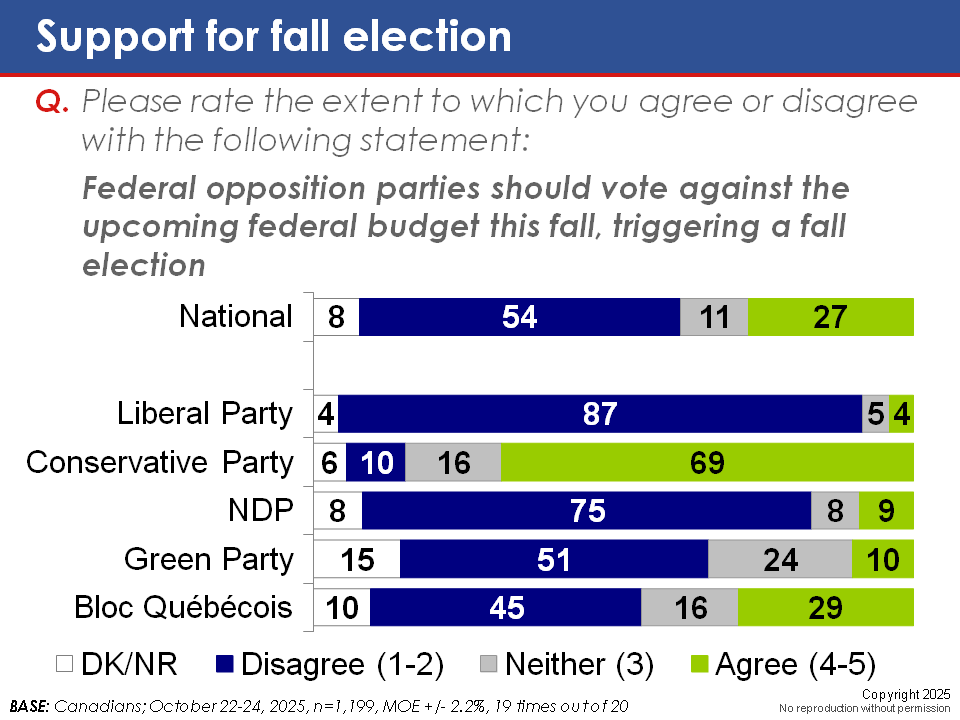
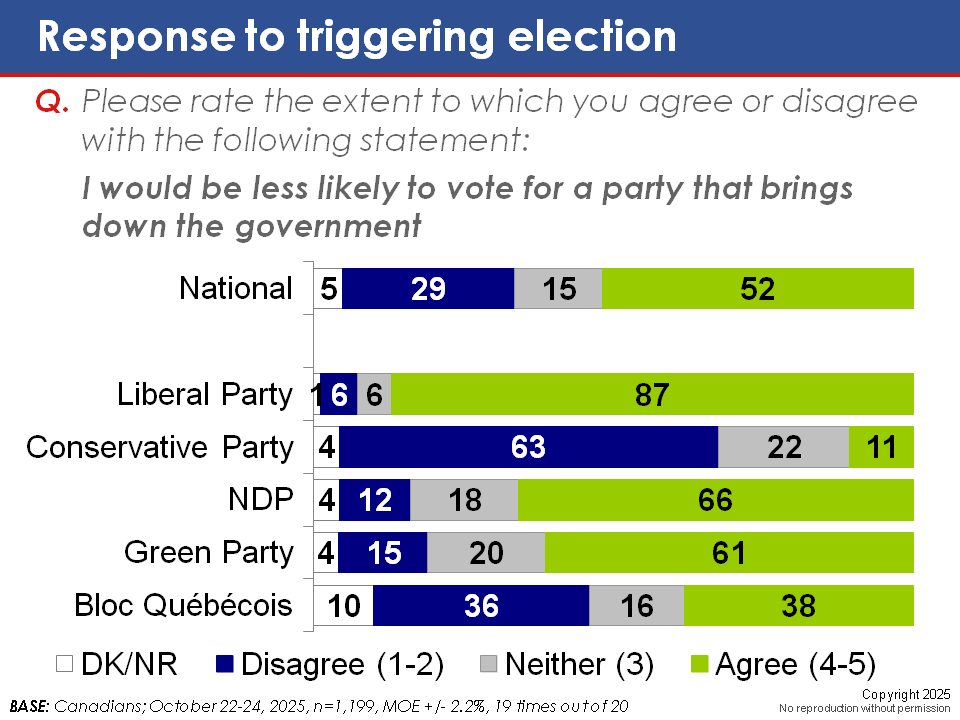
[Ottawa – October 24, 2025] With barely a week to go until the federal government tables its budget, Canadians have a clear message for Ottawa: they do not want another election this year. By a two-to-one margin, Canadians reject the idea that opposition parties should vote against the upcoming budget (and thus trigger an election). Likewise, half of Canadians – including a majority of NDP voters – say they would be less likely to support a party that brings down the government. Notably, 11 per cent of Conservatives say they would consider voting against their party as punishment for sending them to the polls.
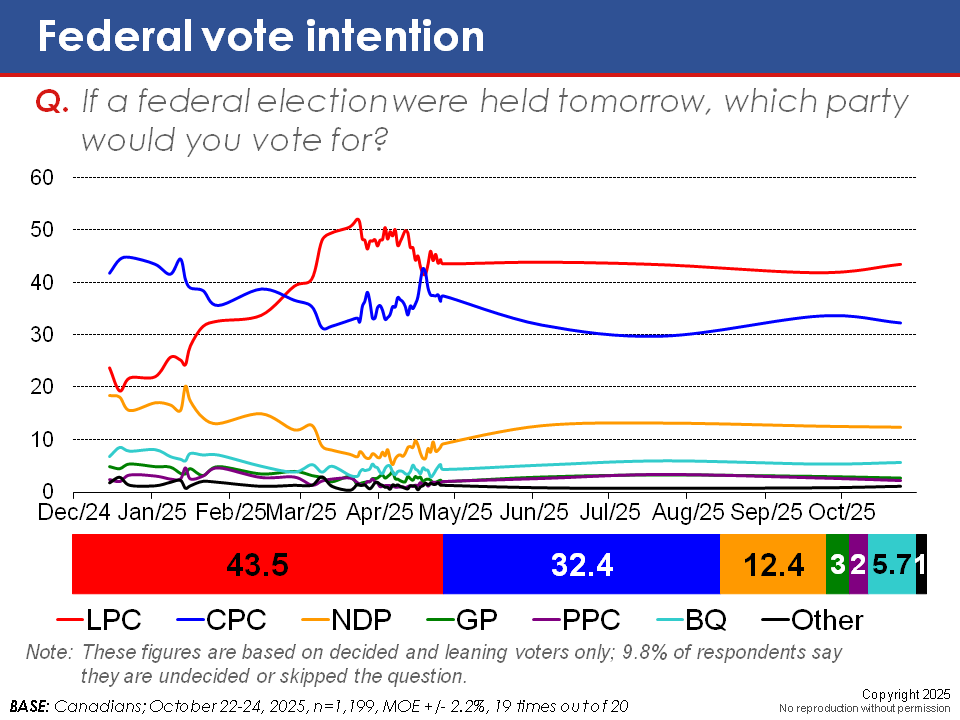
The Liberal Party has expanded its lead somewhat since our last press release and now stands at 43.5 points, enjoying an 11-point advantage. At 32.4 points, the Conservative Party has remained stagnant for several months. The NDP is stuck at 12.4 points, though they remain well above their April 28 showing.
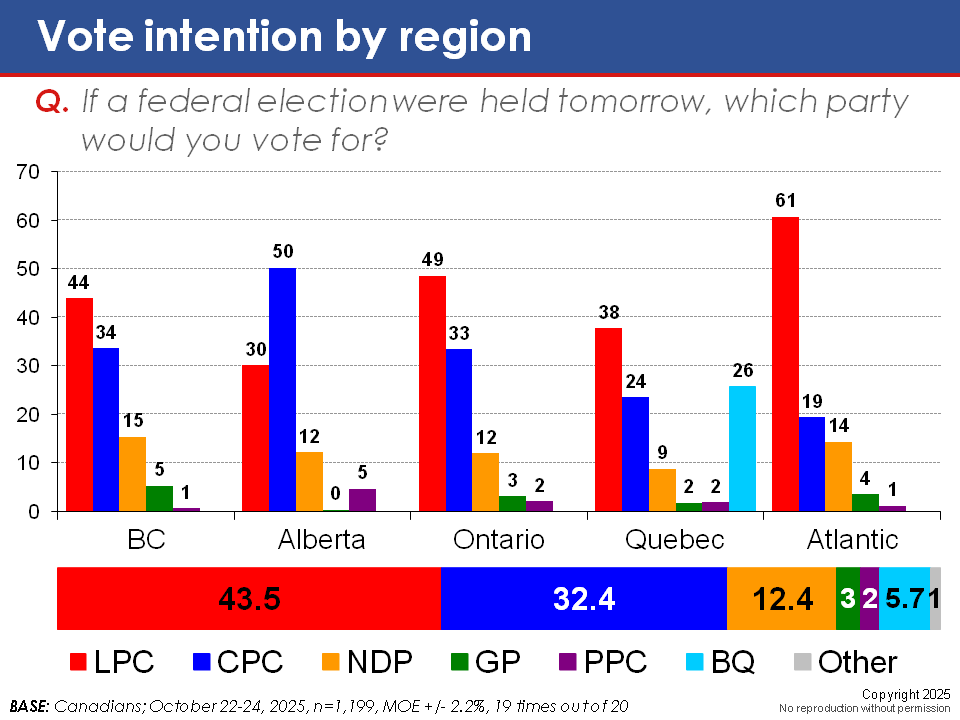
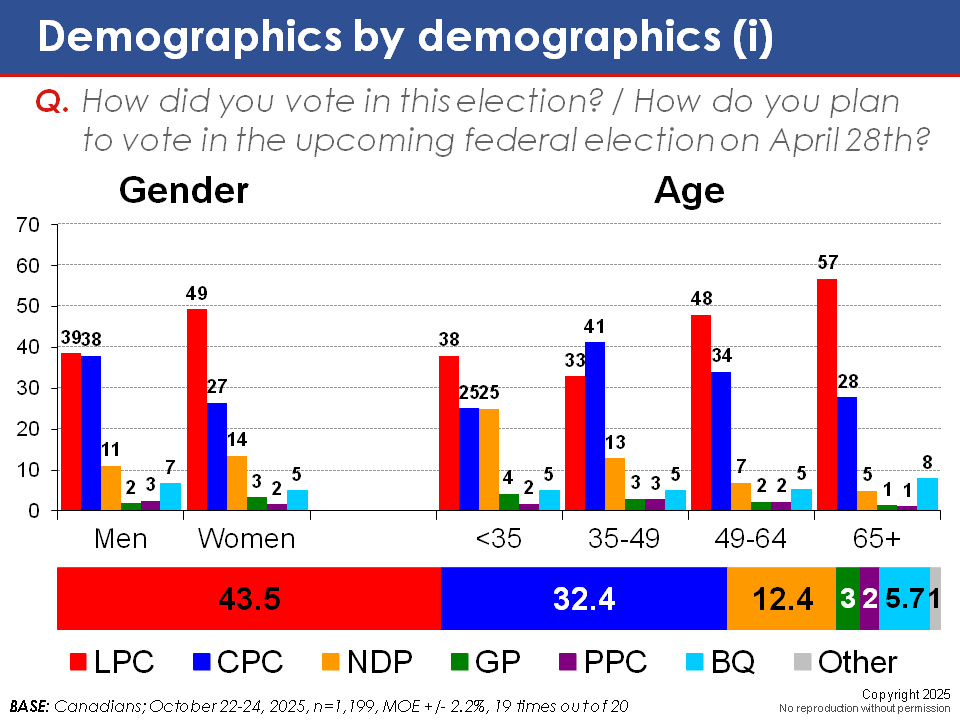
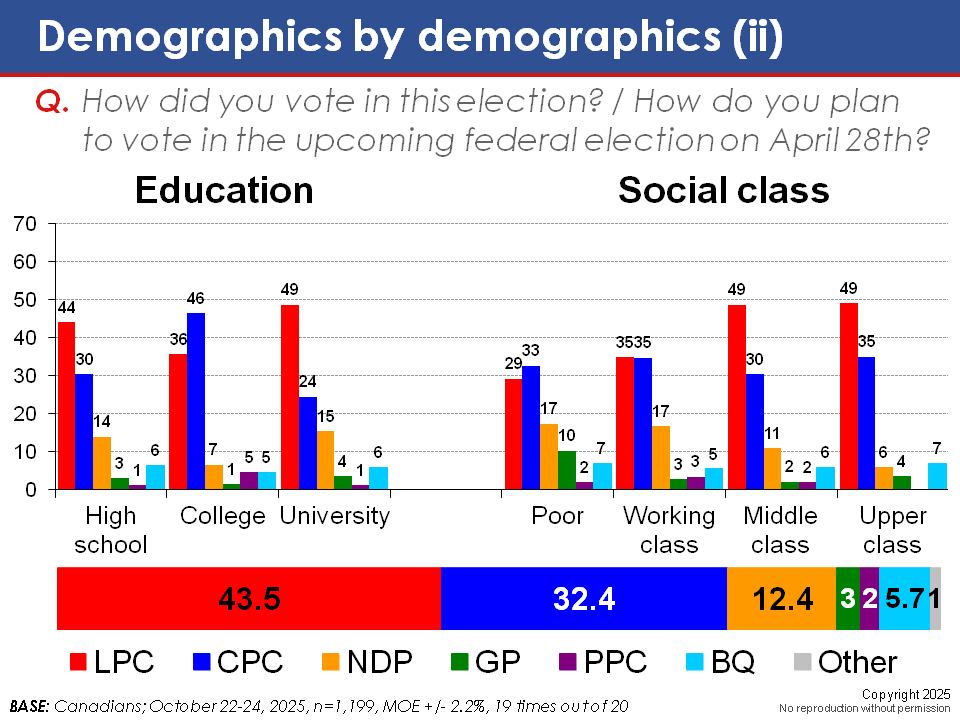
Regionally, the Liberals hold clear and stable leads in Ontario, Quebec, and Atlantic Canada, while the Conservatives remain dominant in Alberta. The Liberals lead among women but are statistically tied with the Conservatives among men. The Conservatives perform best with middle-aged Canadians, while the Liberals lead among those under 35 and those 50 and over. The Conservatives also fare comparatively better with working-class Canadians and those with a college education. Interestingly, the likelihood of supporting the Conservatives is roughly twice as high among churchgoers as among non-attendees, and 10 points higher among households with children.
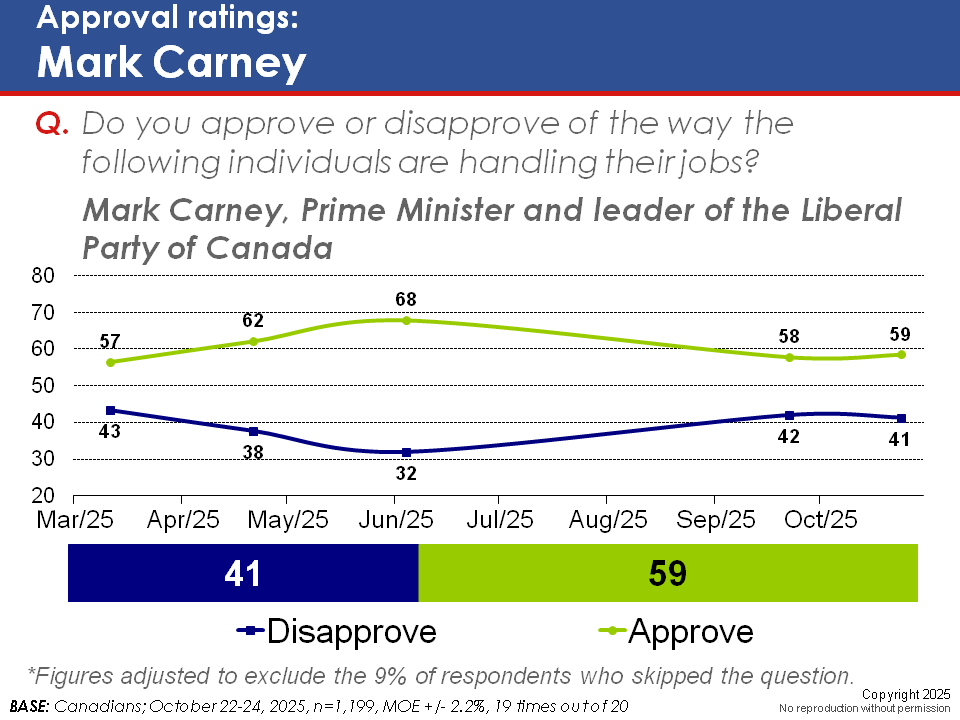
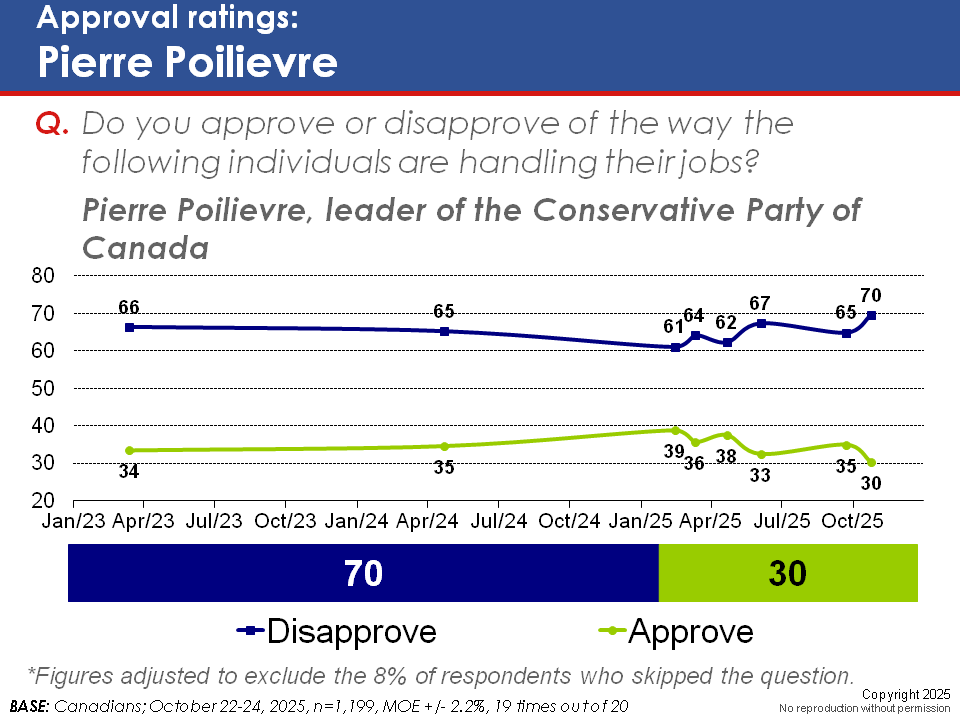
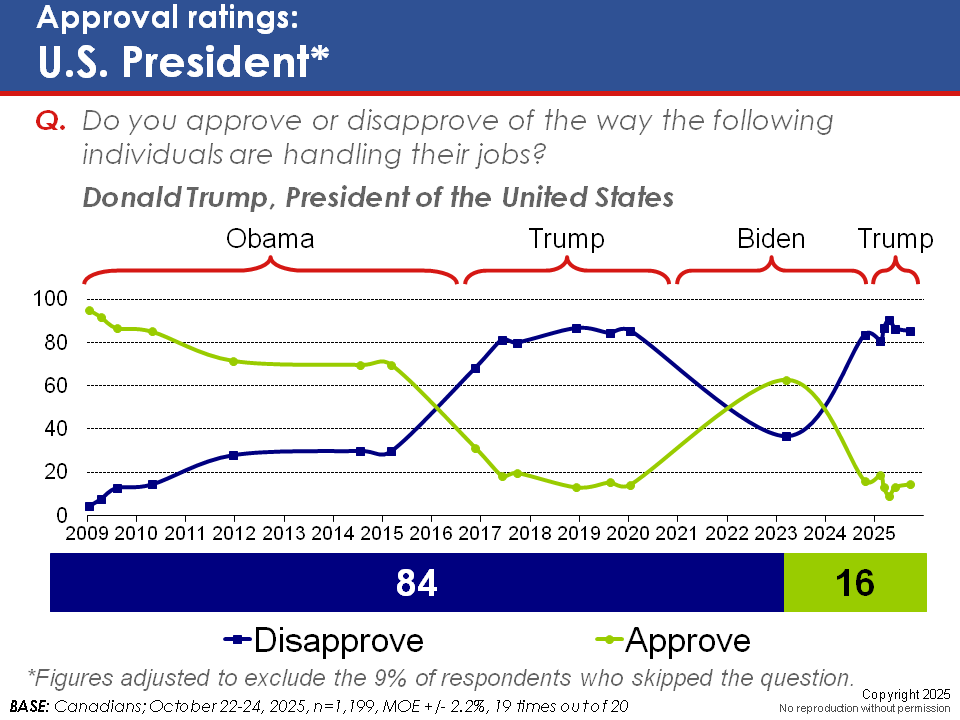
Mark Carney continues to enjoy a high and stable approval rating; six in ten Canadians say they approve of the way he is handling his job, compared to just 30 per cent for Pierre Poilievre. A clear majority (60 per cent) also believe the country’s ability to secure a good trade deal would be hobbled – not helped – by a Poilievre-led government. Meanwhile, Donald Trump retains his abysmally low approval score; only 16 per cent of Canadians give a favourable appraisal of his presidency (though this figure represents a seven-point uptick since April). Approval of Donald Trump is largely limited to Conservative voters, while it is virtually nonexistent elsewhere.
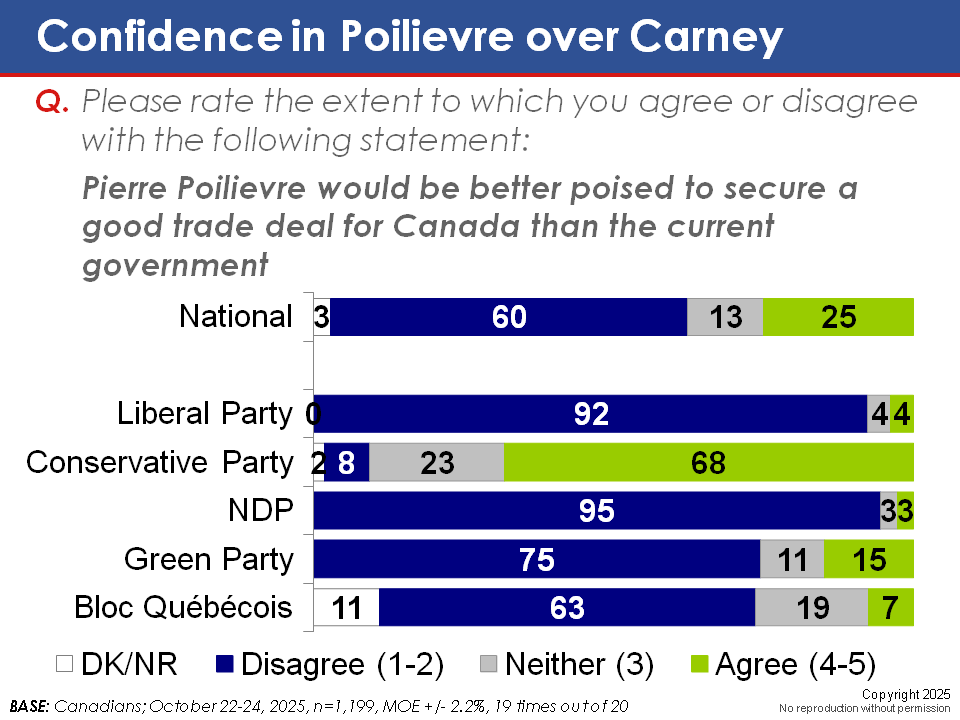

However, Liberal fortunes should not be interpreted as a licence for the party to call a snap election in pursuit of the majority they missed by just three seats in April. Indeed, 62 per cent of Canadians – including 93 per cent of Liberal supporters – say it would be irresponsible to hold another election amid the ongoing trade crisis with the United States.

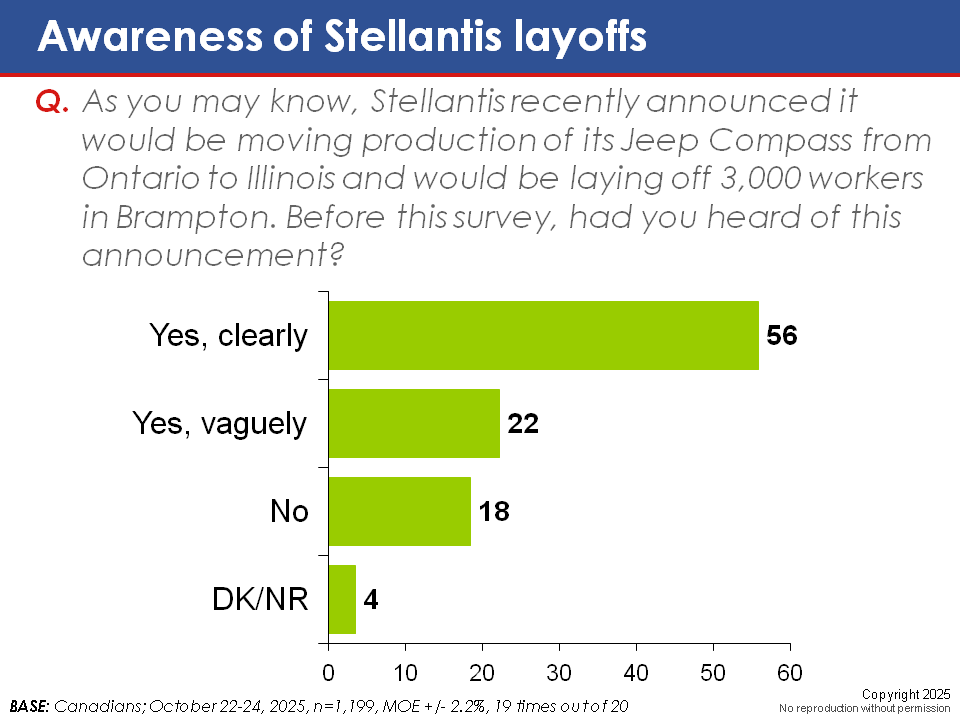
We also examined public reactions to the closure of the Brampton Stellantis plant, which is generating significant alarm. Most Canadians are aware of the closure and, by an eight-to-one margin, Canadians believe it represents a serious problem for the auto industry. By a two-to-one margin, they view it as the harbinger of death for the Canadian auto sector.

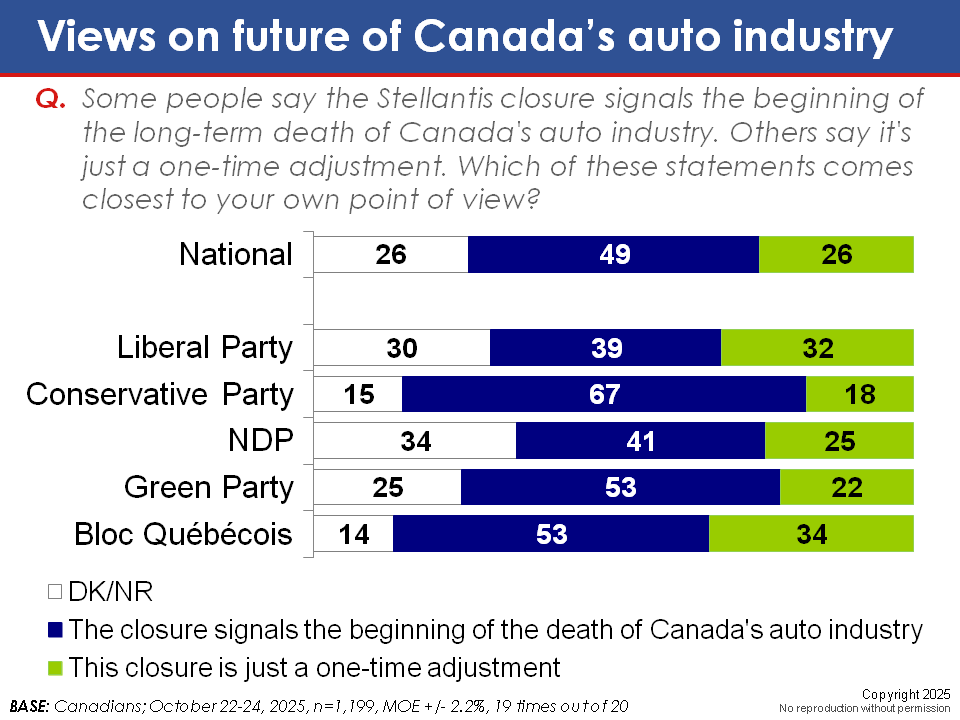
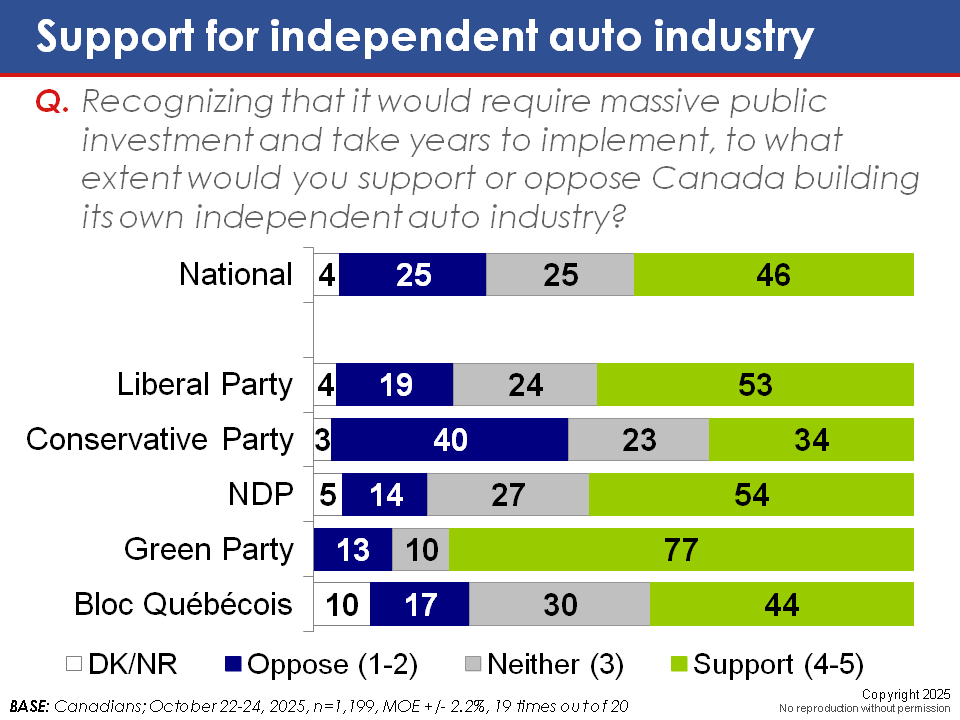
We also tested the hypothetical option of developing an auto industry independent of the U.S., analogous to those in Japan or Sweden. Canadians expressed strong support for the idea, with 46 per cent in favour and 25 per cent opposed. It is also striking how support varies by party lines; majorities of Liberal and NDP supporters back the idea, while Conservatives lean to opposition. To be clear, the success of such an endeavour is dubious; however, the level of support is a clear indicator of the depth of public concern and appetite for bold, decisive action.
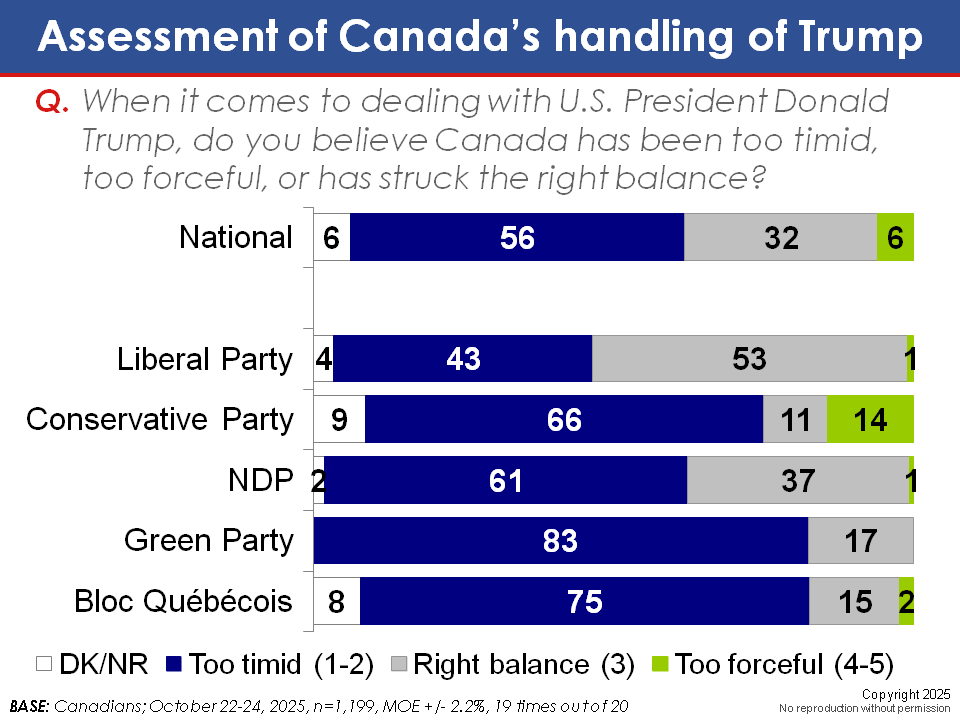
That desire for resolve extends to Canada’s broader relationship with the United States. A majority (56 per cent) say Canada has been too timid in its dealings with the U.S., while only six per cent say it has been too forceful – despite the Ontario government’s invocation of Ronald Reagan. Even among Conservatives, the prevailing view is that Canada has not done enough to stand up to Trump’s demands.
All in all, Canadians are calling for a cross-partisan approach to assert Canada’s interests with boldness and unity. Clear majorities think it would be a bad idea to have an election at this time. The Stellantis announcement is highly followed and is producing visceral fears about the future of that critical industry. The Stellantis closure has heightened public anxiety about the country’s economic future, yet there is near-unanimous agreement on one point: no one wants an election right now.
Methodology:
This survey was conducted online using EKOS’ unique research panel, Probit. Our panel offers exhaustive coverage of the Canadian population, random recruitment (in other words, participants are recruited randomly; they do not opt themselves into our panel), and equal probability sampling (each panellist has a non-zero chance of appearing in the sample). All respondents to our panel are recruited by telephone using random digit dialling and are confirmed by live interviewers. Unlike opt-in online panels, Probit supports margin of error estimates.
The field dates for this online survey are October 22-24, 2025. In total, a random sample of 1,199 Canadians aged 18 and over responded to the survey. The margin of error associated with the total sample is +/- 2.2 percentage points, 19 times out of 20.
Please note that the margin of error increases when the results are sub-divided (i.e., error margins for sub-groups such as region, sex, age, and education). All the data have been statistically weighted by age, gender, region, educational attainment, and household size to ensure the sample’s composition reflects that of the actual population of Canada according to Census data.
EKOS follows the CRIC Public Opinion Research Standards and Disclosure Requirements.
The data tables for this survey are available here. The questionnaire is available here.