
A transnational terror network run by the Iranian Revolutionary Guard Corps Quds Force is behind a string of recent attacks on Jewish sites in Western countries, the Mossad intelligence agency said on Sunday.
According to Israel’s spy agency, senior IRGC-Quds Force commander Sardar Ammar heads the network, which intensified its efforts to attack Jewish and Israeli sites around the world since the October 7, 2023, Hamas attack on southern Israel.
Ammar commands some 11,000 operatives in carrying out covert operations, Mossad alleged.
The network carried out vandalism and arson attacks against Jewish businesses and communal institutions, Mossad said, “aiming to intimidate communities and create conditions that could lead to more serious attacks.”
Sardar’s network also planned attacks against senior Jewish communal figures, it said.
Get The Times of Israel’s Daily Edition
by email and never miss our top stories
By signing up, you agree to the terms
Mossad pointed to three particular incidents tied to the network, among several more it uncovered in cooperation with foreign intelligence agencies.
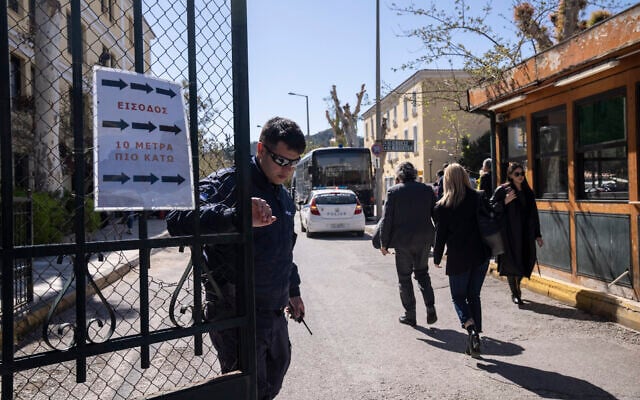
Illustrative – A Greek police officer closes the entrance of the court house following the transfer of suspects that have been charged with membership in a terrorist organization, in Athens, March 2023. (AP Photo/Petros Giannakouris)
In July 2024, Greece’s anti-terrorism police arrested seven people, including two Iranians, over separate arson attacks against an Israeli-owned hotel and a synagogue in central Athens earlier that year.
In July of this year, German prosecutors said that Danish police had arrested a man suspected of gathering information on Jewish locations and individuals in Berlin for Iranian intelligence. He spied on three properties in June, “presumably in preparation for further intelligence activities in Germany, possibly including terrorist attacks on Jewish targets,” prosecutors said.
The next month, Australia blamed Iran for involvement in two 2024 arson attacks, at the Adass Israel Synagogue in Melbourne and a kosher restaurant in Sydney, using criminals and members of organized crime gangs. Canberra also expelled Iran’s ambassador, and said it would list the Islamic Revolutionary Guard Corps as a terror organization. It marked the first time Australia has expelled an ambassador since World War II.
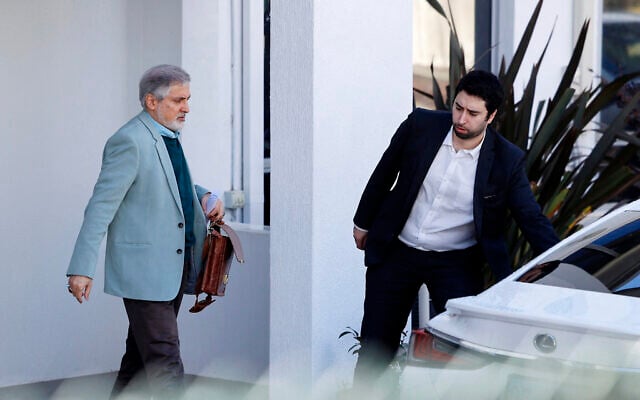
Iranian Ambassador to Australia Ahmad Sadeghi (L) walks toward his car within the grounds of the Islamic Republic of Iran’s embassy in Canberra on August 27, 2025 (Hilary Wardhaugh / AFP)
In order to hide Iran’s involvement, Mossad said, the network recruited non-Iranians, used criminal gangs, and insisted on a high degree of compartmentalization.
The attacks were generally seen by intelligence agencies as amateurish and bumbling, The Times of Israel has been told. For example, criminals twice targeted the wrong Sydney venue before eventually torching the kosher restaurant in 2024.
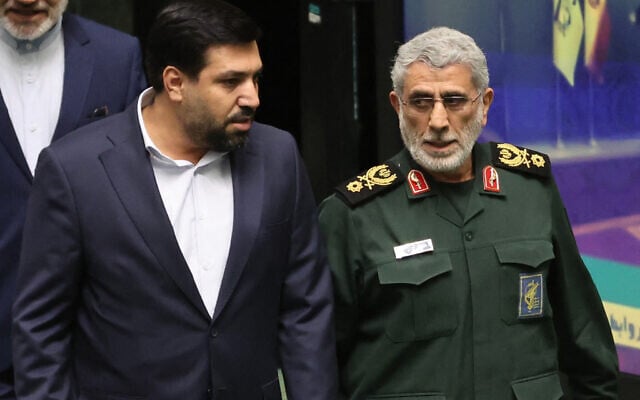
Iranian Quds Force commander General Esmail Qaani (R) arrives for the inauguration of new Iranian President Masoud Pezeshkian at the parliament in Tehran, on July 30, 2024. (AFP)
Iran has a long track record of sowing violence against Jewish and Israeli targets abroad, including over the last two years, as its proxy terror groups in the Middle East have battled Israel on the ground.
Among the many examples: Swedish teens who tried to attack the Israeli embassy in Stockholm on Iranian instructions, three German synagogue attacks planned by a biker gang leader working for the IRGC, and planned attacks at Jewish sites in Cyprus by IRGC members in recent years.
In July, 14 countries, including Britain, the US, and France, condemned what they called a surge in assassination, kidnapping, and harassment plots by Iranian intelligence services.
“We are united in our opposition to the attempts of Iranian intelligence services to kill, kidnap, and harass people in Europe and North America in clear violation of our sovereignty,” the countries said in a joint statement.
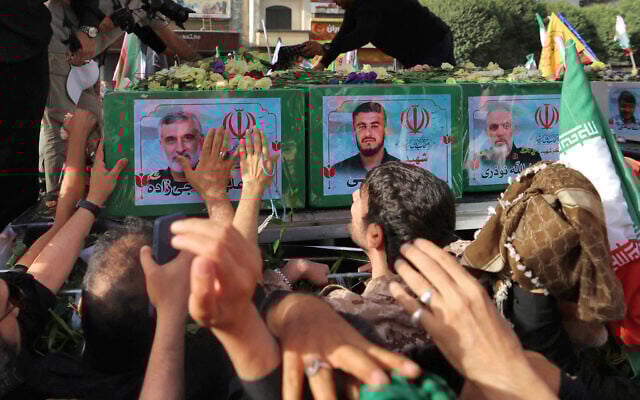
Mourners stand next to the coffin of Iranian Revolutionary Guards commander Amir ali Hjizadeh (L), and other military commanders killed during Israeli strikes on the first day of the war, during their funeral procession at Enqelab Square in the capital Tehran on June 28, 2025 (ATTA KENARE / AFP)
The governments — including Albania, Austria, Belgium, Canada, Czechia, Denmark, Finland, France, Germany, the Netherlands, Spain, Sweden, the UK, and the US — called on the Iranian authorities to immediately stop such illegal activities.
Since early 2022, Britain says it has disrupted more than 20 Iran-linked plots to kidnap or kill individuals in the UK, including British nationals and others Tehran views as threats.
A report released in July by the United States Commission on International Religious Freedom said Iran is increasing its efforts to carry out attacks against Jewish targets in Europe, utilizing local proxies, such as the Foxtrot and Rumba gangs in Sweden, and other criminal networks in the UK, Germany, France, and Belgium.
The long-standing proxy war between Israel and Iran has turned into a direct confrontation, with two Iranian missile and drone strikes on the Jewish state in 2024. Israel struck Iran’s key nuclear facilities during a 12-day war in June this year.
The June war saw Israel kill top leadership in Iran’s regular military and its paramilitary Revolutionary Guard, a force answerable only to Supreme Leader Ali Khamenei that controls its own arsenal of ballistic missiles.
You appreciate our journalism

You clearly find our careful reporting valuable, in a time when facts are often distorted and news coverage often lacks context.
Your support is essential to continue our work. We want to continue delivering the professional journalism you value, even as the demands on our newsroom have grown dramatically since October 7.
So today, please consider joining our reader support group, The Times of Israel Community. For as little as $6 a month you’ll become our partners while enjoying The Times of Israel AD-FREE, as well as accessing exclusive content available only to Times of Israel Community members.
Thank you,
David Horovitz, Founding Editor of The Times of Israel