
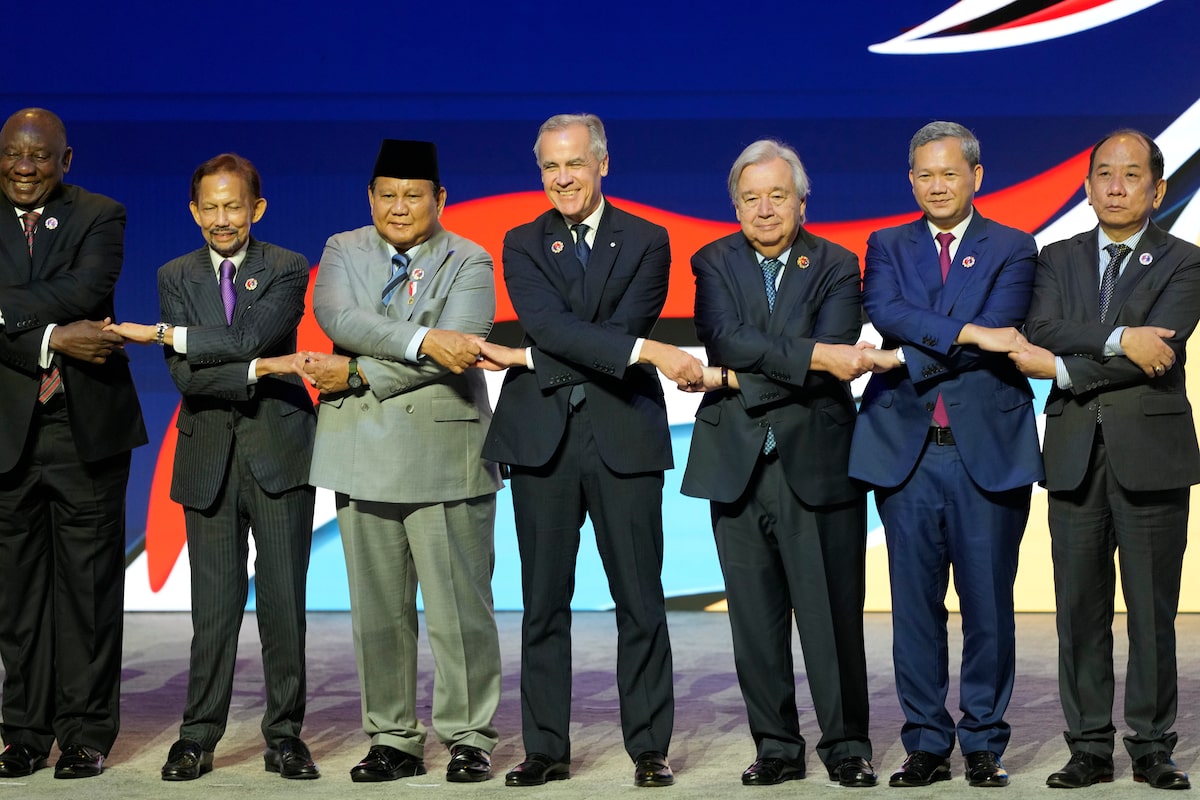
Prime Minister Mark Carney, centre, shakes hands with other leaders at the ASEAN summit in Kuala Lumpur, Malaysia, on Sunday.Adrian Wyld/The Canadian Press
Prime Minister Mark Carney pitched Canada as a reliable trading partner with lots of natural gas and critical minerals at a meeting of Asian leaders as part of his bid to shift trade away from the increasingly protectionist and unpredictable United States.
Speaking at the 11-country Association of Southeast Asian Nations summit on Sunday, Mr. Carney predicted countries would trade more with each other and less with the United States in the future because Washington under U.S. President Donald Trump is raising the cost of selling into the U.S. market with protectionist tariffs.
“We’re an energy superpower – an unabashed energy superpower,” Mr. Carney said at the ASEAN Business and Investment Summit.
“We have the third largest reserves of oil. We have the fourth largest reserves of LNG,” he said, referring to liquefied natural gas. “We’ve just started our first LNG shipments.”
Carney tries to reassure Canadians after Trump threatens 10% tariff hike
He urged Asian countries not to make undertakings that lock them into the U.S. market and prevent more trade with countries that have a more predictable and rules-based approach to commerce.
“What you should try to avoid doing, though, is tying your hands about what you can do with other jurisdictions, because there are a lot more countries, by GDP, that are willing and keen to continue to have relatively open trade, certainly to respect rules-based trade,” he said.
Mr. Carney noted Canada has also launched a process to build a commercial, or revenue-generating, small modular nuclear reactor.
He told the Asian business audience that Canada has one of the globe’s largest reserves of critical minerals and is the “largest centre of mining finance in the world.”
The Prime Minister said there are good prospects for selling more to Canada, noting that he has committed to pouring tens of billions of additional dollars into the Canadian military in what will be a “quadrupling of our defence spending” by the end of the decade.
This will include more money for cybertechnology and artificial intelligence, he noted.
He said there needs to be effort to connect the 12-member free-trade area called the Comprehensive and Progressive Agreement for Trans-Pacific Partnership with the 27-member European Union economic bloc.
He said the two pacts have “complementary approaches to trade” and added that he thinks there is a possibility of “bringing those closer together, having, at a minimum, a docking between the two blocks or broader arrangements that are there, and that’s how you start to rebuild a broader global trading system.”
Mr. Carney didn’t mention it, but the Financial Times reported last week that World Trade Organization members, including Singapore and the United Arab Emirates, are preparing to unveil a new grouping to boost “trade openness” in the protectionist Trump era.
The Financial Times reported that new grouping, to be called the Future of Investment and Trade Partnership, or “FIT-P”, is expected to include about 10 countries, with New Zealand joining Singapore and the UAE as core founding members.
Other potential members include Morocco, Rwanda, Malaysia, Uruguay, Costa Rica, Panama, Paraguay and Norway, the newspaper reported.